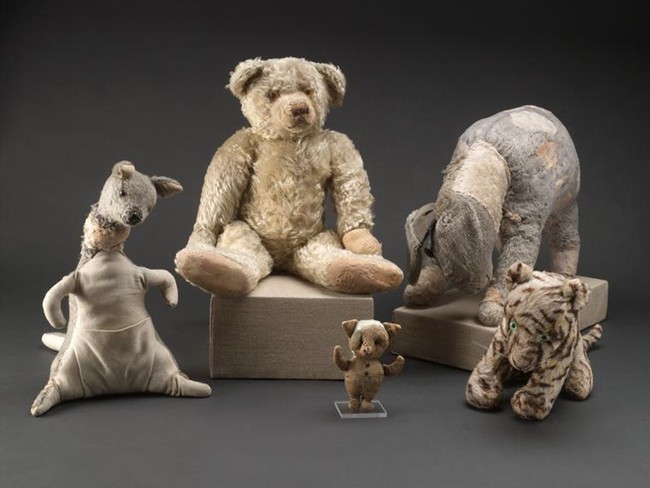
Today is “Winnie-the-Pooh Day,” the anniversary of the birth of Pooh author A.A.Milne. While many people now associate the stuffed “hunny”-loving bear with Disney, the character was born of a World War I veteran’s struggle to recover from the war and relate with his little son.
What does Winnie-the-Pooh’s popped balloon and failed intrusion into a beehive have to do with one of the most devastating battles of WWI? And how did a teddy bear help a traumatized veteran heal emotionally and psychologically while creating a special bond with his young son?
Alan Alexander Milne joined the British military at the outbreak of the First World War, and in 1915 was commissioned an officer in the 4th Battalion of the Royal Warwickshire Regiment, with the Royal Corps of Signals, according to Military.com. In just one August 1915 incident, when his commanders ignored Milne’s warning of enemy movements, 60 British men died in a brief clash. Ultimately, Milne went to fight in the Battle of the Somme, accurately described as “Hell on Earth.” It is interesting that the Somme influenced the creation both of Middle-Earth (by J.R.R. Tolkien) and Winnie-the-Pooh, as two British soldiers tried to cope with the horror through writing fiction.
The first day of the Battle of the Somme was bloody to the point of nightmare, and Britannica states that the offensive cost over a million lives altogether — 420,000 for the British alone. For context, British casualties for all of WWII were around 450,000, meaning the Somme alone rivaled the Second World War for deaths. Bodies were stacked in the trenches. Milne lost many of his closest friends, according to Military.com. Milne himself was wounded.
January 18 is National Winnie the Pooh Day, commemorating author A.A. Milne’s birth on this day in 1882. pic.twitter.com/w2wQkXeX19
— Chevalier Français ✝ ⚜️🛡️⚔️Amoureux de la vérité (@BruleChevalier) January 18, 2026
This is the backdrop of A.A. Milne’s post-war projects. He had a wife, Daphne, and a new civilian life, but he was still dealing with what we now call PTSD. Then in August 1920, Daphne gave birth to Christopher Robin. Milne became a doting and absorbed father, and to connect with his little boy, he invented marvelous stories about the child’s stuffed animals.
Related: Pluto’s Birthday: The Animated Pup Who Changed Character Animation
Winnie-the-Pooh wasn’t just a stuffed animal, though. At the London Zoo, Milne and Christopher Robin found a black bear named Winnipeg, who had been a mascot for the Canadian Expeditionary Force in WWI. Milne and Winnipeg were both in a sense veterans, and both a little shy of strangers. Milne loved the bear, and so did his son. So in honor of Winnipeg, Milne bought Christopher Robin a yellowish-brown teddy bear.
That teddy bear helped Milne explain to Christopher Robin why he sometimes reacted strangely to ordinary noises. Popped balloons and buzzing bee swarms triggered scared reactions in Milne, who had flashbacks to battles and bullets, sometimes startling the little boy. Military.com notes that Milne built these fears into the Pooh stories, helping explain in a child-like way why a person might find popped balloons or bee swarms alarming. Now Pooh has been in print for a hundred years.
The Pooh stories and their cast of characters, including Piglet, Eeyore the donkey, Rabbit, Tigger the tiger, Owl, and Kanga and Roo, are charming tales for little children. They have been immortalized and passed to new generations through Disney movies. Yes, they were certainly funny bedtime stories from a loving father to his son. But they also represent the path that WWI veteran A.A. Milne took to healing and peace.
Editor’s Note: Support and follow PJ Media’s coverage of cultural anniversaries and key news in this new year. Join PJ Media VIP and use promo code FIGHT to get 60% off your membership.