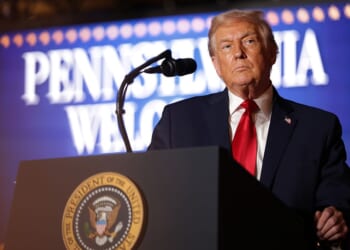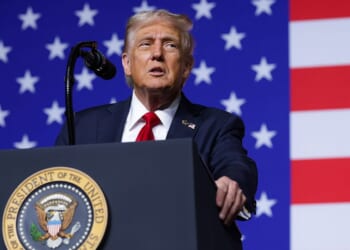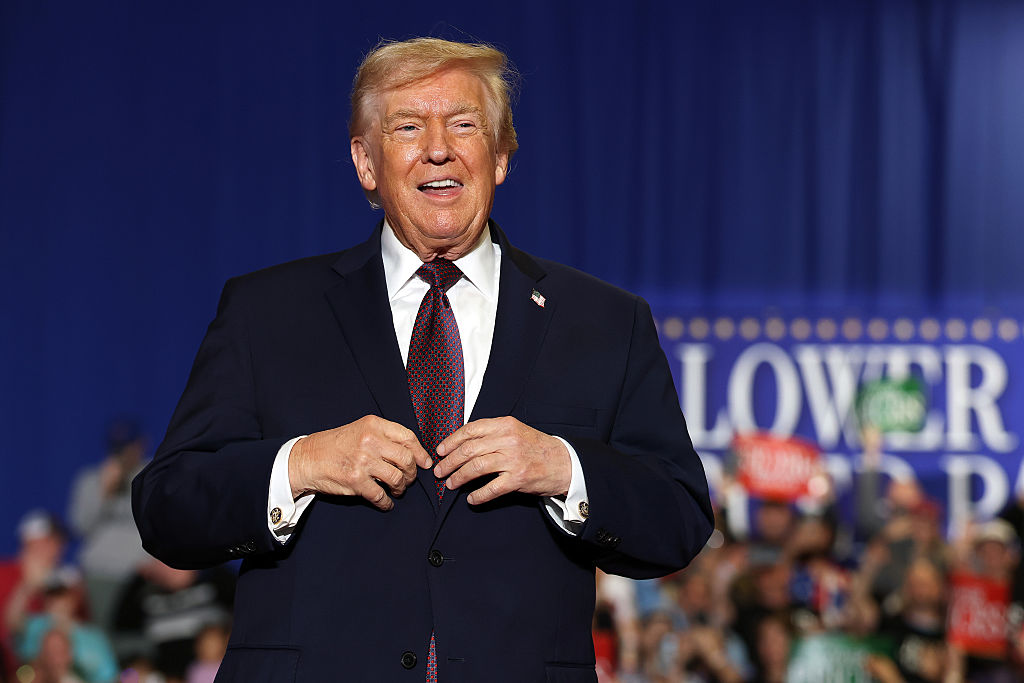
Some might say 2025 was the greatest, a turning point, the likes of which nobody has ever seen before. By anyone’s interpretation, it was certainly a wild ride. Numerous policies, events, and people altered politics and American lives – for better or worse – but nothing influenced the country more than President Donald Trump. After he was sworn in on Jan. 20, he signed a slew of executive orders, created DOGE, withdrew from the Paris climate agreement, renamed the Gulf of Mexico the Gulf of America, made efforts to end birthright citizenship, suspended the US Refugees Admissions program, froze foreign aid, waved goodbye to the World Health Organization, terminated DEI programs throughout government, and pardoned more than 1,500 people charged in the events at the Capitol on Jan. 6, 2021. His first 100 hours back in the White House were a whirlwind that set the tone for a momentous year in Washington and beyond.
Trump Fulfills a Promise
Within the first 100 days of Trump’s second term, federal agents “arrested 66,463 illegal aliens and removed 65,682 aliens,” according to US Immigration and Customs Enforcement. Three-quarters of those arrests were “criminal illegal aliens.” By early June, ICE arrested nearly a thousand people a day. Homeland Security announced in December that 605,000 illegal aliens have been deported since January, with another 1.9 million self-deporting. The number of average border encounters is now reportedly less than 300 a day, a far cry from the Biden years when daily encounters peaked at around 9,000.
The crackdown on immigration was one of Trump’s biggest campaign promises, one he has no doubt fulfilled. Coincidentally – or not – “the number of employed native-born workers has soared by 2.577 million [since January],” explained Liberty Nation News’ Economics Editor Andrew Moran. “Conversely, the number of foreign-born workers has declined by 1.03 million over the same period.”
Deportations have likely also contributed to the big drop in crimes nationwide. Crime rates have been on a steady decline since July (almost a month after National Guard troops were sent to Los Angeles to quell violent protests), according to FBI data. The decrease in immigration has probably saved taxpayer money, too, because illegals often use more in government services than they pay in taxes, which some call a “net fiscal drain.” Still, 42% of registered voters polled by Napolitan News Service said the deportations have gone too far. Sixty-two percent said that “legal immigration is good, while illegal immigration is bad.” Liberty Nation News’ Public Square, estimates that 45.7% of Americans approve of how the president is handling immigration. Regardless of how one feels about his methods, it’s hard to argue the benefits of the president’s deportation agenda.
Congress Goes Through the Motions
Congress wrapped up the year with few legislative accomplishments and a historic government shutdown staining its record. Having made no tangible progress toward federal funding, lawmakers will return on Jan. 6, 2026, and have less than a month to pass nine appropriation bills.
So far, the 119th Congress has passed a measly 60 bills. Not likely to come near the 442 laws the 115th passed during Trump’s first term. Congress did, however, pass the One Big Beautiful Bill Act — the administration’s biggest legislative achievement in 2025 — but getting the megabill through both chambers was no easy task. It took months of hard-fought negotiations between parties and much rewriting. The president signed it on July 4, fulfilling several of his campaign promises: making his 2017 tax cuts permanent, adding temporary tax breaks on overtime income and tips, defunding Planned Parenthood for one year, raising the limit on the federal deduction for state and local taxes until 2030, and reforming Medicaid by making illegal immigrants ineligible for the program and adding work requirements for able-bodied adults.
Forty-six percent of American adults approve of the legislation, according to a survey published by Pew Research Center in August; 43% disapprove. But public perception could soon change. Millions of US households could see “very large” tax refunds in 2026, according to Treasury Secretary Scott Bessent. That would no doubt please a lot of people – if that extra cash isn’t swallowed up by higher prices on consumer goods next year.
Tariff Mania
It began with an executive order in February, which put a 25% tariff on nearly all imports from Canada and Mexico, as well as a 10% tariff on Chinese goods. Days later, Trump paused those imposed on our northern and southern neighbors for a month. Then came Liberation Day on April 2: A baseline 10% was added to all nations exporting goods to the United States, with higher rates for the European Union, China, Britain, and India. Those tariffs went into effect on April 9, but then the president paused all but those on China for 90 days. With so many deals, pauses, hikes, and threats, the ups and downs of the trade war have been enough to give anyone whiplash, especially on Wall Street. But tariffs have brought billions of dollars into the United States – supposedly – and could raise billions more over the next year.
The High Court
One of the Supreme Court’s biggest decisions this year was Trump v. Casa, a landmark ruling that stemmed from a temporary injunction blocking Trump’s executive order ending birthright citizenship. In a 6-3 decision, the Court ruled that district judges “are instructed not to make nationwide injunctions generally,” observed LNN’s Legal Affairs Editor Scott D. Cosenza. “So, the administration should not be subject to them, as a rule, and can find quick relief in the intermediate appellate courts if a district court judge does not fully integrate this ruling into her decision-making.” Activist judges were having a field day kneecapping the 47th president’s agenda, so this was a big win for Trump and possibly for future administrations.
Then there was Free Speech Coalition v. Paxton, in which the Court upheld a ruling by an appeals court that allowed Texas to enforce a state law requiring pornography sites to verify the age of their users. The ruling “limits American adults’ access to only that speech which is fit for children — unless they show their papers first,” explained the Foundation for Individual Rights and Expression. “Americans will live to regret the day we let the government condition access to protected speech on proof of our identity.”
Another significant decision from the Court was in Mahmoud v. Taylor. At issue, said Cosenza, was “whether parents had the right to learn when the school district was going to indoctrinate their kids with LGBTQ+ propaganda and whether they had the right to opt their children out.” The Justices decided in favor of the parents, a ruling that could expand parental rights nationwide.
In mid-2026, the Supreme Court will argue the legality of Trump’s tariffs and whether to overrule Humphrey’s Executor v. United States (1935), which holds that a president can fire an agency chief only for cause. The question in the tariffs case, Learning Resources v. Trump, is whether the Emergency Powers Act gives the president the authority to impose tariffs. The Court also recently agreed to hear a case challenging Trump’s executive order denying citizenship to children born to illegal immigrants in the United States, a legal dispute that will mostly hinge on the phrase “subject to the jurisdiction thereof.”
The Dawn of …
This is only a sliver of this year’s impactful political moments. The ongoing gerrymandering battle, DOGE, National Guard deployments, military actions against Venezuela, the 2025 elections, and US strikes on Iranian nuclear sites are all worth mentioning. The year was full of surprises, highs and lows, executive actions, and enough congressional bickering to keep pundits scribbling daily into the wee hours. Are we at the dawn of the golden age? We shall soon find out.
Dig Deeper Into the Themes Discussed in This Article!
Liberty Vault: The Constitution of the United States