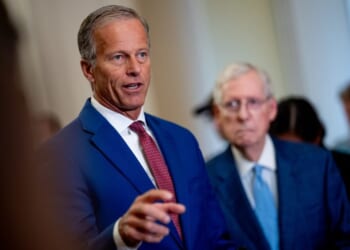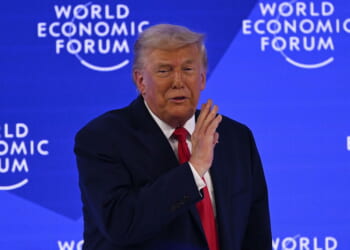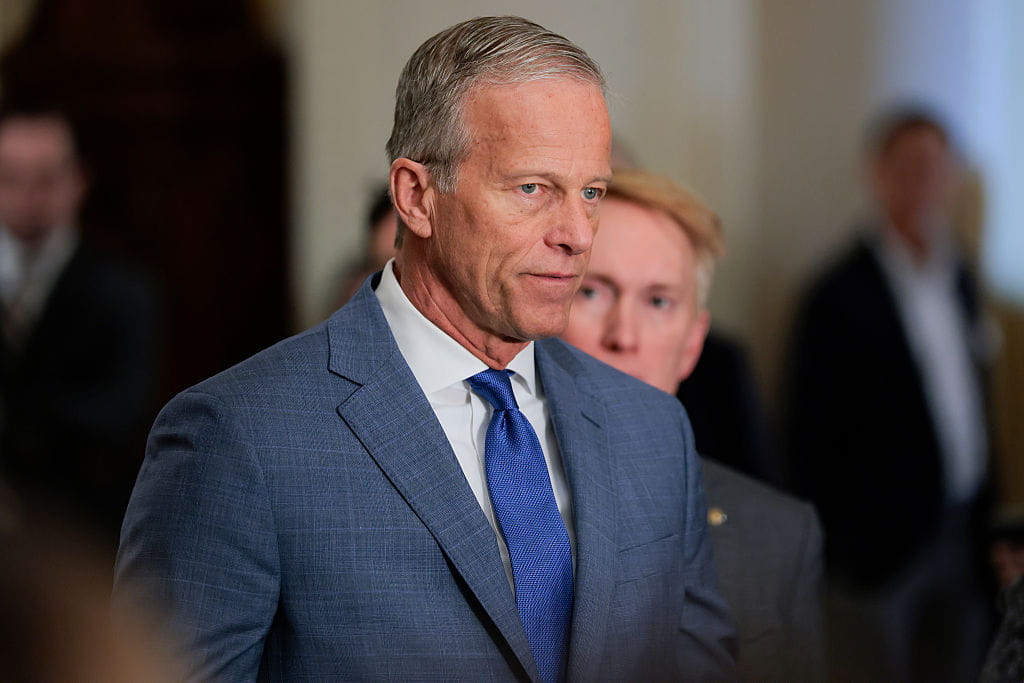
On Feb. 25, the day after President Donald Trump delivered a memorable and at times contentious State of the Union address before a joint session of Congress, Senate Leader John Thune (R-SD) pledged to force a vote in the upper chamber on what is commonly referred to as the SAVE Act. During his speech, the president called upon Congress to “unite and enact this commonsense country-saving legislation right now,” adding that “it should be before anything else happens.”
The Safeguard American Voter Eligibility Act passed the House of Representatives earlier in February with a 218-213 vote. The legislation requires voters to provide proof of US citizenship, such as a birth certificate, US passport, naturalization certificate, or some other official document that establishes citizenship.
While it is somewhat unlikely that any Senate Republicans would want to go on the record opposing the SAVE Act when it comes up for a vote, there is a 60-vote threshold for passing such a bill. Almost all Capitol Hill Democrats have long made their opposition to any voter ID laws well known.
On the Record for the Midterms
Thune knows this is a very steep hill to climb for the GOP, but he apparently sees the benefit of putting the SAVE Act on the Senate floor at this time. Apart from giving the nod to President Trump’s urgency on the matter, Thune would be obliging individual Democrat senators to make their positions known – with hardly more than eight months until the midterm elections, providing Republican incumbents and Senate candidates with campaign ammunition.
“We will put the Democrats on the record,” Thune said during an appearance on Fox News. “It’s a stark contrast … The Democrats even in the chamber last night having to sit there and trying to defend allowing non-citizens to vote in American elections, that is a losing proposition for them.”
Polls indicate strong support among Americans of all political stripes for voter ID laws. Pointing out that ending the partial government shutdown is a top priority, the Senate leader then observed, “It’s an issue – if I were running as a Democrat in the midterm elections in November – I wouldn’t want to have to defend.”
A Senate SAVE Act Strategy
Another Republican senator, Mike Lee of Utah, recently threatened Senate opponents of the SAVE Act with the prospect of a so-called talking filibuster. Speaking on the Fox Business show Sunday Morning Futures on Feb. 22, Lee noted, “Eighty-five to ninety percent of Americans agree that people ought to have to establish that they’re citizens to vote in US elections, and they have to show up on polling day with a photo ID.“ Lee added that, such is the significance of the bill, the Senate owes it to the American people to make opponents of the legislation actively filibuster:
“They shouldn’t be able to filibuster while they’re napping. They shouldn’t be able to filibuster while they’re at the Munich Security Conference. A filibuster in this circumstance should require them to go to the Senate floor, seek recognition, and start speaking until they are no longer able.”
Thune – who, it is fair to say, is generally eyed with mistrust by Trump supporters – has not set a date for the vote. “In due time” is how he put it, which, from a Trump perspective, and considering the usual pace of getting things done in DC, is not promising.

America may well be the only country in which showing ID and proving one’s eligibility to vote is not mandatory. It is difficult, if not impossible, to defend elected Democrats’ opposition to such a requirement. Their argument – or the latest one – is that millions of Americans will be unable to either find or obtain the necessary documentation. In other countries, that is not considered an acceptable excuse, aside from a few possible exceptions. It is neither unreasonable nor inaccurate to assert that, if one is a natural-born or naturalized citizen, the chances of one having no possible way to obtain documented proof of one’s citizenship are remote – even if it entails a little research, a phone call or two, and a bit of legwork.
Thus, it’s hard to see this from the Democrats’ perspective as a legitimate concern that millions of eligible voters will be disenfranchised. In reality, this seems like another version of “the voter ID is racist because black people don’t have driver’s licenses” narrative. Can Republicans give Trump the win he is looking for and get the SAVE Act through the Senate and enacted before the midterms? The answer to that is still elusive.
If they succeed, how will they ensure compliance across all 50 states – especially those run by opponents of voter ID? The battle between the federal government and the states over election controls goes beyond the looming Senate fight, no matter where the chips fall.