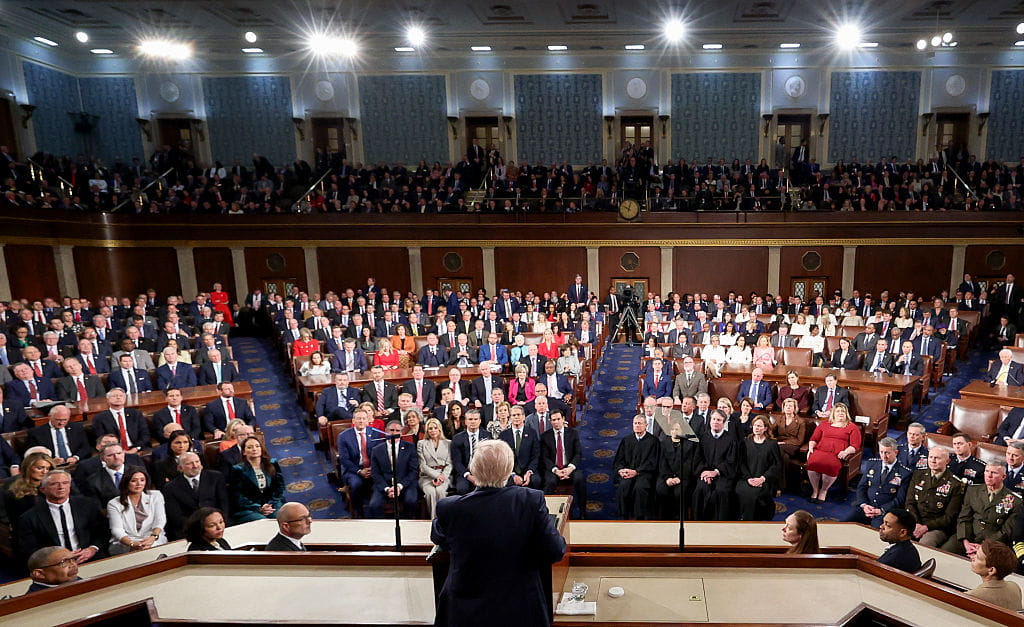
In the wake of President Donald Trump’s State of the Union address, much media attention has been paid to his popularity and approval ratings. And why not? Short of an election, polling is the most surefire way to determine just how a politico is performing – or at least how they are perceived to be performing. A deeper look shows our current political leadership in a fascinating nexus of PT Barnum and Oscar Wilde.
The Greatest Showman
Barnum posited that “there’s no such thing as bad publicity,” and it’s hard to argue with that notion when it comes to President Trump. For the last decade, he has dominated the news cycle and shaped – either through his own actions or the negative responses to them – the narrative for just about every media outlet in town.
After all, if he had not gone on offense, the headlines would have been solely about a rare defeat at the highest court. Instead, the Fourth Estate was forced to contend with the ramifications of his new course of action.
Just how has such political gamesmanship served his popularity ratings?
Let’s Get Churchillian
British wartime Prime Minister Winston Churchill once quipped, “It has been said that democracy is the worst form of Government except for all those other forms that have been tried from time to time.” A notable quote by anyone’s standard. But how does it apply here?
President Trump’s current approval rating, according to Liberty Nation News’ Public Square polling aggregate, is just 42.3%; he is underwater by roughly 14 points. Not a great position for a commander-in-chief hoping to drag his party across the midterm finish line this November. But when taken in context with all the other political leaders, a somewhat different picture emerges.
A Democrat Deficit
Absent a uniting figure to helm the team, the Democratic Party’s de facto figureheads are Senate Minority Leader Chuck Schumer and House Minority Leader Hakeem Jeffries – both of New York.
Jeffries has a current approval rating of just 27.8%, lower than Trump’s lowest ever poll (29% – Pew Research Center), which occurred just three days after the riot at the US Capitol on January 6, 2021. To give some historical context, over the last 100 years, only two presidents have ever had a poll lower than Mr. Jeffries’. Richard Nixon received a desultory 23% (Gallup) during the Watergate debacle, and Harry S. Truman had the lowest on record with 22% in 1952 (also by Gallup), during the heyday of “Korea, Communism and Corruption.”
Senator Schumer is doing even worse than his lower chamber counterpart. He clocks in at 25.8% approval, no doubt exacerbated by his handling of two of the three recent government shutdowns. These are not popular people.
Notably, Senate Majority Leader John Thune (R-SD) has an approval rating of just 19%, but he is not the leader of his party.
Wild About Wilde
What is significant about these poor popularity numbers is that when the approval is taken with the disapproval, Trump’s 55% is actually starker. Jeffries has a disapproval of 36% and Schumer of 47% – so both men are neither well-liked nor greatly despised. And in politics, failing to evoke any kind of reaction is essentially a failure.
As Oscar Wilde famously said, “There’s only one thing in the world worse than being talked about, and that is not being talked about.”
Jeffries and Schumer are not faceless bureaucrats for whom anonymity is the key to career longevity. They are the leading names in their party and the men most responsible for rallying voters ahead of the midterms.
While the ultimate results of the upcoming elections may hinge on a Trump referendum, anonymity and irrelevance are, at the very least, a poor position for the supposed defenders of democracy.