We don’t know how much of Operation Epic Fury remains before us, and so it’s too early to know what lessons we’ll take from it. But while we can’t know the future, the past has been illuminated by the present.
And what’s been illuminated about the past is this: The world let hundreds of thousands of Syrians die needlessly. And no one could have done more to prevent that than the United States under Barack Obama.
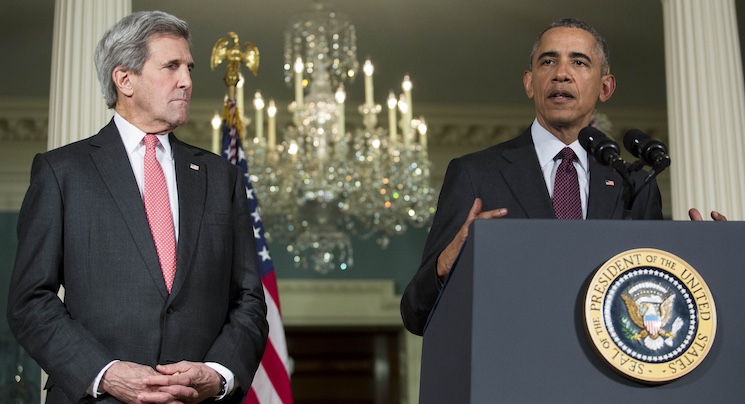
President Obama made three determinations about Iran. The first was that the Islamic Republic’s quest for a nuclear bomb could only be postponed, not unilaterally ended. The second was that any significant setback to the nuclear program could only come through negotiations, because real progress on this issue required Iranian consent. The third was that getting any Iranian agreement to delay its nuclear breakout required ceding a degree of regional hegemony to Tehran.
Operation Epic Fury’s key purpose is to end the tyrannical and bloody rule of Ayatollah Ali Khamenei. The earlier mission to significantly set back Iran’s nuclear program was conducted by force, and it was successfully carried out without a single American casualty.
Six months before those strikes, Bashar al-Assad, the dictator with the blood of a half-million Syrians on his hands, fled Damascus, ending his family’s 53-year rule.
Six weeks before the ignominious end of the Assad dynasty, Syria’s patron Iran was brought low by Israeli retaliatory strikes that virtually wiped out Iran’s air defenses and froze its ballistic missile program. Before that, Iran’s other proxies were flattened by Israel in Lebanon and Gaza.
Assad’s power was an illusion. He was a paper tiger. So was Iran.
And yet, one of the gravest consequences of the Obama administration’s policy of appeasement toward Iran was the belief that in order to get a nuclear deal that was already stacked in Iran’s favor, no action could be taken to save the civilians being gassed by Assad and buried in Syria’s mass graves.
The defining moment of this shameful policy came in the summer of 2013. Obama had set out his “red line” that, when crossed, would trigger U.S. intervention in the Syrian civil war: Assad’s use of chemical weapons. As his administration argued, the use of illicit chemical weapons anywhere constitutes a threat to U.S. personnel and interests everywhere.
In August 2013, Assad unleashed a chemical weapons attack in the Syrian city of Ghouta, killing hundreds with poison gas. Obama acknowledged the line had been crossed and signaled that the U.S. would fulfill its own stated obligation to act. And then, as the Washington Post’s David Ignatius memorably put it, “it was all in motion, and at the last minute, the president blinked.”
From there, the administration welcomed Russian involvement in a failed diplomatic scheme to prevent future such attacks. It was emblematic of Obama’s overall Syria policy throughout the war.
But why?
“Getting a legacy-boosting nuclear deal with Iran was everything for the Obama administration,” recalled Frederic Hof, who worked on Syria policy for the Obama administration until 2011 and was highly critical of the White House’s inaction. “Nothing should be done in Syria that would offend Iran’s supreme leader, Ayatollah Ali Khamenei, or the Islamic Revolutionary Guard Corps’ support for Assad’s mass murder strategy. Offending them — or so the theory went — might cause Iran to walk away from the nuclear talks and forsake a monetary cornucopia in sanctions relief and foreign direct investment.”
Syrians, Hof lamented, “have involuntarily paid such a high price” for America’s ill-fated nuclear deal with Iran.
Inaction in Syria was directly tied to the administration’s false narrative about the Iranian nuclear program. The nuclear program could have been dealt a far greater blow than Obama unconvincingly argued was being delivered by his capitulation to Iranian negotiators, and Syrians could have been saved.
Operation Epic Fury has not been designed to make a point about past Syria policy. But it has done so. And the point is a valuable one.