
If there’s a consensus talking point among the critics of the military action against Iran, it’s that it’s an “unnecessary war of choice.” The complaint doesn’t stand up, but it’s so frequently repeated that it’s worth a careful look to understand precisely why not.
The Democratic nominee who lost to President Donald Trump in 2024 and who is a possible 2028 candidate, Kamala Harris, used those terms in her statement: “unnecessary … war of choice.” So did another potential 2028 candidate, Rep. Alexandria Ocasio-Cortez, a Democrat of New York: “unnecessary … a deliberate choice of aggression.” Mayor Pete Buttigieg, another 2028 contender, used the same terms: “war of choice … unnecessary war.”
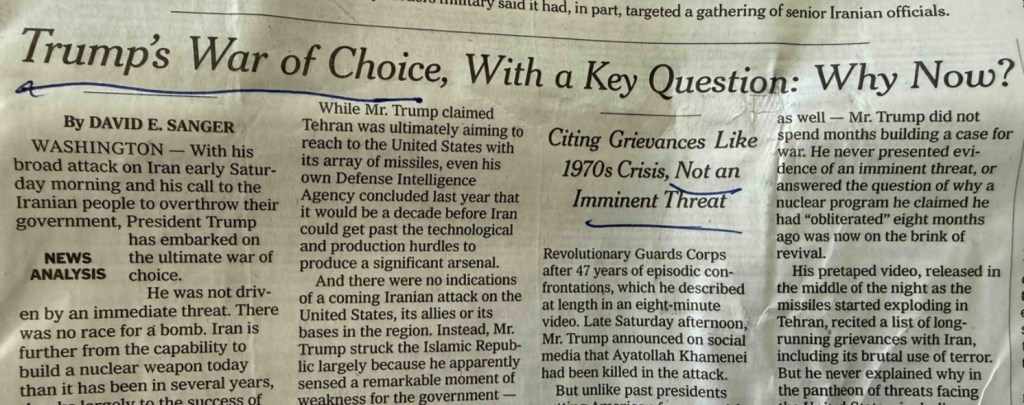
The Democrat-aligned press offered the same interpretive framework. “Trump’s War of Choice, With a Key Question: Why Now?” was the front-page headline over a New York Times article by David Sanger, who teaches a class at Harvard on “Central Challenges of American National Security, Strategy, and the Press.” Sanger described the U.S. military action as “the ultimate war of choice” and noted, “In international law, the difference between a war of necessity and a war of choice is huge.”
The politicians and Professor Sanger don’t mention it, but these distinctions between wars of choice and necessary wars actually go far back in Jewish and Christian traditions. To analyze whether “unnecessary war of choice” applies in this case, it’ll be useful to first look at the sources, then look at the facts of the current situation.
The classic and most detailed statement of the distinction between obligatory or commanded wars and optional or elective wars comes in the Babylonian Talmud, in the tractate Sota, page 44b. Scholars say the Talmud dates from between 300 to 600. Rava, who lived from 280 to 352, explains that “With respect to the wars that Joshua waged to conquer Eretz Yisrael, all agree that they were obligatory. With respect to the wars waged by the House of King David for the sake of territorial expansion, all agree that they were elective wars. When they disagree, it is with regard to preventative wars … One Sage, Rabbi Yehuda, called this type of war a commanded war, and one Sage, the Rabbis, called it an elective war.”
The Babylonian Talmud also deals with the question in Sanhedrin 2a: “The king may bring the nation out to an optional war, i.e., a war that was not mandated by the Torah and is not a war of defense, only on the basis of a court of seventy-one judges.”
Maimonides, in his Mishneh Torah, which was written between 1170 and 1180, also tackled the issue: “The king must first wage only Obligatory wars. What is an Obligatory war? It is a war against the seven nations, the war against Amalek, and a war to deliver Israel from an enemy who has attacked them. Then he may wage Authorized wars, which is a war against others in order to enlarge the borders of Israel and to increase his greatness and prestige.”
The “war against Amalek” line is particularly resonant given the timing of this war, which kicked off on a Sabbath known on the Jewish calendar as Shabbat Zachor. It features a Torah reading in synagogue of Deuteronomy 25:17-19: “Remember what Amalek did to you on your journey, after you left Egypt—how, undeterred by fear of God, he surprised you on the march, when you were famished and weary, and cut down all the stragglers in your rear. Therefore, when the ETERNAL your God grants you safety from all your enemies around you, in the land that the ETERNAL your God is giving you as a hereditary portion, you shall blot out the memory of Amalek from under heaven. Do not forget!” There’s an additional reading from I Samuel 15:2-34: “go, attack Amalek … Spare no one,” which concludes with Samuel killing King Agag of Amalek: “Samuel said: ‘As your sword has bereaved women, So shall your mother be bereaved among women.’ And Samuel cut Agag down before GOD at Gilgal.”
In the Christian tradition, St. Augustine’s letter to Boniface in 418 also speaks of necessary war, defining it as one necessary to obtain peace: “War should be waged only as a necessity … war is waged in order that peace may be obtained.” And Hugo Grotius, a Dutch Christian scholar, wrote in his 1625 “On The Laws of War and Peace,” “the Dread (as we before observed) of our Neighbour’s encreasing Strength, is not a warrantable Ground for making War upon him. To justify taking up Arms in our own Defence, there ought to be a Necessity for so doing, which there is not, unless we are sure, with a moral Certainty, that he has not only Forces sufficient, but a full Intention to injure us.”
How does the U.S.-Israeli operation against Iran stack up against the standards set by the Talmud, Maimonides, Augustine, and Grotius? There’s a separate, parallel conversation about how it comports with the Constitution or international law, but those considerations strike me as somewhat downstream of the political and moral conversation.
It does not seem to me as if it’s a war of choice in the sense of territorial expansion or enlarging borders. Neither Israel nor the United States is planning to capture Iranian territory on a permanent basis and colonize it. If this were a joint U.S.-Israeli operation to seize Greenland from Denmark, I might be in favor of it, but I wouldn’t be here defending it as a war of necessity rather than a war of choice. As to whether modern day Iran is Amalek, there are certainly ample parallels, and the timing with Shabbat Zachor is something. Yet I don’t even think one has to go there. There’s plenty of ground to place the U.S.-Israel action in the terrain of Maimonides—delivery from an enemy who has attacked. And Augustine—war waged in order that peace may be obtained. And Grotius—certainty that Iran “has not only Forces sufficient, but a full Intention to injure us.”
Here the particular, concrete facts about Iran, the United States, and Israel matter greatly, and the New York Times’s shifty and cherry-picking use of them is a sign that that newspaper is playing a political role rather than functioning as an honest broker.
It’s actually breathtaking. Some of the Times silliness relates to the Grotius test of whether Iran has forces sufficient to injure us.
Sanger writes that Trump “was not driven by an immediate threat. There was no race for a bomb. Iran is further from the capability to build a nuclear weapon today than it has been in several years, thanks largely to the success of the president’s previous strike on Iranian nuclear enrichment sites, in June.”
Now the Times wants to describe Trump’s previous strike as a “success.” Yet back in June 2025, the Times marshaled six of its biggest star bylines—plus “David E. Sanger contributed reporting”—for a front-page story claiming, “A preliminary classified U.S. report says the American bombing of three nuclear sites in Iran set back the country’s nuclear program by only a few months, according to officials familiar with the findings. … The report also said that much of Iran’s stockpile of enriched uranium was moved before the strikes, which destroyed little of the nuclear material. Iran may have moved some of that to secret locations.” The Times is going to attack Trump whatever he does. In June 2025, they were saying that the Iranian nuclear program hadn’t really been obliterated. Now, they are criticizing Trump for unnecessarily attacking Iran, because after all, he had essentially obliterated the nuclear program the last time around.
Sanger also writes, “While Mr. Trump claimed Tehran was ultimately aiming to reach to the United States with its array of missiles, even his own Defense Intelligence Agency concluded last year that it would be a decade before Iran could get past the technological and production hurdles to produce a significant arsenal.” Yet Iran need not develop an intercontinental ballistic missile to hit America. It could send over a drone from Canada or Mexico or Cuba. It could launch a medium- or short-range missile from a boat or a submarine. Or it could use terrorists to deliver the blows.
Before the United States launched its preemptive attack, the New York Times was trying to panic readers about Iran’s capabilities against American targets. A Times article from February 22 was headlined, “Iran Could Direct Proxies to Attack U.S. Targets Abroad, Officials Warn.” A June 2025 article in the Times said, “Carlos Fernandez, a former senior F.B.I. agent in charge of New York’s counterterrorism division, said the agents had to take seriously the possibility of sleeper cells in the United States, especially since Iran has been accused of plotting to kill President Trump before the election and a human-rights activist in Brooklyn. Indeed, the bureau has also uncovered members of Hezbollah, who trained in Lebanon but then moved to the United States, where they were eventually arrested in Michigan and New York and charged with terrorism. ‘It’s very real,’ he said. ‘It’s a legitimate concern.’” A July 2025 article in the Times quoted Bruce Hoffman, a terrorism expert at Georgetown University, who told the paper that, as the Times paraphrased him, “Iran and Hezbollah have long sought to position agents within the United States for potential terrorist attacks with at least some success.” Hoffman told the Times, “I don’t think there’s much doubt about that” and said that sleeper agents “can’t be discounted.” The Times is happy to acknowledge Iran’s capability to hit America when the newspaper is doing so for the purpose of underscoring the risks of American action; the Times is dismissive of precisely the same capabilities when it comes to justifying an American attack.
Then there is the question of whether Iran has an intention to injure us. That one isn’t even a close call. These guys have literally been chanting “death to America” since the Iranian revolution in 1978. Trump recounted the list of attacks against Americans that Iran is already responsible for—the seizure of the U.S. embassy in Tehran in 1979 and holding hostage the diplomats stationed there; the 1983 Beirut Marine Barracks Bombing, which killed 241 Americans, and for which a U.S. court found Iran responsible; the roadside bombs in Iraq that killed or maimed so many U.S. troops; the October 7, 2023, attack on Israel, which killed 46 Americans. The Iranians tried to kill the former national security adviser, John Bolton, according to a case the Justice Department brought during the Biden administration. They also tried to assassinate former secretary of state Mike Pompeo. The Iranians launched cyberattacks against U.S. local governments and electric utilities, according to another case brought by federal prosecutors during the Biden administration. They tried to kill Trump and a U.S. citizen of Iranian origin in New York. As Damian Williams, President Joe Biden’s top federal prosecutor in New York City, put it in a November 2024 press release, “Actors directed by the Government of Iran continue to target our citizens, including President-elect Trump, on U.S. soil and abroad.” That same press release quoted the FBI director, Christopher Wray: “The Islamic Revolutionary Guard Corps — a designated foreign terrorist organization — has been conspiring with criminals and hitmen to target and gun down Americans on U.S. soil.” When Trump, in January 2025, pulled Pompeo’s security detail, the New York Times wrote about “warnings from the Biden administration” that he “faced ongoing threats from Iran.” It’s another instance of how what the Times cares about isn’t the underlying reality of Iran’s threat to the United States, but whether and how it can be used politically to bludgeon Trump.
Sanger quotes the former George H.W. Bush National Security Council official, former Colin Powell adviser, former Council on Foreign Relations president and current MS NOW talking head and perpetual font of conventional wisdom Richard Haass insisting, “there were other choices: diplomatic accords under military pressure, economic embargoes, interceptions of Iranian ships.” All these approaches have been tried, without much result. Diplomacy? The Obama administration traded hundreds of billions of dollars of sanctions relief in exchange for unverifiable future promises from Iran. Iran used the money to fund terrorist attacks. Embargoes? The existing sanctions on Iran immiserate the Iranian people; the regime prospers by selling oil to China in violation of the sanctions. Intercept ships? The United States and our allies have been doing that already. Even longtime advocates of a diplomatic approach have lost patience: See the January 14, 2026 New York Times staff editorial headlined “Iran’s Murderous Regime Is Irredeemable.” It said, “The Khamenei regime is too depraved to be reformed.”
The “choice” made by Trump’s critics and Netanyahu’s is to leave that murderous Iranian regime in power while it gathers additional strength that it will use to kill more Americans than the many it already has. Iran is already in its own war against America. It has been for 47 years. Previous presidents have chosen to pretend it isn’t happening. If there’s a choice on this policy menu that was unnecessary, it was that prolonged denial, not the decision by Trump and Netanyahu, at long last, to seek a conclusive victory.
The post ‘Unnecessary War of Choice’? Absolutely Not appeared first on .