If you go east from hilly Austin, Texas, onto the flat coastal plain that stretches for 130 miles toward Houston, you can glimpse a future of the American city. But it won’t look like Manhattan, Chicago, or even Los Angeles. In fact, you might not realize you’re looking at a city at all.
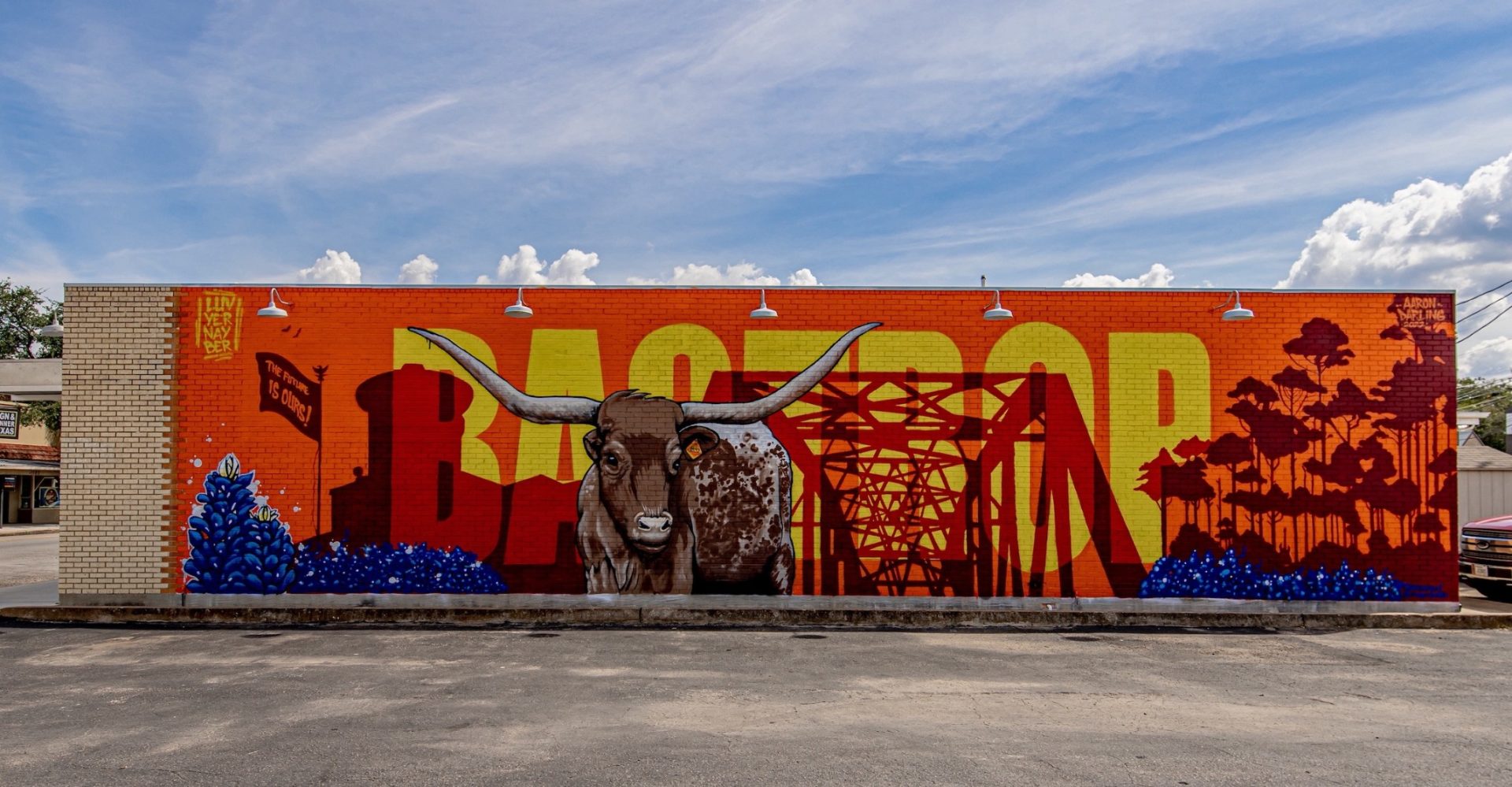
An example of this type of future “urban” development is Bastrop, a small city located 30 miles east of Austin, with a population of 15,000. Bastrop has a historic, brick commercial district, streets of painted Victorian residential homes, and a roaring economy. Celebrity chefs from Austin are opening restaurants here, and are able to afford land for their kitchen gardens nearby, and podcaster Ryan Holiday of The Daily Stoic recently moved in, and can often be seen jogging in the city center.
Bastrop is located in a still largely rural and agricultural county of cattle, cotton, and bees. Even so, it has a population of well more than 100,000, up from about 25,000 in the 1980s. Elon Musk has built the sprawling, ultramodern headquarters of SpaceX here, along with the headquarters for four of his other projects. There’s a new movie studio under construction, launched by two Hollywood production companies, and roughly 5,000 new housing units underway to support the influx of workers.
This, perhaps, is what the “city” of the future looks like — sprawl, but a pleasant, livable variety.
Across the Austin-adjacent region, more than 90% of population growth is taking place in the periphery — and places like Bastrop are welcoming it. “You might think that small-town Texans would not be so open to change,” says Vivianna Andres, an assistant Bastrop city manager who grew up in town. “But we are not limited in our ambitions. We want a great future.”
This kind of growth is a national phenomenon. In the last decade, suburbs and exurbs accounted for about 80% of all US metropolitan growth. The trend is fueled by people seeking to escape high taxes, poor schools, and unsafe streets. The pandemic — which normalized remote work and accelerated the existing exodus to the periphery — intensified the trend. The best of these new areas have attractive lifestyle features like the downhome charm of the city of Bastrop, or plentiful green space, or smaller village-like hubs that create community. These new cities come in varied forms. Some — like Irvine, Calif., or the Woodlands, outside Houston — are planned. Others, such as the developments around Bastrop, are a series of subdivisions. Some are organic, but others simply grow on their own.
Some design visionaries have always seen suburbs and exurbs as a path toward a better future. In the 1940s, the architect Frank Lloyd Wright saw dispersed communities as “a means of liberation” for families, because they allowed residents to work at home or nearby, while also being close to the blessings of nature. Wright’s vision is being carried out, particularly in Texas, in scattered new subdivisions as well as in planned communities.
The Lone Star State’s liberal land regulation allows developers in county lands to develop their own water, sewage, roads, and other infrastructure. Texas has more than 900 Municipal Utility Districts that average about 1,000 acres each, about two-thirds in the Houston metro area. Texas is also the site of the first development of 3-D printed homes, in fast-growing Georgetown, located 30 miles north of Austin.
To some, this outward expansion represents useless sprawl or poor urban planning. But Americans have been birthing cities from the earliest colonial times. In the 20th century, the nation even created a new urban archetype: the high-rise downtown epitomized by New York and Chicago. The world had never seen anything like them before. Today, Americans are once again creating something new.
In some ways, the trend is merely bowing to reality. Jobs began to spread out as early as the 1950s. Since 2000, office occupancy and the construction of new office space have experienced major declines. But these facts have been either decried or ignored by a media based overwhelmingly in dense urban centers.
In 2008, for example, CNN asserted that “America’s suburban dream” was “collapsing into a nightmare.” One prominent urbanist writing in The Atlantic predicted the exurbs would become “the next slums,” an idea widely embraced by the planning establishment.
These critics claim, often rightly, that much suburban development has lacked character, not to mention public places for people to gather. But there are now many communities that combine suburban densities with public and open spaces, plus good schools and robust public safety. Cinco Ranch and Houston’s the Woodlands, and Columbia and Reston outside Washington, DC, are prime examples. Rather than purposeless sprawl, these communities embrace the great British urban visionary Ebenezer Howard’s ideal of “garden cities” that could exist without dependency on the big city.
Irvine, south of Los Angeles — a city of 320,000 founded around 1960 and developed by the Irvine Company — epitomizes the new paradigm. Irvine has one of the most extensive urban park systems in the country, with 270 parks and one-third of its land dedicated to open space. Its largely affluent, increasingly Asian population has been attracted by a safe and well-maintained community with good schools, lots of jobs, and a low crime rate. Many of its workers are based at home; others enjoy short commutes to industrial parks and offices spread throughout the area. More workers come in from outside the city to work than depart from Irvine to work elsewhere.
Irvine’s advantage, notes long-time planner Rob Elliot, who still consults for the Irvine Company, lay with having a large amount of undeveloped land and a good supply of money that was willing to be patient over time. The city has been laid out meticulously and in accordance with resident demands. Irvine, Elliot admits, lacks a walkable downtown, but it meets consumer needs with a polycentric series of town centers located in its many “villages.” “We didn’t want to build another New York City,” he notes. “Suburban urbanism is what people want.”
Today, the focal point for such development lies with market-oriented states such as Texas, Nevada, Arizona, and Ohio, home to the fast-growing New Albany area near Columbus. Over the past two decades, New Albany has relied on master planning to grow to more than 10,000 residents, up from 3,700. Meanwhile, employment at its business park has grown to 15,000. Lifestyle features such as a system of parks, distinct neighborhoods, and walking paths have attracted more than just residents. Since 1998, New Albany has gained more than $4 billion in private investment, 15,000 jobs, and some $100 million in income-tax revenue, according to the New Albany Finance Department.
Overall, communities like these represent 43 of the nation’s fastest-growing regions. Most are within a two-hour commute from a major urban county. In rapidly growing Houston, the nation’s fifth-largest metro region, peripheral areas saw the vast majority of all growth since 2020.
Much of this growth is driven by the migration of young families and professionals, who have been abandoning central cities in droves. In the past decade, the fast-growing counties that are home to most of the nation’s planned-community development, significantly increased their population of people earning more than $75,000, especially those between the ages of 30 and 44. This cohort is avidly seeking single-family homes. In Bastrop, the median house costs $350,000, one-sixth the median price in Santa Clara County, the heart of Silicon Valley.
The Golden State provides a telling counterexample. Once a leader in building new communities, California is now a laggard; three-quarters of new city-making is concentrated in states like Texas, Florida, and Nevada. The test will be the massive, proposed “California Forever” project, covering 100 square miles of what is today mostly grazing land, some 50 miles from San Francisco.
“You would think such a project would be welcome in a state with a particularly torpid economy.”
Backed with tech-oligarch billions — including from heavyweights such as Michael Moritz, Marc Andreessen, and Reid Hoffman — California Forever has the formula of space-plus-capital that worked so well in Irvine. The plan is to develop housing for 400,000 people, as well as new factory and ship-building facilities. The goal, founder and CEO Jan Sramek told UnHerd, is to build affordable housing and provide good blue-collar jobs, essentially “what Silicon Valley used to do.”
You would think such a project would be welcome in a state with a particularly torpid economy. Recently, the Bay Area Council Economic Institute released a report that examines the potential economic and fiscal impacts of the new city and shipyard, and estimates the projects will create 530,000 new jobs and $16 billion in annual tax revenue. And California Forever, whose home prices are to start at $400,000, would seem ideal in a state where housing is scarce and many families are leaving. The development should also offer better-paying jobs, and safe areas with good schools.
Critically, the project also marks a major shift in what I’ve called California’s oligarchic socialist attitudes, which have stressed support for dense development near transit stops over the suburban expansion that once birthed the Valley. “Once the techies’ top employees started getting married and having kids, they realized the value of safe streets and backyards,” one top official told me.
Yet what would be seen as no-brainer in Texas is running into opposition from California progressives, who want single-family suburban owners replaced by urban apartment renters. Pro-density YIMBYs, themselves a creation of the oligarchs, are deeply divided by the plan. There’s also an apparent lack of support for the project in the area, which is currently largely home to middle- and working-class residents who like their semi-rural existence as it is.
The opposition that keeps California Forever CEO Sramek and his staff awake at night comes from well-funded, intensely anti-growth nonprofits. “We face radicalized degrowth types who are rich kids, who want to stop building everywhere,” Sramek says with distaste. He calls the influence of California’s anti-growth greens as “insidious,” and says it is undermining “the spirit of the state” that once symbolized American aspirations.
The plan itself also could prove flawed. California Forever’s lead planner, Gabe Metcalf, envisions a city of tightly packed row houses. Many young families — the project’s potential constituency — may not want to live cheek to jowl when they could get a better bargain on a single-family home in other parts of the interior, or in another state.
California may still muff this ambitious and badly needed project, but other states seem more than willing to engage in city building. A new city, with a planned 100,000 homes, is being built at Buckeye, thirty miles from Phoenix, long a magnet for dissatisfied Californians. These new communities have shown they can attract a younger workforce, as many “new economy” jobs move out of traditional hotbeds like New York, Los Angeles, Chicago and San Francisco.
This movement will be greatly enhanced by wage rates that are increasingly similar in different parts of the country. As Brookings Institution scholar Mark Muro has noted, salaries across a 19-state American Heartland region, essentially between the Rockies and the Appalachians, adjusted for the cost of living, are above the national average. In contrast, those with the lowest adjusted incomes were entirely on the ocean coasts.
Traditional cities, furthermore, will be challenged by the rise of socialist-leaning politicians, not only in New York, but in Los Angeles, Portland and Seattle. The deep-blue cities, led by people who often denounce the idea of home ownership, and even capitalism, could become increasingly unattractive for both workers and employers. Despite media accounts that young people do not want to start families or own homes, most surveys show that the vast majority of Americans in their 30s want to replicate these foundations of middle-class life. One key fact: some one million millennials become mothers every year.
To this generation, the appeal of safe, reasonably priced housing near good jobs cannot be underestimated. And for the country, the new cities represent a revival of an America that is eager to build a future that will be better than the past. This is already becoming a reality in places like Bastrop, where not only people, but new factories, offices and most importantly schools are being built at a rapid clip.
“Ultimately,” suggests Vivianna Andres, the assistant city manager from Bastrop, “this is about making things better for our children, and our children’s children.” If only other communities had the same perspective.