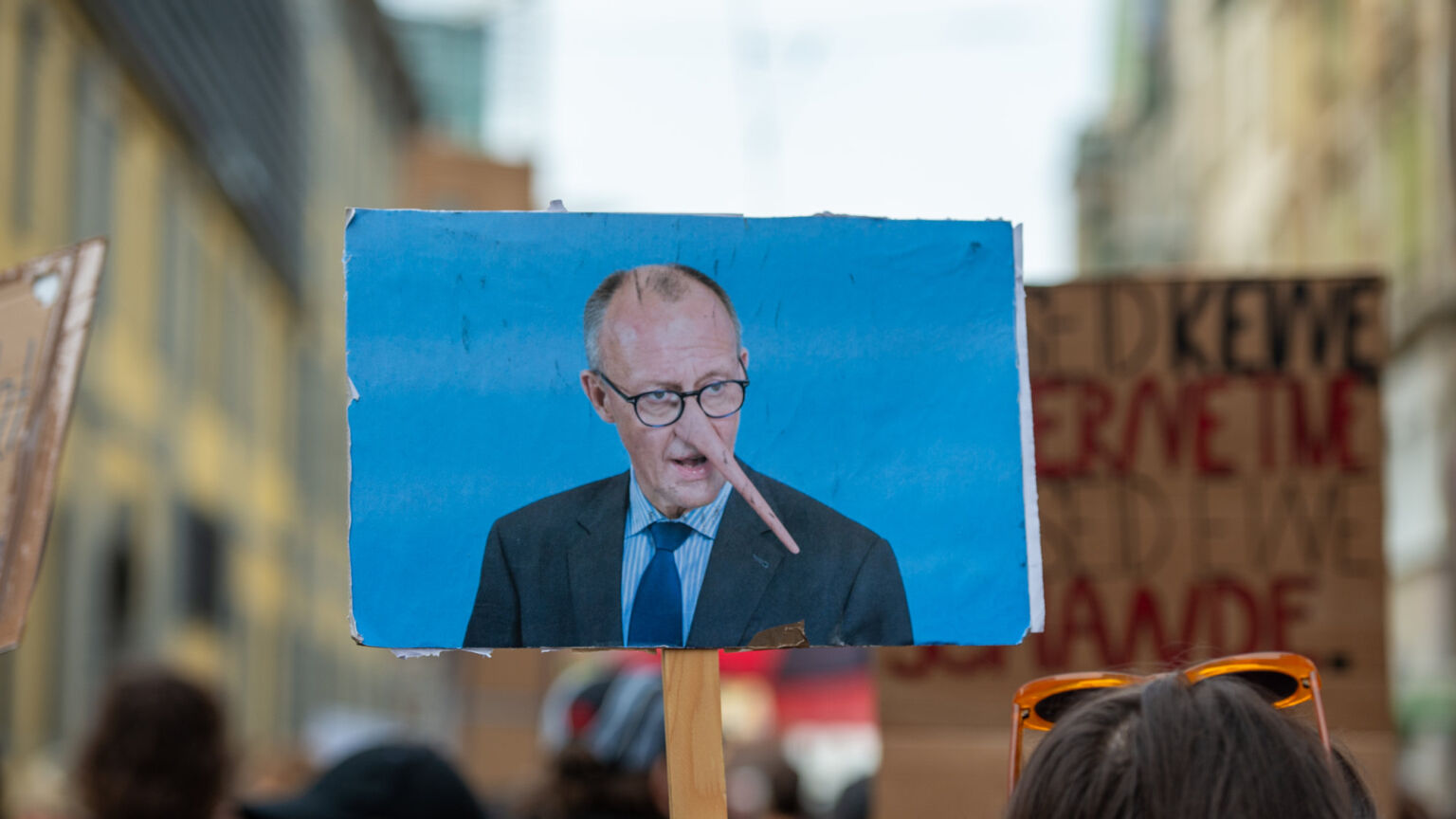
On 23 February 2026, police in Heilbronn, a city in south-west Germany, opened a criminal investigation into a retired man. His alleged crime? Calling chancellor Freidrich Merz ‘Pinocchio’. No threats. No incitement. Just a blunt, rather amusing suggestion that Germany’s national leader tells lies. Welcome to Germany in 2026, where mocking a politician is now a police matter.
The police investigation was sparked by comments made by the pensioner in October. On Facebook, local police announced extra security measures for Merz’s visit to the city. In response to the post, the pensioner commented, ‘Pinocchio is coming to Heilbrunn’, with a long-nosed emoji attached. According to Politico, the police force’s social-media hit squad probed every comment on its post about Merz’s security for ‘possible indictable insults’. On discovering the pensioner’s supposedly grave reference to the fairytale character, they forwarded it to the city’s public prosecution office.
Mercifully, prosecutors made what appears to be a swift decision to close the case. But that hardly excuses the police for investigating a man purely for making what can only be described as an incredibly tepid joke at the expense of a politician.
Worse still, it fits a disturbing trend. In 2024, then vice-chancellor Robert Habeck filed hundreds of hate-crime complaints against ordinary citizens who had dared to be rude about him online, calling him things like a ‘dumb goose’ and his party ‘green rats’ (Habeck was in the Greens). Many of his complaints resulted in hefty fines – one man, also a pensioner, was fined €7,800 for calling Habeck a ‘complete idiot’.
Germany’s thin-skinned politicians have journalists in their crosshairs, too. Last year, David Bendels – editor of the Deutschland-Kurier, a newspaper affiliated with the right-populist AfD – was convicted for posting a meme that showed then interior minister, Nancy Faeser, holding a sign reading, ‘I hate freedom of opinion’. It was a satirical jibe at her push for greater censorship. But that wasn’t how the authorities saw it: Bendels received a seven-month suspended prison sentence and a €1,500 fine for ‘abuse, slander or defamation against persons in political life’. His conviction was thankfully overturned in January by the Bamberg Regional Court. But how did this case ever get so far? Germany is governed by fragile elites, increasingly desperate to control the speech and opinions of a public that is turning against them.
The legal basis for this assault on free speech is largely provided by Section 188 of the German Criminal Code, an ‘aggravated insult’ provision that gives politicians stronger protections than ordinary citizens. Public remarks deemed to make a politician’s ability to do their job ‘substantially more difficult’ can carry penalties of up to five years in prison.
Originally focused on national politicians, the law was expanded in 2021. The stated aim of this was to protect local councillors from online abuse, as this was allegedly deterring people from entering public life. This might sound like a fair concern on paper, but in practice, it’s being wielded to silence the concerns of the German people, and to protect public figures from criticism.
The Criminal Code isn’t the only thing muzzling Germans. Another is the 2017 Network Enforcement Act, or NetzDG. This compels online platforms with over two million users to delete ‘obviously illegal’ content within 24 hours of receiving a complaint, or face fines of up to €50million. The law leans on censorial provisions like Section 188 of the Criminal Code to define illegality. Inevitably, NetzDG pressures platforms into deleting and censoring far more than is strictly legally required, in order to avoid crushing fines.
The German establishment is clearly panicked. The AfD is polling around 25 per cent nationally. Frustration over migration, living costs and institutional failures is real and widespread. Rather than engaging with the public’s frustrations, German politicians prefer to criminalise their expression – ‘hate speech’ laws are just a convenient cover.
Unfortunately, Germany’s censorship-industrial complex only continues to expand. So Done Legal – an organisation co-founded by liberal politician Franziska Brandmann – uses artificial intelligence (AI) to scan social media for potentially punishable posts. Its online portal invites users to upload social-media content that they believe has caused them ‘harm’. If something is flagged by AI, lawyers enter the fray. They write coercive letters to whoever was responsible for the post, demanding the material is removed. The result is that political dissent – rude nicknames, satirical memes and fair criticism – get swept up alongside genuine abuse.
The UN’s special rapporteur for free speech, Irene Khan, recently warned that the space for free expression is ‘shrinking’ in Germany. She cited the ‘heightened protection of officials from public criticism’ as one of the reasons. Unfortunately, Khan’s warning has fallen on deaf ears. Not long after Khan visited Germany, Merz, speaking at the Munich Security Conference, insisted: ‘Freedom of speech ends… when that speech is directed against human dignity and the constitution.’ It’s a conveniently elastic definition, and one that only Germany’s political elite get to draw.
Silencing critics and attacking satire is authoritarian, pure and simple. It is also a tactic that only an insecure politician would resort to. If a pensioner’s mocking comments can do such serious damage to a politician’s sense of self worth, is he or she really fit for public life?
A government that sets the police on pensioners over fairytale nicknames is not ‘protecting’ democracy – it’s terrified of it.
Stephen Sidney is a spiked intern.