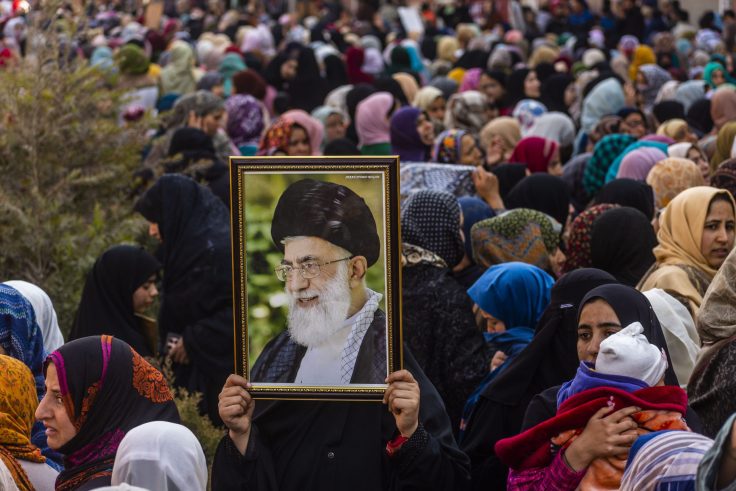
The death of Iranian supreme leader Ali Khamenei—along with more than 40 senior regime officials—has created a regime-altering power vacuum. But Tehran likely remains capable of quashing any uprisings thanks to its sprawling network of local security forces, former U.S. officials and regional analysts told the Washington Free Beacon, indicating that the sustained military action President Donald Trump has indicated is in the works is necessary if the regime is to fall rather than take a new shape. While Israeli officials have said they are aiming for regime change, it is not clear the American military campaign is oriented in that direction as opposed to some sort of regime alteration.
All those who spoke with the Free Beacon said Khamenei’s death is a major blow to the regime. With 60 percent of the country under 30 years of age, Khamenei “is the only leader they have ever known. This has to be discombobulating. We will see protests again,” said Ray Takeyh, who served as an adviser on Iran at the State Department.
Khamenei’s replacement is unlikely to hold the same sway as the late supreme leader, according to former U.S. Iran envoy Elliott Abrams.
“They can find a substitute for most officials, but not for Khamenei,” Abrams told the Free Beacon. “Whoever succeeds him will not truly be supreme leader, able to give unquestioned instructions to the Army and IRGC. He will be a far smaller figure, politically and spiritually. There may not be ‘regime change’ this week, but the regime has been changed, and very deeply.”
The question is whether the regime remains strong enough to quash an attempted uprising as it did in January, when it killed approximately 30,000 protesters. The Islamic Revolutionary Guard Corps and its Basij militia are the central organs of the regime’s apparatus of repression, and there are signs that the U.S.-Israeli operation has weakened their resolve. Iranian foreign minister Abbas Araghchi has acknowledged that the regime’s military divisions are “independent and [somewhat] isolated.”
But Iran’s security forces can operate without clear direction from Tehran. They maintain local branches that control weapons storage facilities scattered across the country, which experts said can be used to overwhelm civilian protesters. The organizational structure requires the United States and Israel to eliminate officials operating beneath the regime’s senior leadership to create the conditions necessary for a successful uprising.
“When it comes to the security forces, what matters is who controls the arms depots,” said Michael Rubin, a former Pentagon official who now serves as a senior fellow at the American Enterprise Institute. “That occurs several levels down, in the provinces and not only at HQ in Tehran.”
The United States and Israel “could decapitate the leadership in Tehran, but the security services, the local branches of the Revolutionary Guard, and the Basij can continue to function,” said former CIA officer Reuel Marc Gerecht, now a resident scholar at the Foundation for Defense of Democracies. He described Khamenei’s death as “a shock to the Islamic Republic” but said he remains “skeptical that it’s going to cause paralysis for very long.”
Israeli officials appear to agree. The head of the Israel Defense Forces’ intelligence brigade, Brig. Gen. Shlomi Binder, said Monday that while the IDF “eliminated over 40 of the most important individuals in Iran in under 40 seconds,” the targeted killings “are not done.”
“We are sending a clear message to our enemies,” Binder said: “There is nowhere we will not find you.”
At the top of Israel’s target list may be the three members of Iran’s newly formed interim leadership council: senior cleric Alireza Arafi, Chief Justice Gholam-Hossein Mohseni-Ejei, and President Masoud Pezeshkian.
Arafi is seen as a hardliner who used his position on the country’s Supreme Council for Cultural Revolution to crack down on reformists, according to an analysis from the United Against a Nuclear Iran watchdog group. Mohseni-Ejei was appointed by Khamenei to lead Iran’s judiciary in 2021 and served as intelligence minister from 2005 to 2009. Pezeshkian, considered the weakest of the three-man council, vowed “bloodshed and revenge” in the wake of Khamenei’s death. Another loyalist is Ali Larijani, the secretary of the Supreme National Security Council and architect of the regime’s bloody crackdown on protesters. Khamenei entrusted Larijani to steer the Islamic Republic before his death.
“The transition is not clear to me, but I don’t think it has to be clear for the Islamic Republic in its dilapidated state to keep functioning,” said Gerecht.
Though renewed protests have yet to grip Iran since Trump launched Operation Epic Fury on Saturday, “there will be an aftershock” of popular revolt once the bombings slow down, Takeyh said. The problem is that the “regime may have gotten its footing sufficiently by then to react strongly, even decisively.”