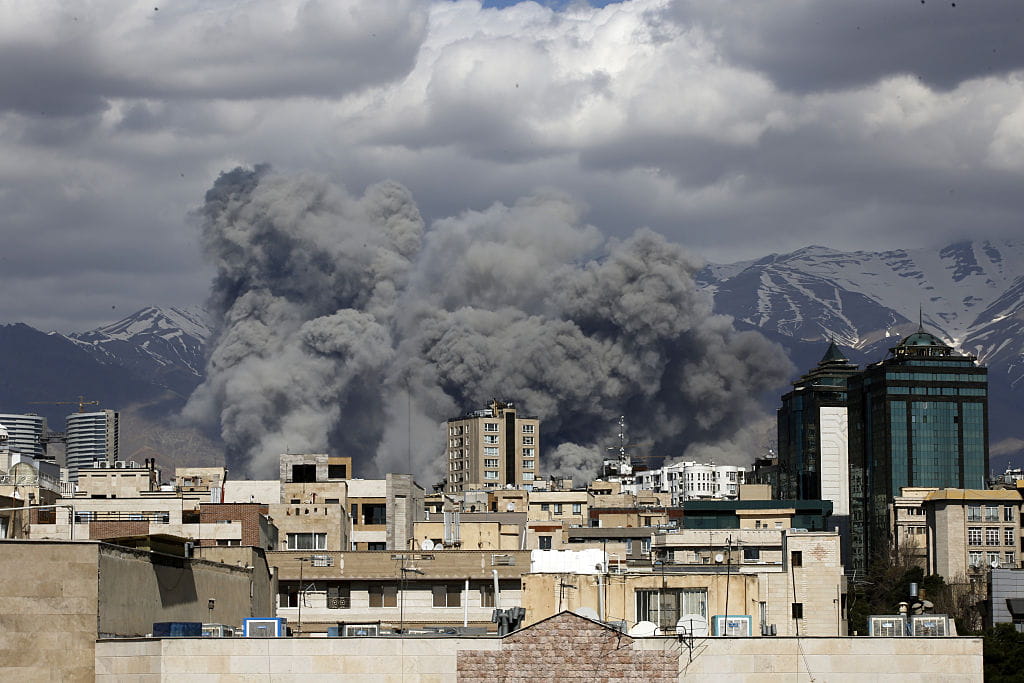
There will always exist Americans who, however well- or ill-intentioned, will oppose war in any form at any time with a stubborn consistency. Others can be counted on to support almost any contemplated military adventure, no matter how risky. For the rest of us, going to war, especially starting one, is a proposition entirely dependent on the circumstances in play. And so we find ourselves at a historic inflection point, another of those crossroads in world history. And unlike the seven men who preceded him in the Oval Office — from Jimmy Carter to Joe Biden — President Donald Trump has chosen to take the road less traveled. Operation Epic Fury in Iran is, like all wars, a road ripe with unforeseeable potholes, far from the comfortable superhighway of denial, delay, and appeasement driven by presidents over 47 years.
But will it lead us down the road to a lasting peace or a dead end?
How Is Iran Different From Iraq and Afghanistan?
With two failed wars already in the books in the first quarter of the 21st century, Americans have famously become war-weary. Though public opinion will likely fluctuate based on events on the ground, early indications are that the people are wary at best of this latest conflict. Only 27% of Americans support the war, according to a flash poll from AP-NORC, with another 30% saying they are unsure.
This begs an abiding question: How much should public opinion drive the process of military engagement? To what degree should it be relevant to the White House’s calculations? With his decision to take down the Ayatollah and his henchmen, the president is gambling on public approval as much as he is on military success, leading to many a question. With Trump saying he is doing this for the future, how does the fate of Iran figure to be relevant to the lives of ordinary Americans? Is it worth losing even a single American life to overthrow a government thousands of miles from our shores? And what happens when the deaths start multiplying into dozens or hundreds? Didn’t we learn a forever lesson in Vietnam, when a war to effect regime change blew up in our faces and brought the country low for years thereafter?
Within minutes of the president’s announcement of the attack, Democrats immediately and reflexively attacked the decision — and the man himself, of course — believing this issue to be found gold, manna from heaven for a party on the back side of the desert. Now his enemies can claim that Trump is a liar and a hypocrite, that we knew he was, in his heart, a warmonger all along. That the Abraham Accords, the Board of Peace, the deals and ceasefires tamping down conflicts across the globe were all for show.
The Nuclear Equation
For those who embrace the notion that this war is unjust, unconstitutional, and reminiscent of the disastrous engagements in Vietnam, Iraq, and Afghanistan, it is important to understand that there is a crucial difference with this campaign in Iran. Even beyond the horrors of the murderous regime in Tehran that just finished slaughtering tens of thousands of its own subjects, Iran had been approaching the capacity to build a nuclear bomb, until Israeli air attacks and Trump’s Operation Midnight Hammer obliterated their nuclear and conventional capacity. But in their failed talks with the United States, Iranian negotiators pledged to continue enriching uranium that could lead to the rebuilding of their nuclear program in the future. It is fair to say that if Iran were not on a discernible path to building a nuclear bomb, it is unlikely, perhaps even inconceivable, that the president would launch this campaign of shock and awe.
 The Ayatollah and his mullahs had for decades been calling for death to America and had by all accounts been closing in on the capacity to make good on that cataclysmic threat. They have repeatedly vowed that their nuclear program is strictly for peaceful purposes, but their words have long proven to be meaningless. Why would they need to bury a fortified nuclear facility far below ground if it was really for peaceful purposes? As has been said, when Islamist leaders breathe, they lie.
But the ultimate reason that Trump chose this moment to rescue Iranians from their murderous rulers is that the regime has reached its nadir. With the overthrow of Bashar al-Assad in Syria, Israeli strikes that all but neutered Iranian proxies Hamas and Hezbollah and severely reduced Iran’s missile program, Trump’s formation of the Board of Peace, and uncontrolled riots in the streets of every major city in Iran, the regime had become more vulnerable than ever. And the remnants of their fallen leadership only made things worse by targeting civilians in Gulf states siding with the United States and Israel, cementing the unity of the Board of Peace.
As Trump himself has said, America First does not mean America alone. Just because Americans do not see visible evidence of the evil emanating from Tehran in their everyday lives does not mean it has no effect on their ultimate security and their ability to sleep at night free of the threat of nuclear annihilation.
This is what we might call a Nixon-goes-to-China moment. Much like when President Richard Nixon, an unquestioned enemy of communism, opened the door to China, Trump can execute this operation because he has established his bona fides as a peacemaker. Would he really launch a region-wide war if he was not convinced that Iran represents the most present — and, most importantly, future — threat to the United States and the world? That is the question that should be on the hearts and minds of anxious Americans.