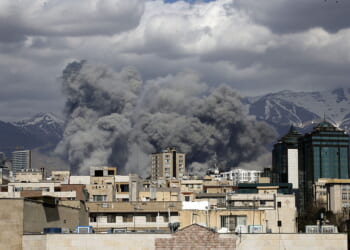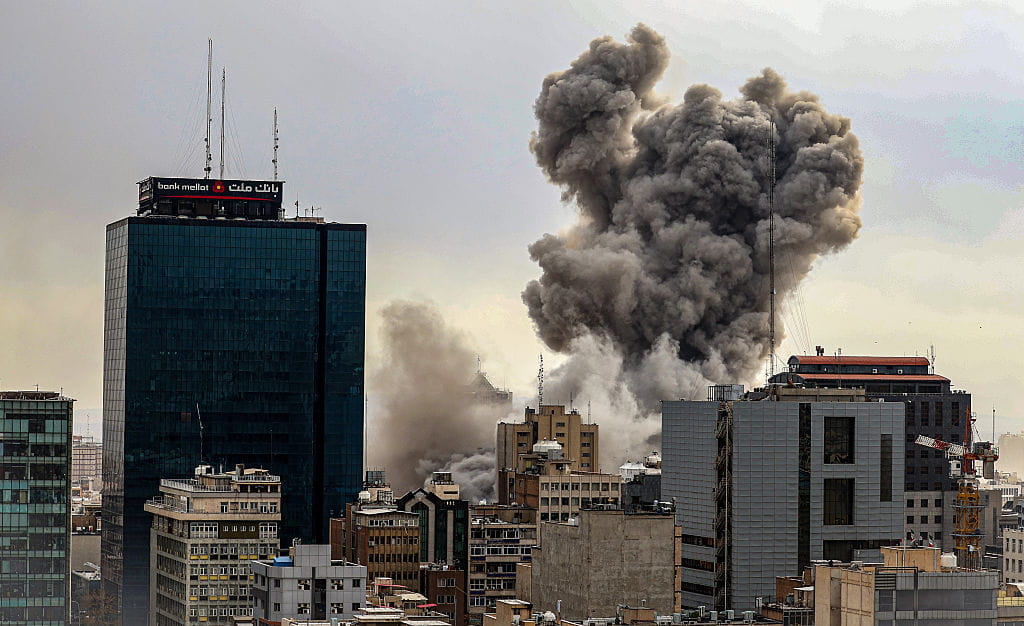
As of this writing, the US and Israel have struck more than 2,000 targets in the United States’ Operation Epic Fury and Israel’s Operation Roaring Lion. The objective is to render Iran incapable of launching ballistic missile attacks on US bases, Israel, or any of its neighbors, deprive it of the resources used to support terrorist proxies, and stop it from refining uranium or developing the capability to produce an atomic weapon. So far, the shared mission’s success has exceeded expectations, but the road ahead is far from clear.
Iran Widens the War
Iran’s immediate reaction was to launch ballistic missiles not only at Israel but also at US bases in Bahrain, Qatar, the UAE, Kuwait, Jordan, and Saudi Arabia. That move has proved to be a mistake. Many of the missiles missed US bases and slammed into civilian structures such as the Fairmont Palm Hotel and Burj Al Arab in the United Arab Emirates, the Crowne Plaza Hotel in Manama, Bahrain, and Kuwait International Airport, as well as other civilian facilities. The Gulf States may have remained neutral had Iran not decided to launch missiles with historically poor accuracy. As one commentator put it, Iran started with two enemies and ended up with nine. Now, Gulf partners are actively supporting the United States and providing significant air defense resources.

During remarks on March 2, President Donald Trump explained that Epic Fury would be considered a success if Iran’s missile capability is destroyed and its “capacity to produce brand-new ones” is eliminated. He added, “We’re annihilating their navy.” Third, President Trump explained that the United States and Israel are ensuring “the world’s number one sponsor of terror can never obtain a nuclear weapon.” Lastly, when the conflict concludes, the Iranian regime will be unable to “arm, fund, and direct terrorist armies outside of their borders.”
The number of Iranian operational naval vessels destroyed as of this writing is 11, the better part of the country’s total naval capability. Eliminating its ballistic missile production is critical. As Secretary of State Marco Rubio explained during a press availability, “They [Iranians] are producing, by some estimates, over 100 of these missiles a month.”
During a recent Pentagon press conference, Secretary of War Pete Hegseth responded to a question about how long Operation Epic Fury would last. He replied, “We’re going to execute at his [President Trump’s] command the objectives we’ve set out to achieve and what he’s shown ability to do that other presidents can’t quite seem to have the aperture to do.”
What Will the Day After the Conflict Look Like?
The question that hangs in the air is: What does a post-conflict Iran look like? The most appealing would be a secular democracy. Yet, any government that forsakes Iran’s nuclear weapons program, ceases developing and building ballistic missiles, and eschews all intentions to project power through terrorist proxies will be welcome.
If the elation over the fall of the current regime among Iranian expatriates around the world and in the streets of Iran’s major cities is any barometer, the potential for a Western-friendly follow-on government is possible. It will take the equivalent of what happened in 1979. As Jonathan Panikoff, director of the Atlantic Council’s Scowcroft Middle East Security Initiative, observed:
“History suggests it will require either the varying Iranian security forces to stand aside, as happened in 1979, or at least a part of the security establishment to switch sides to the opposition. One of those two results may be more likely than it was previously, however. The breadth of economic pain felt across the country, the water crisis, and the regime’s brutal reaction to the protests, killing thousands — perhaps tens of thousands — makes this moment unique among the Iranian public’s history of protests since the revolution.”
A more upbeat perspective came from Jeffrey Blehar, writing for the National Review, who noted: “So many of my childhood friends — refugees from the revolution and its terror, Baha’i, Jew, and Shiite alike — are finally perceiving the dawn of a real hope for their old country after nearly 46 years of darkness.” By virtue of the elimination of so many of Iran’s previous senior leaders, there has been de facto regime change. The momentum of the attacks against the enemy is going well, but the outcome is not certain. This is, after all, the Middle East.
The views expressed are those of the author and not of any other affiliate.