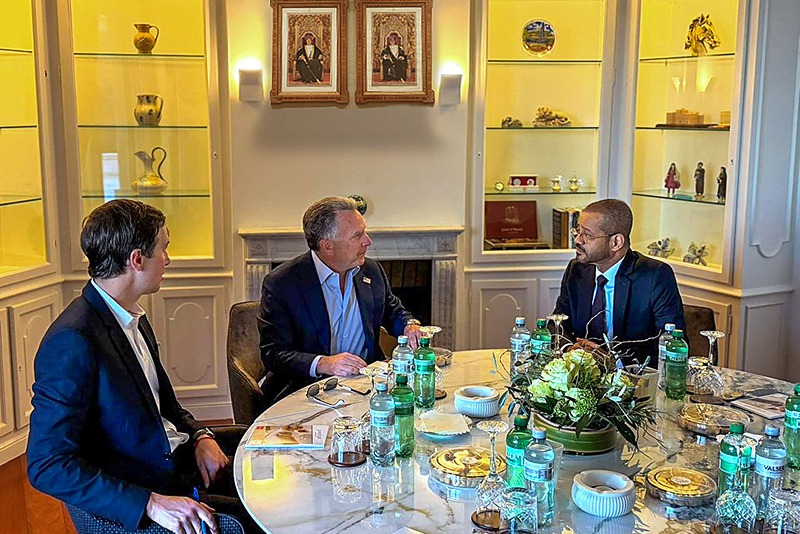
In this handout photo released by the Omani Ministry of Foreign Affairs on February 26, 2026, US special envoy Steve Witkoff (C) and Jared Kushner hold a meeting with Oman’s Foreign Minister Badr Albusaidi (R) in Geneva. (Photo by Omani Foreign Ministry / AFP via Getty Images)
OAN Staff Addie Davis 1:14 PM – Wednesday, March 4, 2026
In a recent Fox News interview, the United States’ Special Envoy to the Middle East, Steve Witkoff, said that during early negotiations with Iran — conducted alongside Jared Kushner — Iranian negotiators asserted they had an “inalienable right” to enrich all their nuclear fuel.
“They had the ‘inalienable right’ to enrich all their nuclear fuel that they possessed,” Witkoff said on Monday during an interview with Sean Hannity. “We of course responded that the [U.S.] president feels we have the inalienable right to stop you, dead in your tracks,” he continued.
He further emphasized that Iranian negotiators claimed this as their “starting point.”
“Jared and I just sort of looked at ourselves, flummoxed, and said, ‘Well, we’re really in for it now,’” Witkoff said.
Both Witkoff and Kushner, President Donald Trump’s son-in-law, recently spent three days in Geneva conducting negotiations to determine if Iran was truly committed to meeting the administration’s core objectives.
According to Witkoff, these goals included the total elimination of Iran’s missile program, the cessation of support for regional proxies, the abolition of their navy, and an end to all uranium enrichment.
To incentivize the transition, the U.S. even reportedly proposed a deal in which it would cover Iran’s nuclear fuel costs for the next ten years, provided the regime completely abandoned its own enrichment capabilities.
“They rejected that, which told us at that very moment, that they had no notion of doing anything other than retaining enrichment for the purpose of weaponizing,” he continued.
Witkoff noted that during the initial session, the Iranian negotiators showed “no shame” as they openly asserted the extent and capabilities of their current nuclear stockpile.
“They controlled 460 kilograms of 60% [enriched uranium] and they’re aware that could make 11 nuclear bombs, and that was the beginning of their negotiating stance,” Witkoff said, describing them as proud to have evaded oversight to achieve this.
He also explained that Iran manufactures its own centrifuges to enrich uranium, having roughly “10,000 kilograms of fissionable material,” of which 1,000 are enriched to 20%.
“There’s almost no stopping them. They have an endless supply of it,” Witkoff said.
According to reports from The Conversation and the IAEA, the technical hurdle in uranium enrichment lies primarily in reaching the initial 20% threshold, as most commercial reactors operate on fuel enriched to less than 5%.
Once uranium reaches 60% enrichment, the transition to 90% — or weapons-grade — is significantly easier, potentially taking as little as a week to ten days. Even 20% enriched material can be brought to weapons-grade within three to four weeks.
Against this backdrop of rapid breakout timelines, Witkoff described the final meeting in Geneva as a last “college try” to secure a meaningful deal.
“It was very, very clear that it was going to be impossible, probably by the end of the second meeting, but we then went back for the third meeting just to give it the last ‘college try,’” Witkoff added.
A plume of smoke rises after a strike on the Iranian capital Tehran, on March 3, 2026. (Photo by ATTA KENARE / AFP via Getty Images)
According to White House Press Secretary Karoline Leavitt, Operation Epic Fury has already resulted in strikes against more than 2,000 targets.
The administration confirmed that at least 49 high-ranking regime officials have been killed so far, including Supreme Leader Ali Khamenei, as U.S. and Israeli forces continue their campaign to dismantle Iran’s command structure.
Stay informed! Receive breaking news blasts directly to your inbox for free. Subscribe here. https://www.oann.com/alerts
What do YOU think? Click here to jump to the comments!