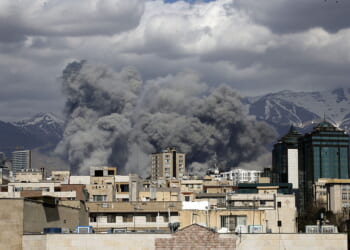
The Senate failed to pass a resolution on Wednesday, March 4, to rein in President Donald Trump’s efforts against the Iranian regime. In a 47 to 53 vote, the upper chamber backed the commander-in-chief with support largely along party lines. The House of Representatives will hold a similar vote today, March 5, which is expected to follow the same path. But does this mean that the prospect of another “forever war” is on the table? And does the president face any restrictions going forward?
At issue is whether the president can engage in military action without the approval of Congress. While it is clear that direct retaliation falls under executive authority, critics maintain that anything beyond this limited scope lies in the hands of the 535 men and women who make up the legislative branch of government.
Getting Constitutional
Article 1, Section 8 of the US Constitution states (in part) that Congress shall have the power to “declare War, grant Letters of Marque and Reprisal, and make Rules concerning Captures on Land and Water.” Fairly straightforward, right? Not so fast. America has a long and varied history of initiating conflicts at the behest of the Executive Branch without the congressional nod.
President Harry Truman sent forces to Korea; President Ronald Reagan started foreign adventures in Lebanon and Libya; President Barack Obama ordered major strikes against Libya (again), with the express intention of fomenting regime change. None of these had a congressional declaration of war. In fact, only five conflicts have had such authorization: the War of 1812, the Mexican-American War, the Spanish-American War, World War I, and World War II. The observant reader will note that a lot more US-involved wars have slipped through that particular net.
The turning point for Congress came in 1973 with serious questions about President Richard Nixon’s prosecution of the war in Vietnam. Nixon tried to veto limits on his authority, but a two-thirds majority in both chambers made the War Powers Resolution the law of the land.
In essence, the Resolution (often called the War Powers Act) has three basic requirements:
- The president must inform Congress within 48 hours of the beginning of hostilities.
- Hostilities can continue beyond a 60-day window only with congressional approval (plus a 30-day extension).
- The president must routinely update Congress.
Which brings us to today. Are critics of Trump justified? Or are they protesting for partisan reasons?
War Powers in Iran
The clamorous refrain is that Trump’s actions in Iran are both “illegal” and “unconstitutional,” accusations that echo through the legacy media and just about all left-leaning news shows. If such claims are true, then the same must have been true for Presidents Obama, George Bush (the younger), Bill Clinton, and Reagan. Each began military actions without prior approval from Congress, and the majority claimed that such permission was not even necessary – or argued that, because military funding was provided through Congress, it was tacit permission.
Consistency in a position is a rare quality in general; in Congress, it appears rarer still.
Senate Majority Whip John Barrasso (R-WY) hinted that there was an element of fatigue associated with the vote, pointing out that this was the fifth effort in the last year by Senator Tim Kaine (D-VA) to rein in Trump’s war powers. “These resolutions have been used only 11 times in 50 years. … The senator from Virginia alone accounts for nearly half of them. Yet Senator Kaine introduced zero war powers resolutions when Barack Obama and Joe Biden were president,” he said.
The upcoming House efforts seek to force the president to cease action against Iran and the Iranian government, with slightly different methods from those tried in the Senate. The lower chamber resolution states:
“Pursuant to section 5(c) of the War Powers Resolution … Congress hereby directs the President to terminate the use of United States Armed Forces from hostilities against the Islamic Republic of Iran or any part of its government or military, unless explicitly authorized by a declaration of war or specific authorization for use of military force against Iran.”
Again, this looks set to fail. After all, the executive must have the power to act – in some instances – unilaterally. Trump’s predecessors were certainly dragged over congressional coals, and yet they were permitted, by law, to operate for a select period of time. Court cases were brought and then dismissed as each president in turn complied with the War Powers Resolution.
Both chambers would do well to remember the adage “Marry in haste, repent at leisure.” When Congress took on Nixon in 1973, the members could muster more than two-thirds to override the executive’s veto. It was a truly bipartisan movement that recognized a president’s authority to deal swiftly with perceived threats and to set limits on that power. Today, it is clear that Congress has no appetite for halting the Iran operation in its early stages, and a number of members have pointed out just how dangerous it might be to stop – images of the botched Afghanistan withdrawal spring to mind. The Senate vote and upcoming House vote are either pro forma or performative, but for the president, the clock is ticking, and he had better start looking for an exit strategy.
Dig Deeper Into the Themes Discussed in This Article!
Liberty Vault: The Constitution of the United States