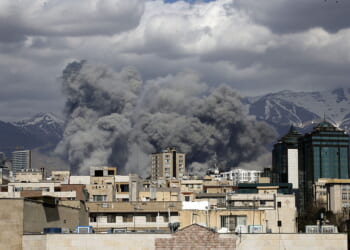
Before the first missile was fired at Iran, energy markets began pricing in a Middle East conflict. When the futures market reopened on the evening of March 1, US crude oil prices rocketed 8% to above $72 a barrel. As Wall Street returned from the eventful weekend, analysts warned that a barrel of West Texas Intermediate or Brent could flirt with $100. By midweek, this appears unlikely.
Energy Dominance
Twenty years ago, the United States had been heavily reliant on the Middle East for its daily energy needs. Today, conditions are vastly different. Or, as economist Stephen Moore recently wrote, “Thank God for ‘Drill, Baby, Drill!’”
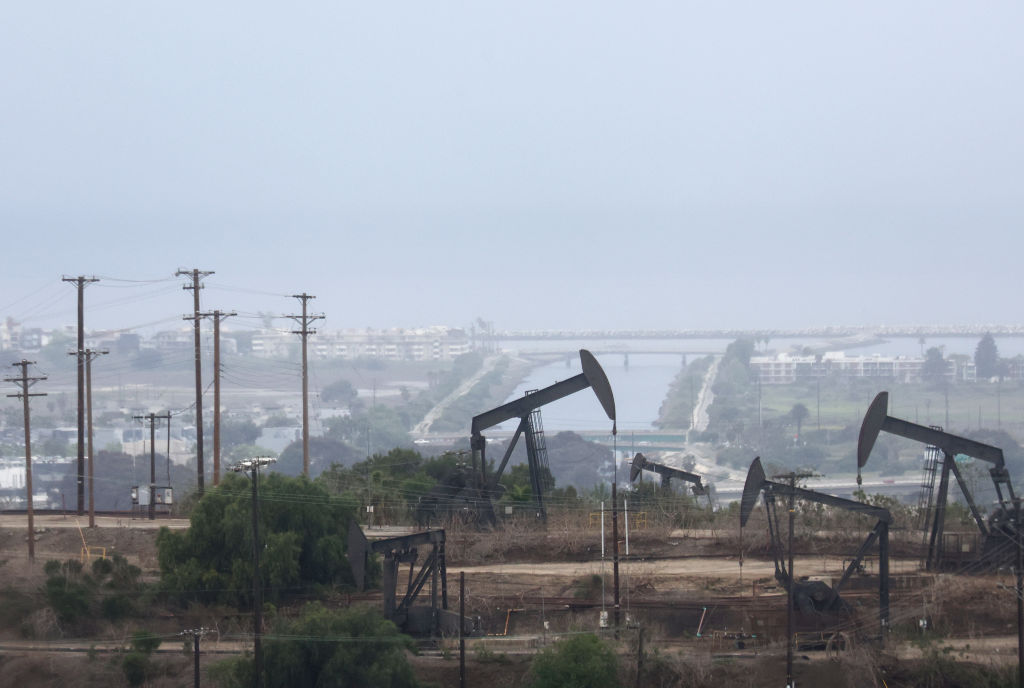
The United States produces nearly 14 million barrels of crude oil per day. In fact, the country is producing so much of the good stuff that it exceeds the combined output of Russia and Saudi Arabia. When you factor in liquid fuels, the US daily output is around 24 million barrels.
America’s natural gas story in the 21st century has been remarkable. Though some hiccups have occurred along the way – mainly in the form of regulatory hurdles and environmental roadblocks – domestic production of the so-called bridge fuel exceeds 100 billion cubic feet per day, surpassing that of China, Iran, and Russia combined.
Massive production has happened even as energy costs have trended lower.
What’s more is that the United States has billions of barrels of oil sitting in its backyard following the ousting of former Venezuelan President Nicolás Maduro. And if it needs a cushion, the energy net exporter can ask Canada for a few million barrels. Ultimately, this is no longer the 1970s – America’s energy security is not a delicate rosebud that needs to be handled with care.
$100 Oil
By now, it is evident that any spike in oil prices is primarily driven by geopolitical tensions rather than economic fundamentals. Last year, even though black gold tanked 22%, there were periods of spikes fueled by conflict in Iran and the wider region. For investors, it is not so much about production as it is about transportation.

Tehran is a marginal producer, with output averaging around three million barrels per day. Most of this production is directed toward Asia, mainly China, of course. So, if Iran were eviscerated, its impact on international supply would be minimal. The primary factor is the Strait of Hormuz, a narrow waterway located between Iran and Oman. It sees nearly 20 million barrels per day of oil and petroleum products, as well as a large chunk of liquefied natural gas.
In the initial aftermath of the joint US-Israeli Operation Epic Fury, there were mixed reports that Iran had shuttered the crucial chokepoint, much to the chagrin of Beijing. The reality is that the regime did not need to close the door. The market had already done it for the Islamic country.
Traffic had been slowing down as the war approached. In recent days, the movement of commercial oil and gas tankers and other cargo ships has plummeted. Industry data suggest there has been only one energy shipment in the strait over the last several days. While companies did not want to risk their employees’ safety, the bigger factor was that insurance companies either canceled coverage or drastically raised their premiums.
As a result, the White House announced that it would offer guaranteed political risk insurance and may provide naval security. Treasury Secretary Scott Bessent teased that other options would be unveiled soon. This helped stabilize energy markets, sending prices lower on March 4 for the first time since operations began.
Speaking to reporters alongside German Chancellor Friedrich Merz, President Donald Trump expressed his confidence that prices will come down: “As soon as this ends, those prices are going to drop, I believe, lower than even before.”
Military assistance and government intervention during the upheaval in the Middle East are added insurance to ensure Texas tea does not tango with $100.
Blowback
Will the intervention in Iran backfire in the coming decades? It has before. In 1953, the United States and the UK overthrew Mohammad Mosaddegh and installed Mohammad Reza Shah Pahlavi. The reason was to protect their oil interests after Mosaddegh had nationalized the nation’s energy sector. Twenty-six years later, the Islamic Revolution occurred, ousting the shah and ushering in today’s oppressive Islamic Republic.
In the era of perpetual intervention in foreign countries’ domestic affairs, the blowback principle has reared its ugly head repeatedly, whether arming the mujahideen in Afghanistan during the 1980s or overthrowing Muammar Gaddafi in Libya more than a decade ago. Indeed, American energy independence is critical when maintaining an interventionist foreign policy.