Any young boy who loved baseball and daydreamed of World Series greatness would have at one point imagined himself walking up to the plate to the cheers of the home crowd in the bottom of the ninth inning, game seven of the World Series. Your team needs one run to win the game and the series to make history.
The crowd’s abuzz, apprehensive that you won’t get it done, but on the edge of their seats, ready to go nuts if you do.
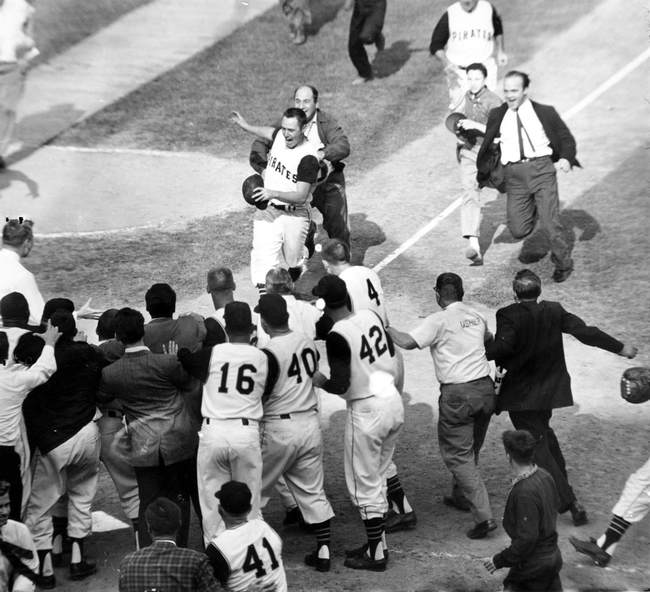
In real life, such a feat only happened once. In 150 years of Major League Baseball, and in 148 World Series matchups, only one time did a player end the league’s season with a walk-off home run in the bottom of the ninth to win the series. That day was Oct. 13, 1960, and the player to do it was Pittsburgh Pirate second-baseman Bill Mazeroski, who died Feb. 20 of this year at the age of 89.
Bill Mazeroski, who beat the Yankees in Game 7 of the 1960 World Series, died at the age of 89. https://t.co/7tZ4IVQof9
— USA TODAY (@USATODAY) February 22, 2026
If you’re not a real baseball nut, or if you’re not from Pittsburgh, there’s a good chance you’ve never heard of Mazeroski, who is a Hall-of-Famer. There’s a reason for that. Like the town he played for his whole career, and where he lived for the rest of his life, he was as unassuming a man as you’ll find. He was humble and genuine. He never sought the spotlight, but the spotlight found him.
On that clear October afternoon at Forbes Field in the shadows of the University of Pittsburgh, Mazeroski was the first batter to lead off the ninth inning for the Pirates. The score was 9-9. No men on base, no outs. The New York Yankees put Ralph Terry on the mound.
Terry’s first pitch was a ball. Mazeroski elected not to swing. He would later say that he was looking for a fast ball on that second pitch, and that’s exactly what Terry threw. Right down the middle until Mazeroski slammed his Louisville Slugger into the meat of that ball, rocketing it 379 feet over the left field wall.
The packed crowd of 36,683 fans in Forbes Fields went crazy, with fans pouring onto the field before Mazeroski was even able to complete his tour of the bases, waving his batting helmet in his hand, touching home into the embrace of his teammates and baseball lore.
To comprehend a fraction of what this must have felt like, John Fogerty captured the essence of it in his song Centerfield when he wrote about an anonymous baseball great through the eyes of a boy on the sandlot:
We’re born again, there’s new grass on the field,
A-roundin’ third and headed for home,
It’s a brown-eyed handsome man,
Anyone can understand the way I feel.
You have to remember that in 1960, baseball was America’s game. Football had not yet replaced it in the culture as the preeminent national sport. Roughly 40 million were watching the game on television. Throughout Pittsburgh and the rest of the country, millions more were listening on the radio. During the game, nothing else was happening in Pittsburgh. Those who weren’t watching but instead listening – which constituted the majority of Pittsburghers – heard the call of that final home run and filled the streets with a spontaneous celebration the city had never before seen.
Steelworkers, cab drivers, kids in schools, and people in offices stopped what they were doing to do nothing else but celebrate that iconic moment together.
10-time All-Star, 8-time Gold Glover, 2-time World Series champion, Hall of Famer.
MLB Network mourns the passing of Pirates legend Bill Mazeroski. pic.twitter.com/cFs9Ls2vQt
— MLB Network (@MLBNetwork) February 22, 2026
Mazeroski became an instant hero, and an unlikely one at that. He was best known as a solid fielder at second base. He only averaged about 10 home runs a year. That home run thrust him into the spotlight more than anyone else, even though that 1960 Pirates roster also included another member of the Hall of Fame, Roberto Clemente.
This kid was too young to watch or remember that game, but it wasn’t long before he was tearing up his blue jeans, imitating everything Mazeroski did on the field. We lived close enough to Forbes Field for my cousins and me to take a short streetcar ride to the ballpark, which we did quite often, even if we didn’t have tickets.
They played a lot of day games in those days, and if you were a bit of a street urchin, which we were, you could try to finagle a ticket from someone who had an extra one. Or, you could just hang out on the other side of the outfield wall during batting practice and chase fly balls as they crossed the wall and ricocheted under cars in the parking lot.
For us, it was enough just to be around it all, just to be in that game-day atmosphere. Mazeroski was and is my favorite player of all time. As an adult, I met him a couple of times, one of which was standing in line at an Italian grocery store not far from where he lived. I turned around, and there he was. We exchanged some pleasantries and did what people do in check-out lines, mostly minded our own business.
Mazeroski wasn’t the type of person to look to make money off of his name through advertising and sponsorships the way players sometimes do. I’m sure he did some advertising at some point, and I know he was a frequent player at charity golf outings, but he never traded on his own name as he could have.
He played 17 seasons for the Pirates, won eight Golden Glove awards, and was sent to the All-Star game seven times. He retired from baseball at the age of 36 in 1972 after winning a second World Series with the ball club in 1971. He remained close to the fans and the team for the rest of his life, frequently showing up at spring training in Bradenton, Fla.
Bill Mazeroski working with Neil Walker at 2B back in the day pic.twitter.com/8ICCQ4qMRH
— Platinum Key (@PlatinumKey13) February 22, 2026
His home was not all that far from another more famous and equally unassuming sports legend, Arnold Palmer. These were men who let their play define them and usually speak for them. They never lost sight of who they were and where they came from.
Pittsburgh has had its share of sports legends, but Mazeroski was unique, both in terms of what he accomplished and how he carried himself afterward and for the rest of his life. He was an everyman and appreciated the opportunities given to him and the people who cheered for him.
Spring training is underway in places like Florida and Arizona, and the grass is greening up on those baseball diamonds. As Fogerty would say, “The sun came out today, we’re born again, there’s new grass on the field.”
And it’s all got me thinking about that one man who, one time in the history of the game, did that most ‘baseball’ of things.
Exclusively for our VIPs: ‘America 250’ Tuesday: At 15 and 78, Respectively, They Fought for Freedom
Find out what you’re missing behind the members-only wall. It’s time for you to take advantage of the full catalogue of common-sense thinking that comes with a PJ Media VIP membership. You’ll get access to content you didn’t even know you wanted, and you’ll be hooked. The good news is, PJ Media VIP memberships are on sale! Use promo code FIGHT to get 60% off an annual VIP, VIP Gold, or VIP Platinum membership!