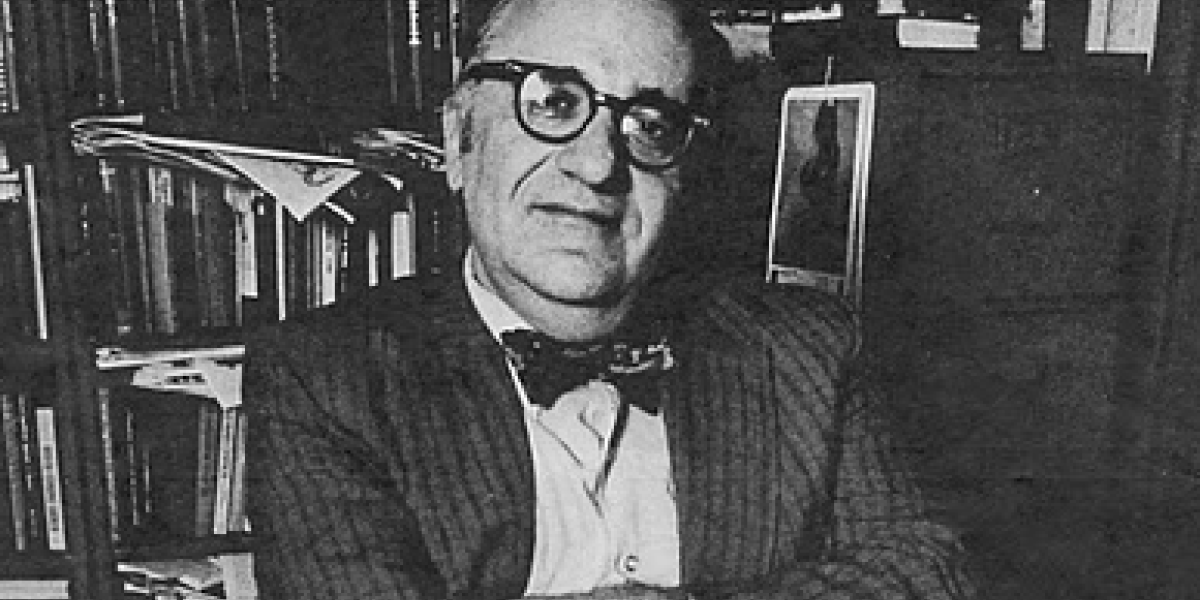
March 2 would have been Murray Rothbard’s 100th birthday, so it is only fitting that I devote this week’s column to my great friend and mentor. I have often written about his life, but this time I would like to describe him as I found him in our many conversations, both in person and over the telephone.
One of the greatest joys of my life was listening to Murray Rothbard. A conversation with him might take you anywhere. The last time I spoke to him, about a week before he died, he talked about a problem in Schumpeter’s economic theory, a recent book on Jewish theology, the fallacies in a philosophical defense of backwards causation, the O.J. Simpson case, and Hegel’s relation to the tradition of German mysticism.
On every topic, he had illuminating things to say, all delivered in his rapid voice, accompanied by that unmistakable laugh. Murray could grasp the essentials of an argument as fast as anyone I have ever met and at once bring to bear on whatever the point at issue his immense learning. On one occasion I had to give a joint seminar with him at the Ludwig von Mises University summer program. He had just read an article by Milton Friedman, highly critical of Mises, which he viewed with less than complete enthusiasm. He proposed to devote the seminar to an analysis of the article and—with barely a pause for breath—demolished each paragraph of the piece. Another year, he began his seminar with a brilliant hour-long discussion of political power that ranged from Lao-tse through Hobbes and Locke to the public choice school.
His immense knowledge of many different fields was unsurpassed in my experience. In a lecture on the Austrian theory of the business cycle, he mentioned the common objection that the expansion of bank credit might have no effect, if investors anticipated trouble. After the lecture, I asked whether Mises had answered this point. He said, “See his response to Lachmann in Economica, 1943.” I often went to used bookstores with him, in both Palo Alto and Manhattan, and listened to him as he commented on nearly every book on the shelves. When he was a student at Columbia, he admired the philosopher Ernest Nagel, who he said would always encourage students to do new work. Murray was like this himself. He constantly encouraged students to work on Austrian and libertarian topics.
His immense knowledge extended far beyond academic topics. He not only followed presidential campaigns, but he had a detailed knowledge of congressional races as well. He could take any congressional district in the United States and tell you who was running and what the main issues in the district were.
The Libertarian Party, in which he was an active force for a number of years, attracted many odd characters, and of course Murray had detailed information about nearly all of them. He would often regale his friends with hilarious stories about their adventures. In this he was joined by his wife Joey, who shared his interest in what everybody was doing. During the 1979 LP convention at the Bonaventure Hotel in Los Angeles, he gave a talk at a local libertarian supper club. Joey said to me about the leader of the club, “Do you know what she paid Murray for the talk? Zip!”
Naturally enough, Rothbard had strong likes and dislikes. He loathed Bill Clinton, and Joey told me that when he was watching Clinton speak on television, she had to restrain him from rushing to the TV set and kicking in the screen. Murray and Robert Nozick really didn’t like each other much. It was much more that Nozick didn’t like Murray than the other way around. I always had to bear in mind when I was talking to Murray about Nozick, whom I was dazzled by, that he didn’t like Nozick very much. Ralph Raico and Bruce Goldberg brought Nozick to Murray’s apartment, and at first, they got along well, but when Murray mentioned his view that you can’t measure interpersonal utility, Nozick dismissed his remarks with a laugh. A less esoteric issue on which they differed was the Middle East. Nozick was very pro-Israel and Rothbard was very much the other way. They also had some differences on particular candidates in the Libertarian Party, tending to support different people. Murray was very involved in Libertarian Party politics, and he would be very upset with people who supported a different group from the one that he wanted and kept arguing about the matter with him.
He would insist on what he believed was right, but I think the thing that’s sometimes overlooked is that the people who opposed him tended to be very insistent on what they thought and they kept arguing with him and wanted to insist on what they thought. It was only if they kept after him that he would eventually lose his temper. I remember there was one case where George Smith and Wendy McElroy—who were very prominent libertarians in Los Angeles circles—were supporters of non-violent resistance to the state and for that reason they became very interested in the thought of Mahatma Gandhi and wrote about him. Rothbard had some very negative comments on Gandhi, for example, that during World War I he had given recruiting speeches in India for the British Army, not what you would have expected from a supposed pacifist. After Murray’s attack on Gandhi, Wendy McElroy wrote a reply defending Gandhi and Murray was perfectly alright with that. But then George Smith wrote another very much sharper criticism of Rothbard, and Rothbard got very upset. Joey had to ask me not to read passages from George’s article when I was on the phone with him.
Murray Rothbard was a man of unique energy and passion, combining intellectual genius with a passion for liberty. I wish that all my readers could have met him.