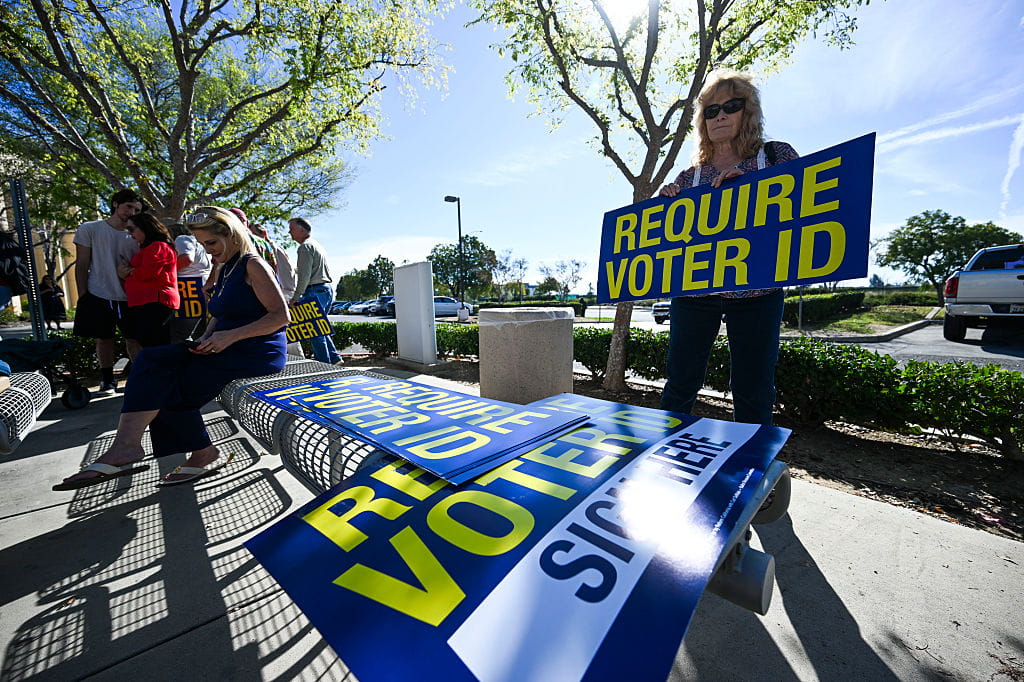
On the national stage, the SAVE America Act dominates the news when it comes to voting rights. Competing narratives battle it out in Congress and across the media, with one side arguing election integrity must be protected by requiring voter ID and proof of US citizenship and the other either calling for a vote for every voice regardless of citizenship, saying voter ID requirements are sexist and racist, or both. And the battle is heating up. But a deeper look into the opinions of regular people from across the political spectrum reveals the battle lines aren’t that clear. As well, the SAVE America Act isn’t the only game in town. What’s happening at the state level might surprise you.
From the Gulf Coast to the Swamp
Down in the Lone Star State, four-term incumbent Senator John Cornyn is fighting for his congressional career against a strong primary challenger for his US Senate seat, Texas Attorney General Ken Paxton. President Donald Trump has yet to officially endorse either, but has asked that whoever doesn’t get his endorsement withdraw from the race. Paxton told Just the News, “I’m staying in this race,” and that reportedly has the president a bit upset.

But on Thursday, March 5, the Texas AG made the Senate GOP an offer: Bring the SAVE America Act to a vote, suspend the filibuster, and pass the bill, and he’ll drop out of the race. “The Save America Act is the most important bill the U.S. Senate could ever pass, and I’m committed to helping President Trump get it done,” Paxton posted on X.
His willingness to sacrifice his own political advancement – and Texas AG to US senator is a pretty big jump – shows his real dedication to the cause. Will that affect the president’s decision? It certainly has made an impression on Trump’s son, Don Jr.
“Wow!! Total commitment to one of the most important pieces of legislation to save Our Republic,” Trump Jr. wrote Friday, March 6, in an online response. “Pass the Save America Act now!!!!”
And All the Way Over to the Golden Coast
The national story is sensational, of course, but it’s far from the only high-stakes battle. Despite California Governor Gavin Newsom’s lament that requiring proof of citizenship to register to vote – something he had to show in order to run for governor – is hard because he doesn’t know where his birth certificate is, there’s a growing movement in the Golden State to require voter ID and bar non-citizens from voting, even in state and local elections.
A petition to require voter ID and citizen-only voting in California has reportedly surpassed the 875,000-signature threshold to qualify for the November ballot. According to the political activism group Reform California, organizers submitted the “California Voter ID Initiative” petition with 1.3 million signatures. The measure received bipartisan support, they claim, with signatures from folks across the political and demographic spectrums in all 58 of the state’s counties.
If this is passed as a ballot issue, it would overrule any law passed by the Democrat-controlled supermajority in the state legislature by amending the California Constitution to require voter ID when casting a ballot and for the state to maintain accurate voter rolls and verify the citizenship of all registered voters.
Democrats have just enough power in the US Senate to block the SAVE America Act without Republicans killing the filibuster, and they hold far more sway in the Golden State legislature, making any such state bill effectively dead on arrival. But if the people change the constitution, there’s nothing progressive lawmakers can do about it. So, at least in California, the question becomes: Just how broad is the support for voter ID, really? Reform California is confident the measure can pass in November, citing local polls showing that 71% of Californians favor voter ID.
Voter ID – The Partisan Breakdown
Just a few days ago, on Tuesday, March 3, the White House announced yet another poll showing “massive support for SAVE America Act.” This survey asked a clear question:
Do you support or oppose the proposed SAVE America Act that would:
- Require proof of citizenship to register to vote
- Require voter ID
- Require states to remove non-citizens from their voting rolls
- Require states to share unredacted voting rolls with the Department of Homeland Security
According to the White House announcement, the results are 71% in support to 29% opposed. The partisan breakdown is a 50/50 split between Democrats, 91% for to 9% against for Republicans, and 69% for to 31% against for independents/others.
The almost unanimous support from the GOP is far less surprising – or, for that matter, significant – than the fact that half of all polled Democrats and almost 70% of everyone else back it as well. Often in such politically divisive issues, one would expect to see one of the major parties all in or close to it, while the other is at least almost entirely opposed. In those situations, the independent/other component is the most significant.
For 50% of Democrats to back any measure called for by 91% of Republicans is significant. That such a broadly supported measure still isn’t law is remarkable. But how does that hold up under scrutiny? According to the Pew Research Center, 83% of Americans favor voter ID requirements, including 70% of Democrats and 75% or more of white, black, or Latino Americans. Gallup’s poll on the issue shows 84% support comprised of 98% of the Republicans polled, 84% of independents, and 67% of Democrats. Rassmussen has tracked an increase in support for voter ID over the last decade or so, culminating in 75% support across the board. The partisan and demographic breakdown was as follows: 51% of Democrats, 78% of Republicans, 67% of unaffiliated voters, 74% of whites, 69% of blacks, and 82% of “other minorities.”
In the court of public opinion, voter ID clearly wins – and that’s backed up by a look at the states, as well. At present, the GOP controls both chambers of 28 state legislatures compared to just 18 for Democrats (with the other four being split). There are 26 states with Republican governors compared to 24 headed by Democrats. And, finally, 23 states are led by Republican trifectas – the governor and majorities in both chambers of the legislature – compared to 16 Democrat trifectas and 11 split governments.
Now with all that data in mind, consider the fact that voter ID is already required in 36 states. That’s 13 more than the number of Republican trifectas, ten more than the number of Republican governors, and eight more than states with GOP-controlled legislatures. The loudest voices on the left – including the biased establishment media – paint this as a partisan issue and a cause of the, as they see it, far-right, racist, and sexist MAGA crowd. But from public polling to actual politics and established law, the data simply doesn’t support that. Clearly, there’s something to this idea that appeals to Americans of all political stripes – well, almost all, anyway.