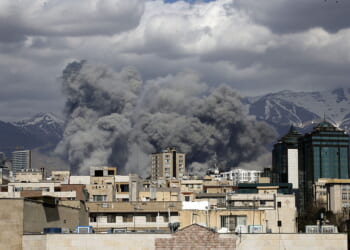
The war launched by the United States and Israel against the Islamic Republic of Iran raises serious questions about sovereignty – above all, the tension between respect for state sovereignty and the regrettable fact that states will sometimes decide they have no alternative but to violate it by force. But the more pressing question for us is closer to home – what does this conflict reveal about British sovereignty, and our government’s ability to act in the national interest?
There are those who habitually claim that the UK is simply in thrall to the US. They claim that British governments have been all too willing to follow Washington’s line, an approach that led to Britain’s involvement in the disastrous war in Iraq in the mid-2000s. And there are others who now take the opposite view. They claim that Britain has become increasingly hostile to the US, and especially to Israel. They argue that UK prime minister Keir Starmer’s fear of upsetting the Muslim vote in Labour’s former heartlands is now feeding into an anti-Israel, anti-US foreign policy.
Both arguments contain elements of truth. But the reality is at once more banal and more alarming. Britain has not surrendered its national interest either to Washington or to an Islamist veto. The deeper problem is that Britain no longer has an articulated national interest at all. Our political class has simply allowed sovereignty to drain away amid confusion, evasion and institutional decay. Britain is governed by a domestic elite that is increasingly detached, incapable and, in many cases, quietly hostile to the idea of national interest itself.
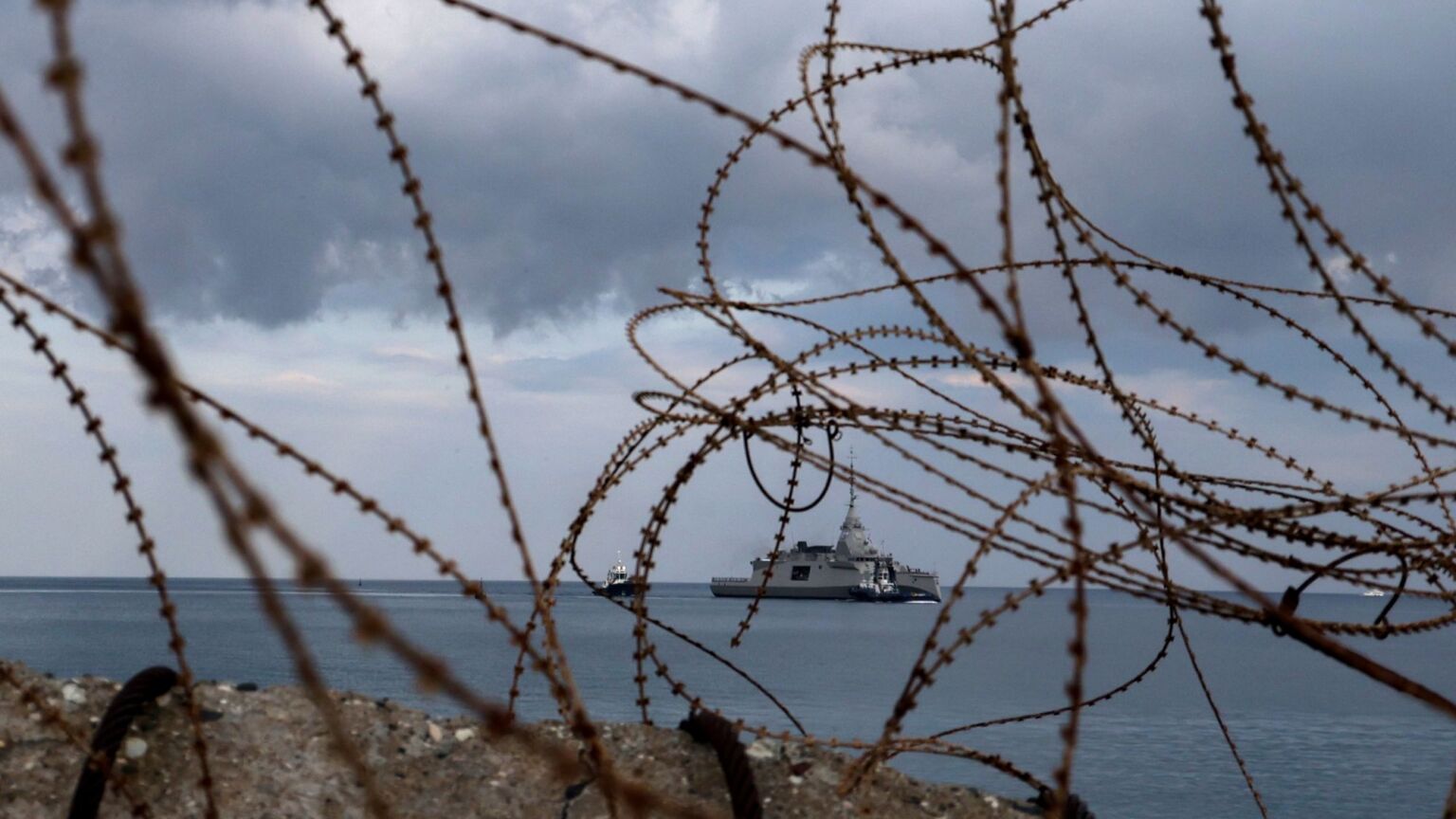
The response to the Iran-Hezbollah drone attack on Britain’s Royal Air Force Base in Cyprus earlier this month has been revealing. For the first time since 1980, Britain had no warships in the eastern Mediterranean or the Gulf. Air defences were effectively absent. The UK’s main carrier strike group was still en route to Greenland. Britain ended up having to rely on Greece and France to help secure its own military base. That is not evidence of foreign capture. It is evidence of institutional incompetence.
An even starker example was provided by the Foreign Office in August 2021, as Kabul fell to the Taliban. In a Times comment piece published last week, former civil servant Ameer Kotecha reveals how, amid British forces’ calamitous withdrawal from Afghanistan, Foreign Office staff were invited to mark World Afro Day (‘a global day of celebration and liberation of Afro hair’) with a panel discussion. One of the participants was a director in charge of ‘matters of national security’.
Little seems to have changed over the past few years. Kotecha also revealed how, during the drone strike on Cyprus, the Foreign Office’s internal intranet reportedly led not with the unfolding international crisis, but with prompts encouraging staff to ‘Take charge of your development’.
The details are absurd, but the pattern is familiar. The Foreign Office is of a piece with the rest of the civil service. Still working from home long after the pandemic ended, Foreign Office staff seem preoccupied with endless diversity strategies, corporate initiatives and de facto excuses for drift. Actual expertise in foreign languages and serious knowledge of Britain’s adversaries seems thin on the ground.
This is all indicative of a governing elite no longer capable of thinking in terms of the national interest. The first duty of the state, and of the officials who serve it, ought to be to put the country first. Yet today’s governing class appears to prioritise almost anything and everything else.
In the absence of any sense of the national interest, British foreign policymakers have filled the vacuum with the language of international law and human rights. It is no coincidence that this is the terrain on which Keir Starmer is most comfortable.
But talk of international law and human rights does not address the question of Britain’s national interest. It evades it. It allows our governing elites to avoid having to use their judgement and take responsibility for foreign-policy decisions.
The language of human rights and international law is also hopelessly elastic. It can be invoked to justify the Iraq War or to condemn Israel’s actions in Gaza. It can be used to support arming Ukraine, or to refuse to support the US in the war with Iran. Even Vladimir Putin speaks the dialect of human rights and international law when it suits him.
It is tempting to blame the decay of the national interest on the rise of human-rights lawyers like Starmer himself, or the influence of external actors, from the Chinese Communist Party to Islamic sectarians. But these are consequences, not causes.
The problem is that too few people in British public life are willing, or even able, to speak plainly about the sovereign national interest. That is why even the smallest signs of change matter. Starmer, dragged by the US-Israeli strikes on Iran into a harsher and more fragmented world, has at least begun to use the language of national interest – admittedly, he has so far used it less as a coherent doctrine and more as a cover for Britain’s hesitation over supporting the US. Still, the shift matters. It suggests that the old evasions of responsibility are becoming harder to sustain.
Britain does not yet have a fully worked-out doctrine of national interest for every arena of policy. That work remains to be done. But the fact a prime minister is speaking in those terms at all – asking what strengthens British sovereignty, what protects British citizens, what serves Britain as a nation – is already a necessary corrective. It is certainly a more honest basis for politics in a world increasingly shaped by hard power and competing national interests.
More than that, it answers a demand the British people have been making for years. The 2016 Brexit vote was not merely an instruction to leave the European Union. It was an insistence, however inarticulate, that the country should once again be governed in accordance with its own interests, by people willing to name them.
That remains the task. The job now is not to hide behind law, process or international pieties. It is to recover the habit of sovereignty – to decide, clearly and unapologetically, what serves Britain’s national interest, and then to act accordingly.
This is an edited version of a speech given at the Battle of Ideas North, on Saturday 7 March in Manchester. The session was ‘Iran, Greenland, Brexit Britain… does sovereignty still matter?’
Jacob Reynolds is a writer based in Brussels and London.