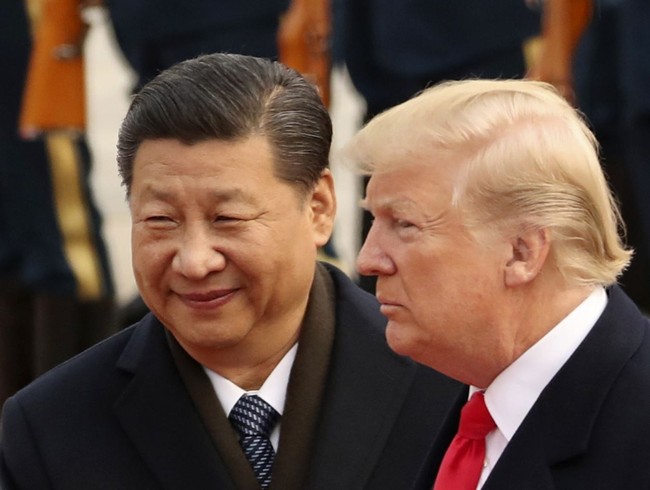
President Donald Trump and Chinese Communist party boss Xi Jinping meet later this month for the first official visit to Beijing by a United States president since Trump 45 visited there in 2017 — and Beijing already has some positive spin prepared.
While you can be sure there will be plenty of smiles for the camera — despite Beijing’s displeasure with Operations Absolute Resolve and Epic Fury — I’m less certain what Trump hopes to get out of the meeting — at least when it comes to his signature issue: trade.
Chinese Foreign Minister Wang Yi on Sunday praised previous “good interactions” between Trump and Xi that he said had created an “important strategic safeguard” for bilateral relations during what is admittedly a tense period between the two great powers.
He added that Beijing want 2026 to be “a landmark year of sound, steady and sustainable development of China-U.S. relations.”
Does not getting into a shooting war in the Pacific count? Because that would be nice.
While I’m kidding — I hope! — about the shooting war, it’s on trade where Beijing might make the promises that the White House wants to hear, but that the Chinese consumer simply can’t provide. In January, Trump sounded optimistic about getting broader market access to China, saying, “I think it’s going to happen,” and boasted of substantial investments and commitments from China to buy more American products.
Except that Chinese consumers aren’t exactly in a buying mood, and Chinese producers seem to be caught in a price-cutting battle for marketshare both at home and abroad.
China observer Mark Simon has a fascinating new Substack essay titled “Mr. President, We Need to Talk About China,” arguing that “We need someone in the Trump administration to walk into the Oval Office and give it to the President straight: China doesn’t have what the U.S. needs.”
“China is no longer the hyper-growth engine the world became addicted to. It is an economy struggling under the weight of its own bad bets, trying to export its way out of a domestic collapse.”
I’m always wary of predictions like “domestic collapse,” but Simon is spot-on that China is trying to export its way out of its current troubles. “China’s 2025 economy is split in two,” Sinopsis reported in February, with “booming exports and tech versus weak domestic demand.” The report continued: “Residents can still maintain basic ‘pleasure consumption,’ but a situation of consumption downgrading leading to price drops is evident.”
Emphasis added. China has been in a deflation trap for years, with one stimulus package after another failing to increase consumer demand. Beijing has since taken to dumping subsidized exports onto global markets — keeping Chinese factories humming (and otherwise restless workers working) while squashing foreign producers.
Chosun Daily summed up a bipartisan U.S.-China Economic and Security Review Commission report to Congress from late last year:
The report highlighted the issue of oversupply in manufacturing sectors such as steel, electric vehicles, petrochemicals, and textiles, which causes global price declines and inventory burdens, and dubbed this phenomenon “China Shock 2.0.” It stated that “as a result of technology theft, massive government subsidies, and aggressive industrial policies, large-scale production of high-value-added products has begun, shaking the manufacturing sectors of both developed and developing countries across the value chain.”
“Domestic demand is so weak that companies are locked in a race to the bottom,” as Simon put it. “Factories are pumping out record numbers of EVs and solar panels that nobody at home can afford, so they’re dumping them on global markets at fire-sale prices.”
Chinese trapped under Xi’s regime won’t or can’t even buy heavily subsidized goods — which hardly bodes well for whatever promises Xi might put to paper during his summit with Trump.
“The U.S. business community has taken note,” Simon added, “with recent surveys showing a record number of companies redirecting investment away from China as they no longer view it as a top growth destination.” American business executives increasingly accept a “cautious reality where slowing growth and regulatory uncertainty outweigh the promise of 1.4 billion customers.”
American executives know something that might have slipped by the White House. If that’s the case, Trump should give them a good hearing before making any deals with Xi.
Recommended: Does This Mahrouq Money Explain Thomas Massie?
Enjoying PJ Media?
Get exclusive content and support independent journalism with 60% off a PJ Media VIP membership. Use promo code FIGHT and join today.