There is good reason why the classical philosophers prioritized domestic affairs.
The specter of regime change is haunting the Trump coalition.
Enthusiasts and critics of the U.S./Israeli-Iran War are arguing over its justification, desirability, and feasibility (or lack thereof) based in part on whether or not it is a war aimed at regime change. The Trump Administration has thus far phrased its public rationales for the war in terms of degrading Iran’s military capacities, eliminating its nuclear program, and ending its support for proxy terror groups—with a view to encouraging and enabling rather than directly effecting regime change. Trump concluded his February 28 announcement of Operation Epic Fury by addressing the Iranian people: “When we are finished, take over your government. It will be yours to take.”
Meanwhile, Israeli Prime Minister Benjamin Netanyahu has been explicit for years, as well as in the opening days of Operation Roaring Lion, that regime change in Tehran is an Israeli goal. The Israeli Air Force seems to have taken the lead in the decapitation strikes against Iranian leadership, beginning with Ayatollah Khamenei, who was killed in the opening salvo of the war.
All of this should prompt a series of fundamental questions: What is a regime, and what constitutes regime change? Should regime change ever be a goal of American warmaking? Given our recent legacy of regime-change wars and nation-building failures in Afghanistan and Iraq, how should Americans reason about regime-change wars in the Trump era?
Back to the Basics
Regime is the central theme of classical political philosophy.
Aristotle speaks of the regime as the “way of life” of a political community. He adds that a regime is an arrangement of authoritative offices within a political community. The governing body (politeuma) is the regime (politeia)—for example, oligarchs constitute the oligarchy, the tyrant constitutes the tyranny. Other political phenomena such as laws, resolutions, and decisions are epiphenomena of the primary political phenomenon, the regime. The ruling class (those who compose the regime) makes, interprets, and executes the laws; crafts and promulgates resolutions; and deliberates and decides on war, peace, and other matters of state.
Far from being a mere technical arrangement of the machinery of government, with little to no connection to the kind of people who form and are formed by it—an unfortunate connotation that some might take from the translation “constitution”—a regime is perhaps that which most fully reveals the character of the community. Aristotle even claims that “whatever the authoritative element conceives to be honorable will necessarily be followed by the opinion of the other citizens.” The climate of opinion, and the scale of values, is established and perpetuated by those who rule.
One translator glosses Aristotle’s notion of regime as “the effective government or governing body of a city; the way of life of a city as reflected in the end pursued by the city as a whole and by those constituting its governing body.” Aristotle enumerates six basic regimes via quantitative and qualitative principles. The most authoritative office in a city might be held by the one, the few, or the many; and power might be exercised for a “correct” end—the common advantage of the whole political community—or in a “deviant” way—the advantage of a part: the ruling class, along with their friends and favorites, to the detriment of the community as a whole.
The fitness or unfitness of a particular regime for a particular community depends on a whole host of conditions and circumstances. One of the glories of classical political philosophy is its combination of a deep realism with a profound sense of the highest possible achievements.
For Aristotle, the best regime depends upon optimal conditions that human efforts cannot engineer. It is distinct from, and provides a standard for, the best regime under most conditions, which in turn is distinct from the best regime given a particular set of conditions. The blessings of a reasonably virtuous population, a large middle class, and geographic conditions favorable to prosperity and security—the propitious preconditions for founding and perpetuating a just and moderate republic—are vanishingly rare. From the classical perspective, inferior conditions impose a low ceiling on what a less fortunate community should hope to achieve. Only a fool would expect abundant growth in poor soil.
Making Distinctions
What does all of this tell us about regime-change wars?
Here we must make a distinction. In common parlance and philosophical analysis alike, “regime” can refer to several things:
(1) Most narrowly, the one person at the top (Aristotle’s politikos). Hence we refer to the “Saddam Hussein regime” or the “Trump Administration,” recognizing that regime decapitation—the loss of the head or highest officer—would change the character of the whole system.
(2) More broadly, all the members of the ruling class, the elite, or the administration (Aristotle’s politeuma). Whatever the structure of government, and whoever is at the top, a great many individuals are involved in running any large state or complex organization. As the saying goes, “Personnel is policy.”
(3) Most fundamentally, the form of government, or “regime” in the comprehensive sense used by classical political philosophy (Aristotle’s politeia).
Each usage is valid and is related to the others. For better or for worse, the United States has waged regime-change wars in all three senses.
The Bush Administration waged war for a fundamental regime change (Type 3) in Iraq, seeking to alter the entire form of government by instituting a constitutional democracy. Because its goal was the most holistic sort of change, it entailed the narrowest form of regime change (Type 1)—toppling Saddam Hussein—as well as the intermediary form: purging all members of the previous regime’s ruling class (Type 2). Whether de-Ba’athification was wise or not, it was a plausible means to the overly ambitious end being pursued: instituting a wholly new form of government. The abject failure of nation-building in Iraq and Afghanistan during the 2000s–2010s is the main cause of American skepticism toward anything that might resemble a regime-change war in the 2020s.
Nevertheless, many Americans recall a happier example of full-spectrum regime change in the occupation of Germany after World War II. Hitler was dead (Type 1), the Allies pursued de-Nazification (Type 2), and we cultivated a liberal constitution for the Federal Republic of (West) Germany (Type 3). However, the success of such an ambitious project is inconceivable without victory in a total war, followed by formal occupation, hundreds of billions of dollars in investment, and an ongoing military presence that has recently entered its ninth decade—in other words, very different conditions than those in the invasion and occupation of Iraq.
World War II still dominates the moral-political imagination of many older Americans. What (dwindling) support exists for wars explicitly aimed at full-spectrum regime change likely owes a great deal to this persistence. The example of postwar Germany suggests that a full-spectrum regime-change war necessarily requires an open-ended commitment to nation-building.
But the more modest form of regime change pursued, the more plausibly it might be accomplished without requiring a full nation-building project. Donald Trump has spent the opening months of 2026 testing this possibility.
Taking Down “Super Bigote”
In Operation Absolute Resolve in Venezuela, the Trump Administration executed a “decapitation,” that is, a regime change in the narrowest possible sense. Black-bagging President Nicolás Maduro and his wife Cilia Flores in the middle of the night is an almost comically straightforward instance of a Type 1 regime change. Trump’s decision to cooperate with Vice President Delcy Rodríguez (and snub opposition leader María Corina Machado) was an attempt to avoid Type 2 regime change. By leaving most members of Maduro’s administration, as well as the Venezuelan ruling class more broadly, in place, the administration has attempted to steer well clear of a Type 3 regime change, in which the whole form of government is altered. As a result, it has drastically reduced the likelihood of the U.S. being drawn into the kind of nation-building project that haunted us in Afghanistan and Iraq.
As noted above, the three senses of regime are interrelated, and all three matter, both for the domestic population and for foreign relations. But the one guy at the top matters far more for foreign relations than the form of government. Replacing Maduro will matter for the Venezuelan people, but not nearly as much as a full purge of the Chavistas would, or as much as instituting a new form of government. Trump, however, understands the Venezuelan people’s interests as secondary to our own: the American president is charged with securing the common good of his own country.
Trump’s hope in removing Maduro, while allowing Rodríguez to replace him and then pressuring her and all others who remain in positions of authority to concede to his demands, seems calculated to achieve maximal results for American interests while incurring minimal risk. The jury remains out on the wisdom of this strategy. But the Venezuela strike seems to reflect a realistic, classically grounded approach to the limitations of the U.S.’s ability to reorder the domestic affairs of a foreign nation.
War in Iran
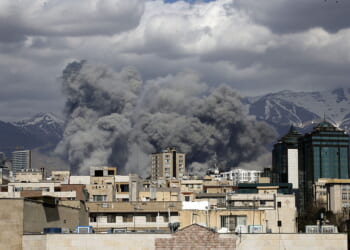
The current war on Iran immediately achieved a Type 1 regime change in the decapitation strike that killed Ayatollah Khamenei and most of the Iranian regime’s top political and military leadership. But it remains to be seen just how far the U.S. and Israel will go to achieve a Type 2 regime change.
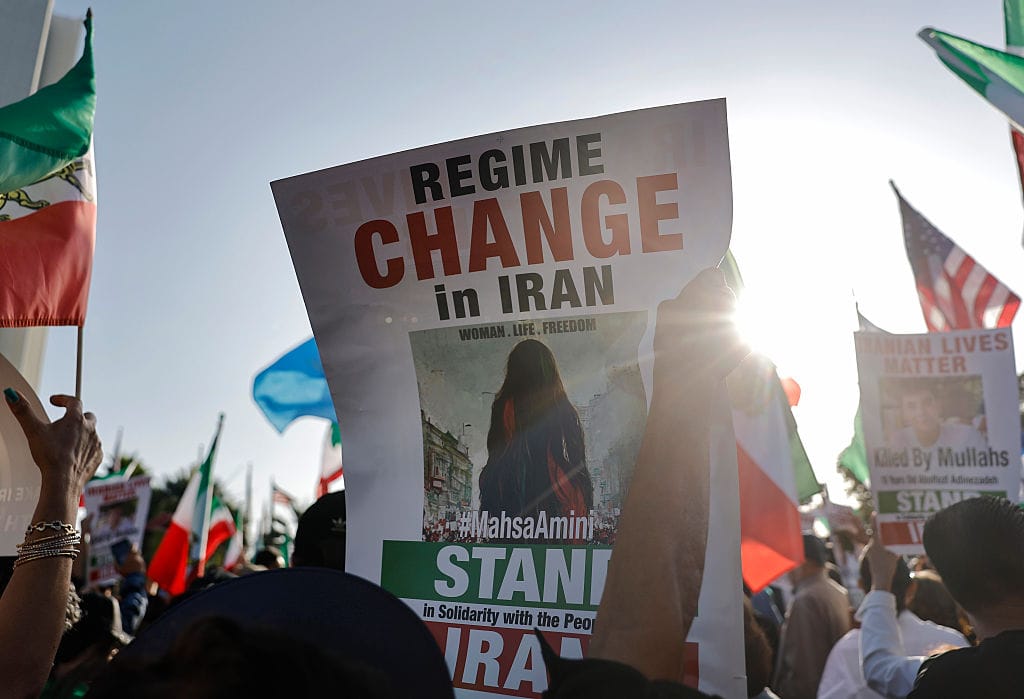
The explicit goal of a full-spectrum regime change in Iran, even if accomplished by the Iranian people or some element within the Iranian elite, has set many members of the Trump coalition on edge. Enabling the Iranians themselves to overthrow the entire Islamic Republic would seem to require someone to eliminate the entire ruling class (Type 2).
Does Trump think the U.S. and Israel can accomplish this intermediary form of regime change through air power alone? If not, is he contemplating a sustained—and presumably expanding—mission? Or is he hoping that a weakened regime will provoke the Iranians to rise up by way of a massive insurrection? If so, what would be the strategic dangers, as well as human costs, involved?
Libya and Syria may not loom as large in the American popular mind as Afghanistan and Iraq, but perhaps they should.
Some might be tempted to dismiss this wariness as a form of “Iraq Syndrome.” But the classical analysis of regime explains, and partially justifies, the wariness toward the current war in Iran. The most fundamental sense of regime is intimately bound up with a nation’s culture, history, and capacity. The Bush Administration was foolish to project the secular, liberal, and humanitarian ideals of the 21st-century West onto the peoples of Afghanistan and Iraq. But such ideals would have had to be the ideals of the Afghans and the Iraqis for new Western-style constitutions to mean anything.
The harder-nosed thinking that Trump has displayed with regard to the fate of Venezuela after nabbing Maduro—and the restraint that such realism introduces into our warmaking—was nowhere in evidence then. The late Angelo Codevilla was one of the few who counseled precisely this approach to the Muslim world: “After settling America’s quarrel, America should leave Iraq to the peoples who live there…. How they may govern themselves, deal with one another and with their neighbors, is no business of ours.”
Aristotle is clear that there are gradations of regime change. Some are clear-cut and sudden—a tyrant’s usurpation, or the overthrow of a monarchy followed by the institution of an aristocracy or republic. We might think of the rise of the tyrant Tarquin the Proud as the last king of Rome, followed by his expulsion and the institution of the Roman Republic. Others are more subtle and gradual: at some difficult-to-define point, the growing power and scope of certain offices (newly instituted or metastasized over time) to the detriment of other offices will constitute a change in the regime.
Claremont Institute scholars have been arguing for decades that the administrative state the Progressives established a century ago threatens to transform what remains of the republic established by the U.S. Constitution—and with it, the way of life reflected in and reinforced by the old American regime. Some of them (Codevilla in particular) have analyzed the symbiotic relationship between the corruption of our foreign policy and the corruption of our domestic regime.
As President Eisenhower saw long ago, and as President Trump has experienced repeatedly throughout the last decade, the growth of the military-industrial complex (and, since then, the intelligence services and the national security state) poses a substantial threat to our republican form of government. The potential for internal breakdown is why the classical philosophers consistently prioritized domestic politics over foreign affairs, and identified the common good of one’s own community as the proper goal of political rule.
When the U.S. wages war, our leaders should be mindful of whether they are securing or endangering our own regime, the way of life it embodies, and the common good it facilitates. That, after all, is their first duty—and the one for which they will be held accountable by their constituents, by history, and by God.