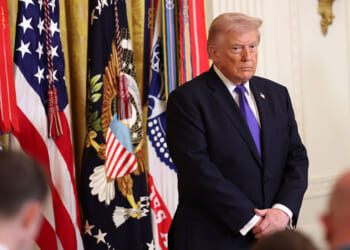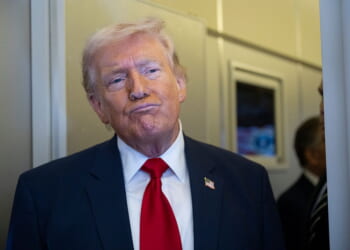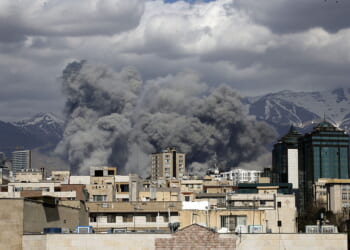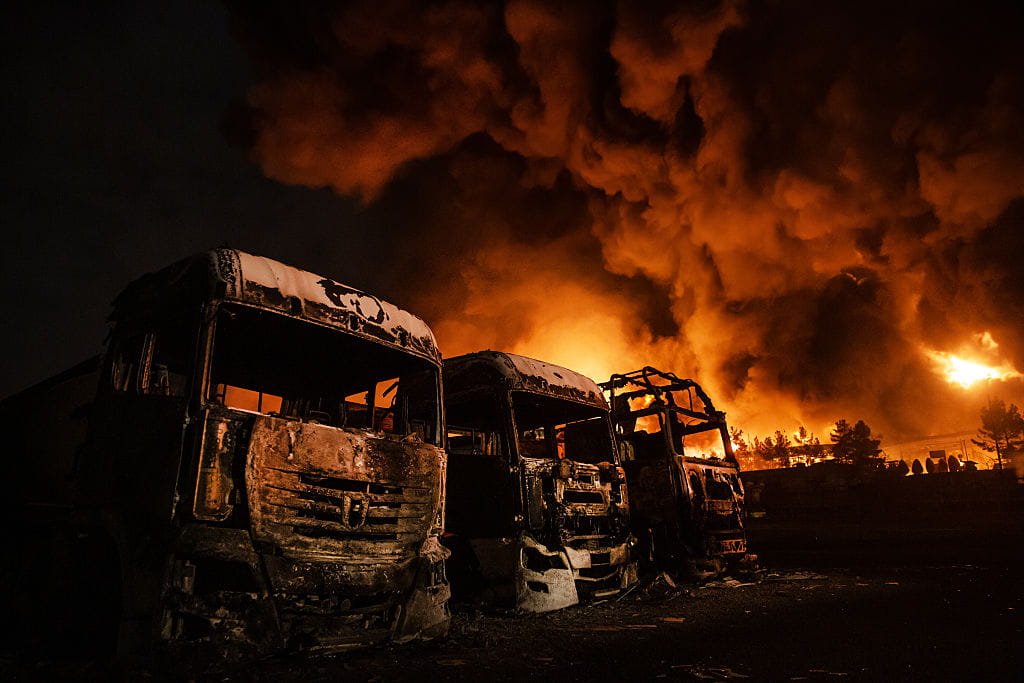
As the war in Iran edges closer to its second week, the US Fourth Estate is rife with stories denigrating President Donald Trump’s administration and claiming it has “no plan.” Indeed, the media refrain insists that there is no exit strategy from the conflict and that, even if the White House has one, there is no way to implement it. Let’s ignore for a moment that the president and Secretary of War Pete Hegseth are both highly unlikely to share any sensitive details with an often-hostile press, and consider what an endgame might look like on all sides of the field.
It’s worth noting that this is not the traditional warfare we saw in the 20th century, nor that of the early 2000s. To date, this has been a series of controlled airstrikes that seek to dismantle and disrupt Iran’s ability to wage a war. While Trump has hinted that “boots on the ground” is not an unthinkable option, the likelihood of US forces marching on Tehran to plant the Stars and Stripes is extremely low.
So, the question becomes, what does a victory look like for each participant? For Iran, we need to examine this from two perspectives: the ruling government and the people. For America, we should examine three types of victory. First for the country, next for Trump, and last for the peace and security of the wider world that the United States has long defended.
Mission Accomplished in Iran?
A big win for the remaining regime leadership in Iran would be its continued existence. Ayatollah Khamenei is dead, along with a number of senior figures. His replacement is his son, Mojtaba Khamenei, who declined to appear for his own “inauguration.” It became clear in the first several days of this war that the level of Israeli and US intelligence was far superior to what was initially thought.
If those currently in power can stay alive and remain as the ruling body, it will be seen as a major internal victory. However, the cushy days of impunity are a thing of the past. The comprehensive air mission being carried out demonstrates that allies of the regime can be targeted precisely and with deadly force. The rulers may survive, but they will be a much more isolated power faction.
For the Iranian people, an end to decades of brutality would be a welcome win. While propaganda from inside Iran shows a surprising level of support for its leaders, we can be reasonably sure that this is more about escaping revenge than genuine love of the leadership. After all, five members of the Iranian women’s soccer team took the opportunity at a match in Australia to escape their security detail and claim asylum. One might wonder just how many of the squad would have returned home if they did not have family members literally on the firing line for retribution.
America’s Big Win?
This is not a popular war. A recent Quinnipiac poll registered 53% opposing direct military action in Iran, with just four in ten supporting it. The issue appears to be America’s recent history of getting embroiled in major conflicts that end in ignominy, with the loss of blood, treasure, and international standing. Keeping these aspects in mind, what would it take for the US public to consider the mission accomplished?
Naturally, limited loss of life is top of the wish list. But the fact is, this was not an unprovoked war. Lives were already being lost through terrorist atrocities courtesy of Iranian cash and tactical support. American lives were already in harm’s way.
A win for the American people would be a short war, limited loss of life, and, importantly, a clear resolution.
Trump’s Victory Lap?
It’s a sticky wicket. If the president had said on day one that the goal was to eliminate the supreme leader as a warning not to get too feisty with the anti-American talk, he could have claimed victory in much the same way as he did when US forces captured Venezuela’s Nicolás Maduro. But a simple decapitation exercise appears not to have been the plan. As Trump stressed when he let the world know what was happening, he intended for the Iranian people to seize an opportunity and secure a transfer of power from a brutal regime to something less hostile.

The problem is, so far, the Iranian people have not been too obliging. This does not mean that they are content with the status quo. It takes an uncommon bravery to put one’s head above the parapet just weeks after an estimated 30,000 citizens were killed for protesting.
Trump is not running for election again. While he may want the GOP to do well in the upcoming midterms, his second term has demonstrated aptly that he considers Congress a fair-weather friend. He is now likely focused on his political legacy. And what a legacy it could potentially be! Venezuela was a bloodless removal of a corrupt dictator; Iran is a brutal regime with fingers in terroristic pies that impact just about every Western nation. If he can leave office with the war concluded and the nuclear threat of Iran permanently neutralized, he will have achieved more than any president of the last 80 years.
And, Finally, the World …
Speaker of the House Mike Johnson made a curious comment just days ago. While making the case that he did not support nation-building in Iran, he said that “America has a very important role to play in the world” as “the defenders of freedom and liberty.” He continued:
“Does that mean that we should be intervening everywhere around the world and nation-building and doing all these other endeavors? … No, because we don’t have the resources or the appetite to do that. That’s not our responsibility. Our responsibility, in my view, is to project peace through strength.”
And this seems to be the point. How does a country “project peace”? Perhaps he meant to say “project strength” and then achieve peace. But, again, how does one “project” strength if one is not prepared occasionally to show the will to use it?
Under President Joe Biden, Russia attacked Ukraine, knowing that a “minor” incursion would not be cause for US alarm: After all, Biden himself said it wouldn’t be. More than four years on, Ukraine is still paying for that public weakness. President Barack Obama’s infamous “red lines” on chemical weapons convinced the worst people in the world that they could always work out a diplomatic deal with the United States, no matter what atrocities they perpetrated. And now we have Iran – the world’s number one state sponsor of terrorism.
For decades, the regime has chanted “death to America” and spent fortunes funding terror attacks against the United States and its allies – all the while inching closer and closer to the full realization of a nuclear weapon. The Iranian leadership operated with impunity while other world leaders offered cash, smiles, and an aura of legitimacy.
Whether Trump is ultimately proven right in his decision to wage war against this rogue state is for the history books to decide. But for now, Iran has spent its munitions, lost its leadership, and made a pariah of itself among regional neighbors that have, in the past, provided plenty of diplomatic support. And these facts alone make the world a much safer place.