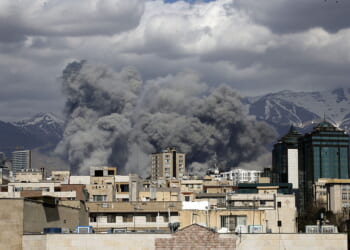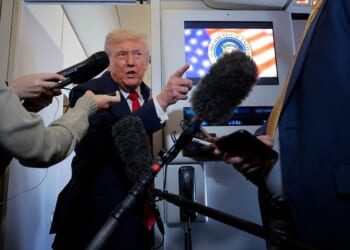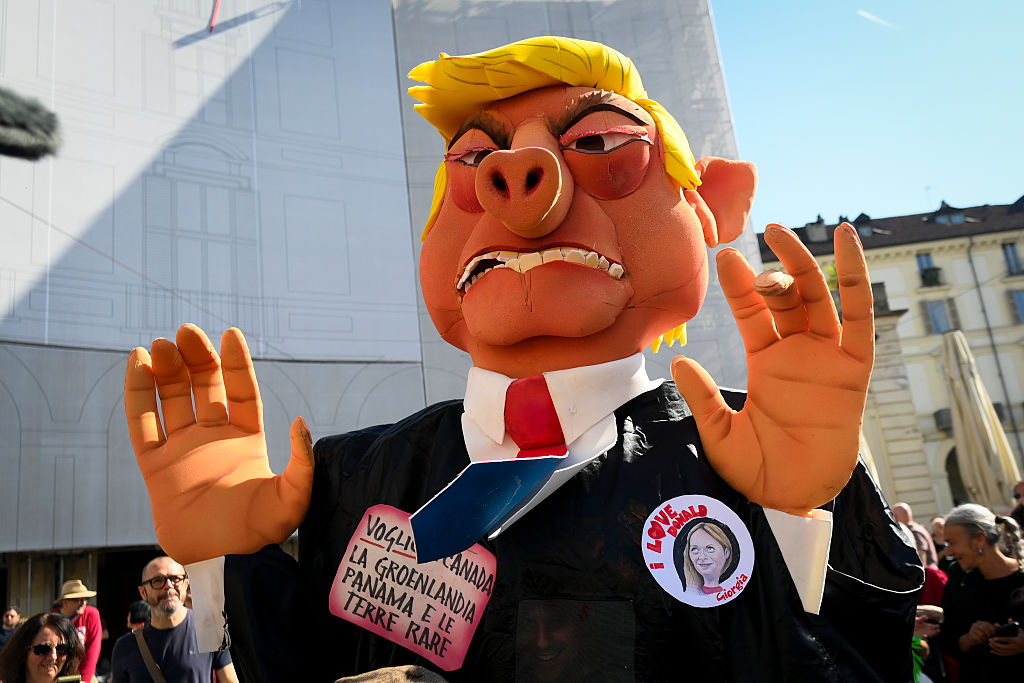
On the face of it, Donald Trump looks like a natural ally for Europe’s sovereigntists and national-populists — and most of them eagerly embraced him as one when he returned to the White House in 2025. A few went so far as to even adapt his branding, advocating to Make Europe Great Again (MEGA). But that embrace may now be unraveling. Trump’s aggressive tariff campaign against Europe, his annexationist rhetoric over Greenland, and above all the ongoing war against Iran and its attendant energy disruptions are making even some of his closest European populist allies jittery. For the European Right, a painful reckoning with the reality of American power may soon become unavoidable.
The real question, however, is how they failed to see this coming. The uncritical acceptance of Trump by Europe’s populist Right reveals a poor understanding of US foreign policy, and a near-total absence of geopolitical vision. Regardless of who sits in the White House, the logic behind America’s foreign policy remains the same: advancing US economic and geopolitical interests at the expense of everyone else.
Since the early Nineties, every single American president has ended up bombing some faraway country, despite all of them — including George W. Bush! — campaigning against foreign entanglements. Trump 2.0 is merely the latest, and most brazen, iteration of this pattern. Having vowed to “stop all wars” as recently as in his inauguration speech, he has since pursued the most aggressive and militarist foreign policy since Bush Jr., culminating in the attack on Iran — something none of his predecessors had dared to do, despite four decades of Israeli pressure to that end, precisely because they understood the catastrophic consequences. For Europe’s self-described patriots, America’s addiction to military intervention — much of it, over the past quarter century, on or near Europe’s doorstep — should have prompted some caution. That would have been far safer than automatically aligning with “America First” or taking Trump’s promise of peace at face value.
This imperial logic applies to its allies just as much as to its adversaries. Since the Second World War, Washington has consistently treated Europe as a key extension of its global empire, a region to be controlled politically, economically and militarily, and kept firmly aligned with US interests. Nato has been central to this project. As summarised by its first Secretary General, Lord Ismay, its function was that of “keeping the Russians out, the Americans in and the Germans down”. In other words, the original purpose of the Alliance was not to defend Europe, but to prevent the emergence of an autonomous bloc, ensure its strategic subordination to the United States and foreclose rapprochement with Russia.
Earlier European sovereigntists understood this. Charles de Gaulle deeply resented what he saw as American domination of Western Europe under the guise of the Atlantic alliance, arguing that it reduced European nations to the status of protectorates rather than genuine sovereign states. In 1966 he acted on this conviction, withdrawing France from Nato’s military structure and expelling US forces from French soil.
In the six decades since, US policy towards Europe has remained essentially unchanged. In the Eighties, when European nations, led by France and West Germany, sought to pursue a détente with the Soviet Union, Washington pushed back, insisting that European security policy be subordinated to American Cold War strategy. And even after the fall of the Soviet Union, the US made clear that that European security would remain anchored to American leadership through Nato.
Far from providing security to the continent, the Alliance’s eastward expansion was a key factor in triggering the Russian invasion of Ukraine, which the US then exploited not only to “bleed” Russia — but also to drive a wedge between Europe and Russia, and force the EU to decouple from Russian gas and turn to American gas instead, both of which were longstanding US strategic imperatives. This was made possible by a European political class in submission to the transatlantic dogma. Just look at their silence in the face of the Nord Stream bombing, an act of sabotage carried out with at least US foreknowledge, if not direct US involvement.
European populists have long attributed this subservience to ideology — an unholy alliance between liberal-globalists on both sides of the Atlantic. But Trump himself explodes this thesis. Despite being as ideologically remote from Europe’s liberal-transatlanticist class as it is possible to imagine, he has extracted from them essentially the same compliance: on trade, defense, Nato spending and even Greenland. The master-servant relationship, it turns out, has nothing to do with ideology; it is structural. One might expect this from a “globalist” political establishment quite clearly beholden to foreign and vested interests. Yet the same transatlantic streak seems to run through virtually all European Right-populist parties, which means the continent’s sovereigntists are either comfortable with Europe’s subordination to Washington or genuinely blind to its structural nature, believing that Trump would somehow be different.
“The master-servant relationship, it turns out, has nothing to do with ideology; it is structural.”
In fact, things have only got worse. Since returning to the White House, Trump has launched an aggressive trade war against Europe, threatened to annex part of its territory, weaponized the continent’s dependence on American gas to extract political concessions and demanded Europeans spend hundreds of billions on US weapons. Europe’s globalist establishment has dutifully complied with all of it. But Europe’s sovereigntist parties have not put up much of a fight either. Whatever the short-term political calculations, the optics of self-described European patriots saying little while their transatlantic ally economically waterboards the continent are not good.
The war on Iran may prove to be the turning point. Europe is already feeling the economic ripples: oil and gas prices have surged dramatically, heaping further hardship on households and businesses already battered by the switch from Russian to American energy. Indeed, according to the EU Commission President, the war has already cost European taxpayers an additional €3 billion in fossil fuels imports. A prolonged conflict — or even a stabilization of prices at current levels — would be economically devastating for the continent. And if Europe loses access to Qatari LNG, its dependence on American gas will become absolute.
That alone would be alarming if it were simply an unintended consequence of war. What if rising energy prices were, however, factored in from the outset? As the world’s largest producer of oil and gas, and Europe’s principal energy supplier, the United States stands to gain substantially from the price surge. This raises the possible scenario: if the proxy war in Ukraine was designed to decouple Europe from Russian gas, the Iran war may be aimed at decoupling it from Mediterranean resources altogether. As noted earlier, US imperial strategy spans decades and administrations, and the ideological color of the president is largely irrelevant to its execution.
Nor does this account for the war’s other potential consequences: mass refugee flows towards Europe, as previous US Middle Eastern wars have generated, and growing pressure on European governments to become more directly involved militarily. Europe now faces two devastating wars on its doorsteps — one to the east, stoked by Washington, and one to the south, actively waged by it. The first pushed Europe into economic and geopolitical vassalage, but the second may be the shock that finally breaks it, plunging it into economic and social collapse.
In light of all this, it’s little wonder that rifts are starting to emerge between MAGA and the European populist camp, and most visibly in Germany, the country most economically affected by these wars.
The AfD is probably the party that has received the most explicit US backing, including Elon Musk’s notorious declaration that “only the AfD can save Germany”. But the Trump administration’s increasingly reckless and aggressive foreign policy is now causing serious strains within the party.
The AfD has always been broadly split into two camps. One — stronger in western Germany, associated with party leader Alice Weidel and foreign policy spokesman Markus Frohnmaier — is pro-MAGA, transatlantic, pro-Israel and neoliberally oriented. The other — dominant in the east, represented by party co-chairman Tino Chrupalla and Thuringian leader Björn Höcke — is more openly nationalist and Eurocentric, more sympathetic to Moscow, hostile to US interventionism, and critical of Germany’s unconditional support for Israel.
Höcke has been characteristically blunt. In 2022, he stated: “It was and is US strategy, as a foreign power on our continent, to drive wedges between peoples and nations that could actually work very well together.” He argues that Germany must cease to be a “vassal state” of the United States, and that Washington, as a non-European power, “should withdraw from Europe”, since “the natural partner for our way of working and living would be Russia”.
When Trump bombed Iran’s nuclear facilities last June, the divide became impossible to paper over. Chrupalla wrote on X: “A fuse has been set on the powder keg of the Middle East.” More recently he said: “Donald Trump started as a president of peace. In the end, Donald Trump will end as a president of war.” Meanwhile, within the other wing, Frohnmaier declared that Israel had “every right” to ensure that “its existence is not threatened”.
The party leadership has tried to manage these tensions, largely aligning with Trump on most issues. But the outbreak of the war in Iran has caused these pressures to bubble to the fore. In a notable break with other European Right-populist parties, most of which either endorsed or stayed silent about the US-Israeli strikes, the AfD issued an official statement, claiming that “the renewed destabilization of the Middle East is not in the German interest and must be brought to an end”. It is a modest step, but a telling one. And as the war grinds on and its costs for Germany mount, the Eurocentric wing of the party is likely to grow stronger.
Similar fault lines will inevitably open in other Right-populist parties across the continent and beyond — and indeed they already are. A vivid example comes from the UK, where Nigel Farage’s Reform has found itself tied in knots over the Iran war. Within the space of days, Farage criticized Starmer for not backing the US operation more forcefully, while simultaneously attacking the rising fuel prices that the same war has caused. Meanwhile, Reform’s own ranks were split: deputy leader Richard Tice called for full UK support for the US offensive, while the party’s new Treasury spokesperson Robert Jenrick, who recently defected from the Conservatives, told the BBC: “If you’re asking me the question, do I think that it is in the interests of the British people… for us to be deploying British airmen in bombing raids over Iran right now, when our allies have not asked us to do that, then, no, I don’t think that’s necessary.”
Labour wasted no time pointing out these contradictions, accusing Reform of “saying they would bomb Iran” one week and “backtracking as petrol prices rise” the next. It illustrates the impossible position in which Trump’s war has placed his European populist allies: they cannot support it without owning its economic consequences, and they cannot oppose it without betraying their transatlantic loyalties. But more crucially, it points to the total lack of geopolitical vision among most Right-populist parties.
They better get their act together fast. Any national-populist party that wants to seriously challenge the European liberal-globalist status quo — and wishes to retain credibility with its voters — can’t limit itself to anti-immigration, anti-“woke” and anti-establishment domestic politics. It needs to articulate a coherent foreign-policy framework in line with Europe’s core economic and geopolitical interests. As de Gaulle understood 60 years ago, this necessarily means breaking with Washington and its forever wars.