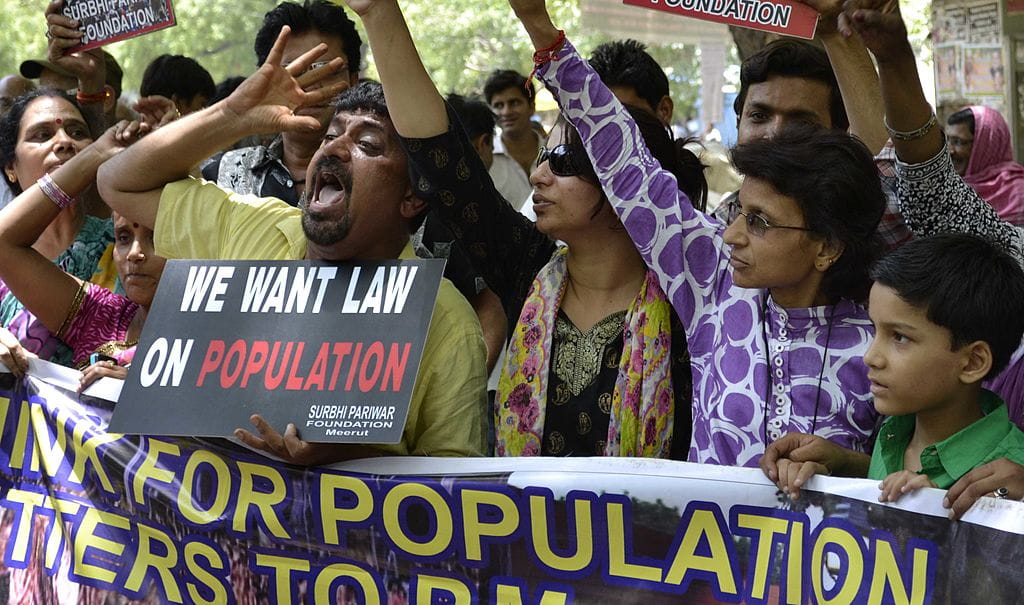
American scientist Paul Ehrlich died on March 13 at the age of 93. He was better known as the author of 1968’s The Population Bomb, and the ideas in his book have been a source of controversy for the last 58 years. Proponents say he placed a much-needed spotlight on environmentalism. Critics argued that his recommendations produced damage across multiple generations. Either way, the idea that too many human beings would be the end of mankind is a failed prognostication.
Paul Ehrlich and the Downfall of Mankind
The ultimate premise of The Population Bomb is that global population growth will be mankind’s downfall, with “hundreds of millions of people” dying from starvation in the 1970s. This is because an acceleration in the number of human beings would outstrip the food supply, causing mass starvation, substantial environmental degradation, political upheaval, and ballooning death rates. Put simply, society would collapse.
Paul Ehrlich then proposed that population control be incorporated into national policy decision-making. This included incentives for smaller families, penalties for large ones, and birth control regulation. He did not believe that technological progress and economic advancement would be enough to offset the supposed drawbacks of population growth.
Despite the panoply of doom-and-gloom predictions that did not come to fruition, the best-selling author continued to espouse the consequences of having seven billion people on the planet. “It’s much darker today, and you can prove it,” Ehrlich told Climate One in 2018.
Like that of Greta Thunberg, Ehrlich’s crusade has evolved to include other leftist causes, which would contribute to a decline in the Earth’s population. He told The London Guardian in March 2018:
“To start, make modern contraception and back-up abortion available to all and give women full equal rights, pay, and opportunities with men.
“I hope that would lead to a low enough total fertility rate that the needed shrinkage of population would follow. [But] it will take a very long time to humanely reduce total population to a size that is sustainable.”
He may not have wanted to confront the truth, but the world is better off now than in 1968.
Happy Days Are Here
International numbers are telling.
Production of corn, rice, soybeans, and wheat has consistently set records. The share of people who are undernourished has fallen notably this century, while the global daily calorie supply per person has steadily risen over the last five decades. The end result? Deaths from protein-energy malnutrition have collapsed across all age categories since mid-1980.

Even omitting the food angle of his book, the environmental forecasts were also wrong. For example, Ehrlich argued that pollution would ravage the population. Instead, the death rate from air pollution has significantly come down since 1990. This happened even as the number of people with access to electricity rocketed since the turn of the century.
What’s more, poverty has been in decline. The share of people living on less than $3 per day has fallen from 45% of the global population in 1990 to around 10% today.
There are indeed challenges the world still grapples with, but aggregate statistics show that people have greater access to food and energy, even though several billion men and women live on the planet. Given the optimism about progress in artificial intelligence, mankind will have a fruitful existence in the decades to come.
The biggest long-term threat to our species, however, is the looming population crisis. The world listened to Paul Ehrlich years ago, resulting in China’s one-child policy, and Baby Boomers and Generation Xers refusing to have children. But the world is not learning from the past.
In January 2023, CBS’ 60 Minutes aired a segment that concluded the Earth is facing another mass-extinction event. Host Scott Pelley had Ehrlich on the show. He said with a straight face: “I and the vast majority of my colleagues think we’ve had it; that the next few decades will be the end of the kind of civilization we’re used to.”
We Need More People
The national population growth has been slowing rapidly due to falling fertility rates. The number of people on the blue pearl traversing the universe is expected to peak in the coming decades. This is triggering pressures on economies, institutions, and welfare programs. While governments have been attempting to reverse course, it may be too little, too late.
That said, nobody can predict the future with 100% accuracy. Perhaps there will be another baby boom in the 2030s or 2040s.
Whatever the case, Ehrlich and other Malthusians would have foreseen new technologies that would contribute to widespread food production and the decline of starvation worldwide. However, there is little fame and fortune in telling everyone to calm down and everything will be okay. The big bucks are in doomsday scenarios.