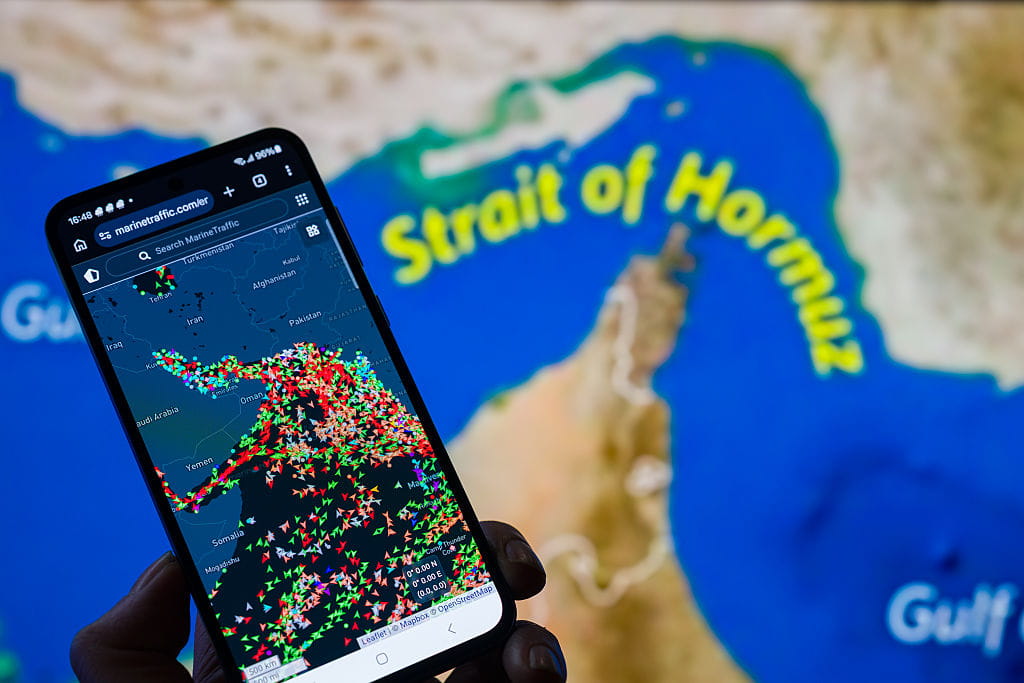
Securing and keeping the Strait of Hormuz open is a key objective of the war against Iran. It’s a big job that requires the suppression of Iranian anti-ship missiles and drones and the destruction of Iran’s capability to produce more such weapons. Though the United States is capable of doing the job, other countries, particularly those in Europe and NATO, have an interest in ensuring the strait remains secure. Consequently, President Donald Trump is asking for assistance in protecting ships transiting the Hormuz Strait. Initially, he received a cool reception.
Opening the Strait of Hormuz Is a Priority
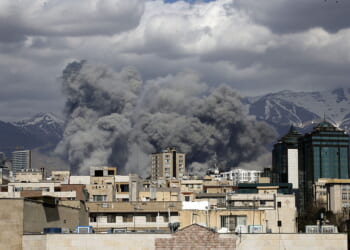
Part of Trump’s plan to defeat Iran is to eliminate Tehran’s capability to hold the Strait of Hormuz hostage, stopping the transit of oil tankers. The strategy is to destroy Iran’s anti-ship missile, drone, and mine inventory and the country’s means of replenishing it. That would make it safer for US warships to escort and protect oil tankers and other cargo ships making their way through the strait. On March 11, it was reported that three cargo vessels that attempted to run the Hormuz Strait without protection and were hit by Iranian weapons, most likely drones, one possibly from underwater. A US Central Command press release warned merchant vessels to avoid civilian ports since the “Iranian regime is using civilian ports along the Strait of Hormuz to conduct military operations that threaten international shipping.” The release also made clear that “civilian ports used for military purposes lose protected status and become legitimate military targets [for the United States] under international law.”
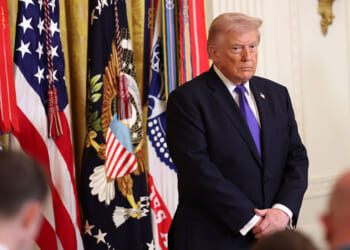
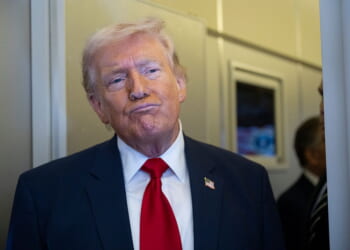
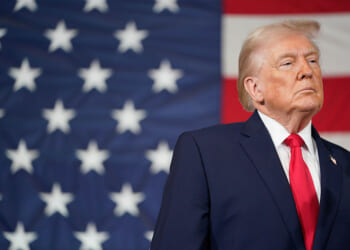
Because NATO specifically and Europe generally, as well as Asia, have a stake in the oil flowing through the Hormuz Strait, the United States has requested their assistance. “If there’s no response or if it’s a negative response, I think it will be very bad for the future of Nato [sic],” Trump told the Financial Times. “It’s only appropriate that people who are the beneficiaries of the Strait will help to make sure that nothing bad happens there,” Trump explained. He has requested assistance from France, South Korea, Japan, China, and the United Kingdom to keep the Hormuz Strait open.

The countries Trump has appealed to for help are not disinterested parties. According to a Visual Capitalist infographic published on March 3, China receives 38% of its oil imports through the Hormuz Strait, South Korea 12%, Japan 11%, and Europe 4%. Asia, taken as a whole, is most affected by the closure, importing up to 89% of its oil. In contrast, the United States receives just 2.5% of the flow. It would seem that the affected countries would be eager to assist in opening the waterway – but not so.
According to the BBC, “US President Donald Trump has renewed his criticism of the UK government over its response to the Iran conflict, after Prime Minister Sir Keir Starmer said the country would not be drawn into the ‘wider war.’” Trump went on to observe he was “not happy” with the British for not being “involved enthusiastically.” To put a finer point on his dissatisfaction with the UK’s response, as well as the lack of eagerness on the part of Europe to help, Trump took to Truth Social. In a March 17 posting, the president opined:
“The United States has been informed by most of our NATO ‘Allies’ that they don’t want to get involved with our Military Operation against the Terrorist Regime of Iran, in the Middle East, this, despite the fact that almost every Country strongly agreed with what we are doing, and that Iran cannot, in any way, shape, or form, be allowed to have a Nuclear Weapon … Because of the fact that we have had such Military Success, we no longer ‘need,’ or desire, the NATO Countries’ assistance — WE NEVER DID!”
President Trump Is Not Happy
Trump made the point in his posting that the United States has spent “Hundreds of Billions of Dollars per year protecting these same Countries, to be a one-way street — We will protect them, but they will do nothing for us … ” You get the impression the president is miffed — and rightly so. The United States and Israel are in the process of ridding the world of the number one sponsor of terrorism. Furthermore, it should not be lost on NATO countries in particular that Iran is no respecter of the alliance. “Turkey said on Monday (March 9) that NATO air defenses shot down a second Iranian ballistic missile that had entered its airspace and warned that it would move against any such threats, which increasingly pose a test for Ankara and the alliance,” Reuters reported.
What will pose more stress for NATO and European partners is a failure to provide some level of support to secure the Strait of Hormuz. Can the United States and Israel eventually reduce the threat to shipping in the Hormuz Strait? Yes. Would it be better if those who benefit from the strait being open provided a helping hand? Yes. However, if it is up to the United States and Israel alone, then so be it.
~
The views expressed are those of the author and not of any other affiliate.