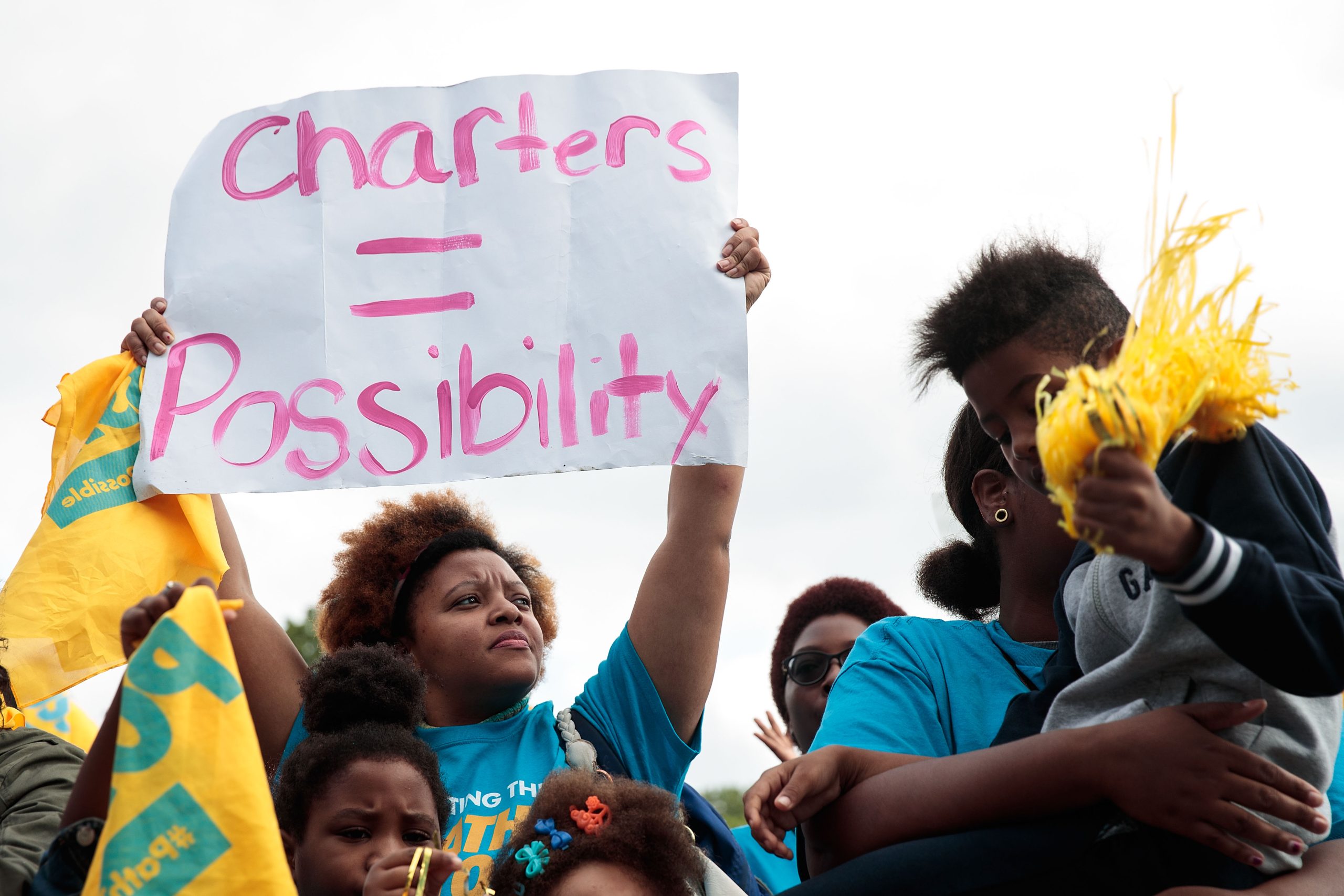
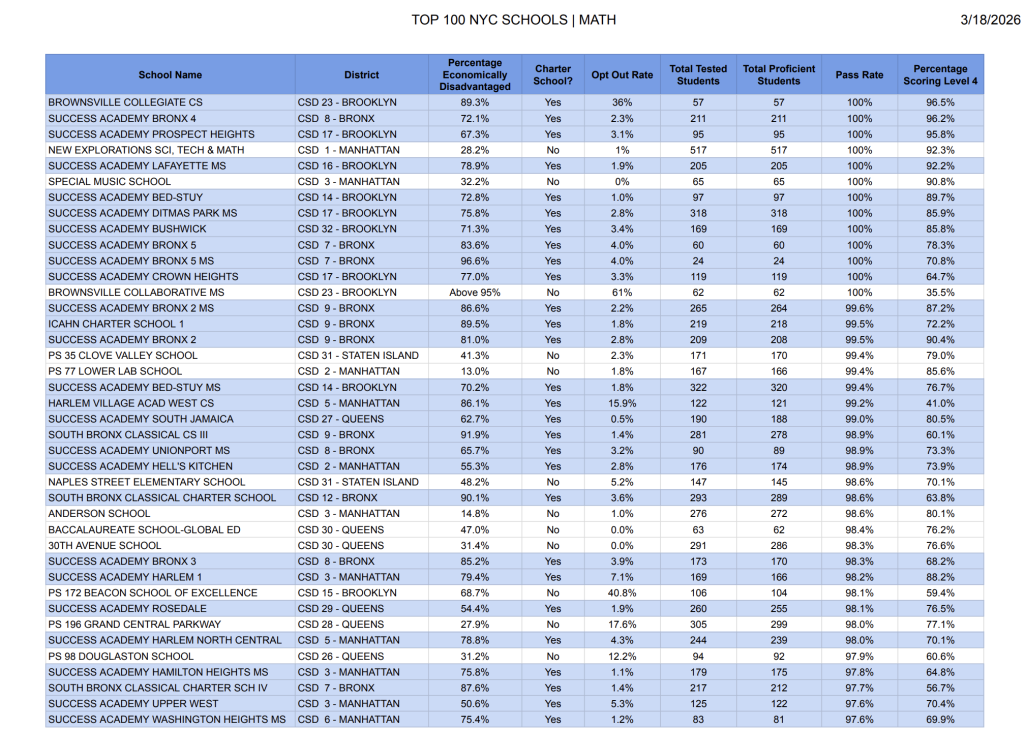
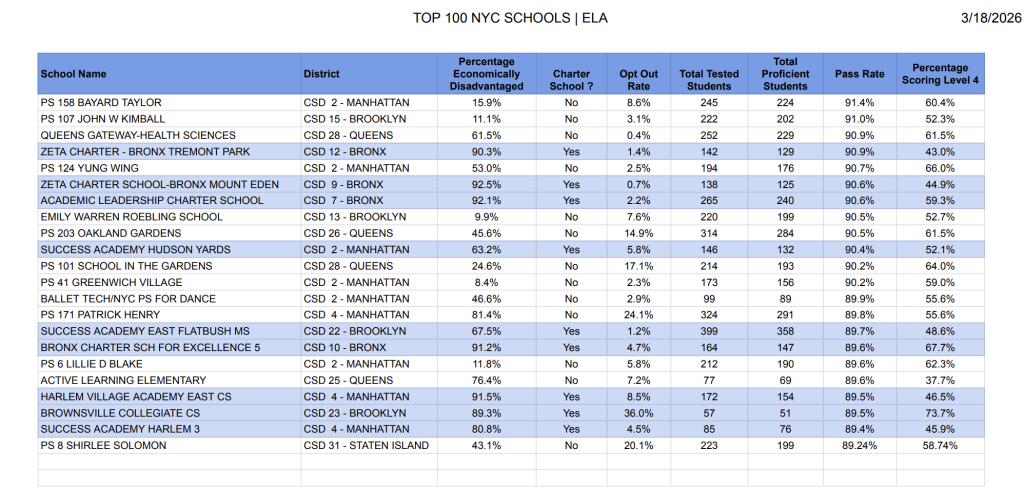
More than half of the best 100 public schools in New York City as measured by performance on state math and English tests are charter schools, many of them located in poor neighborhoods and serving students that the city describes as economically disadvantaged.
City and state websites offer report cards on individual schools but make it hard to sort schools by test scores or compile a list, perhaps because the results are embarrassing to the government-run schools. So no one—until now—has reported that charters make up 59 of 100 top math schools and 53 of the 100 top schools for English language arts in New York City, according to 2025 state tests. Many of those schools are in the Bronx or Harlem or in parts of Brooklyn that are not Park Slope.
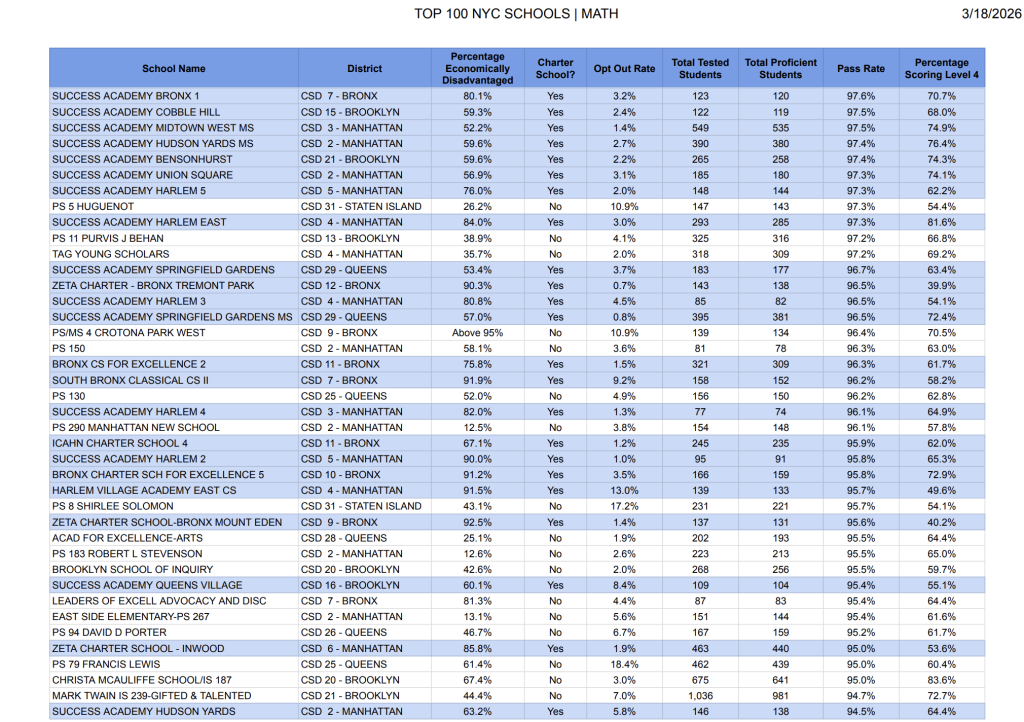
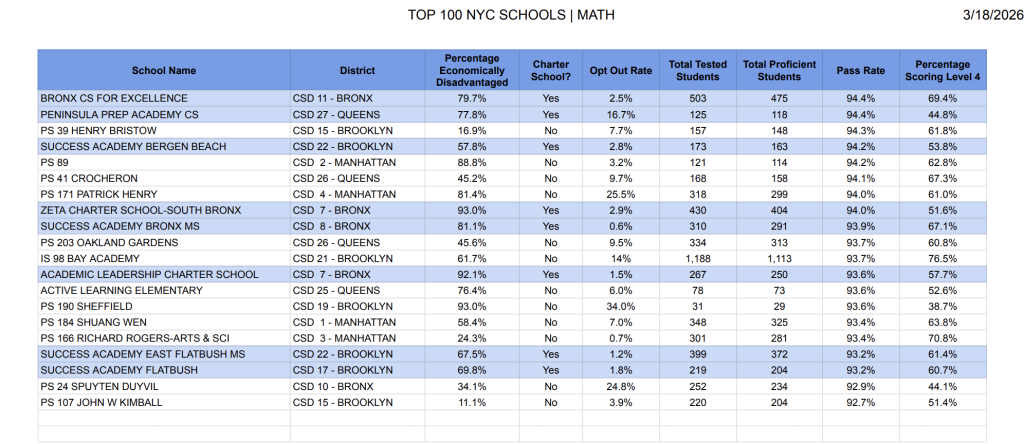
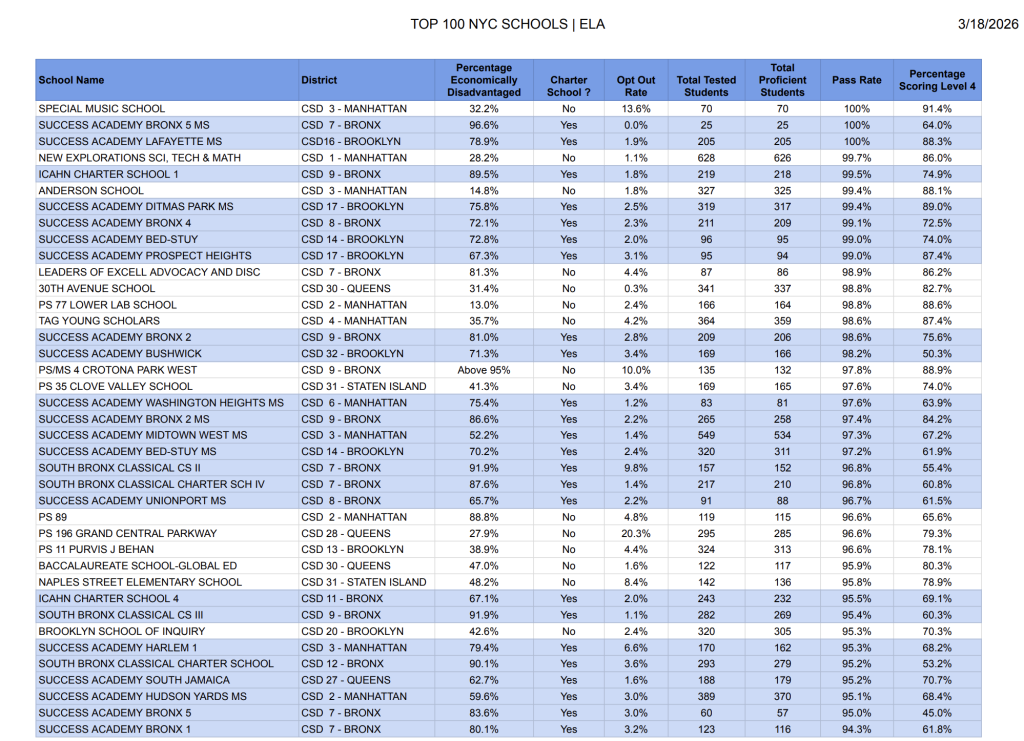
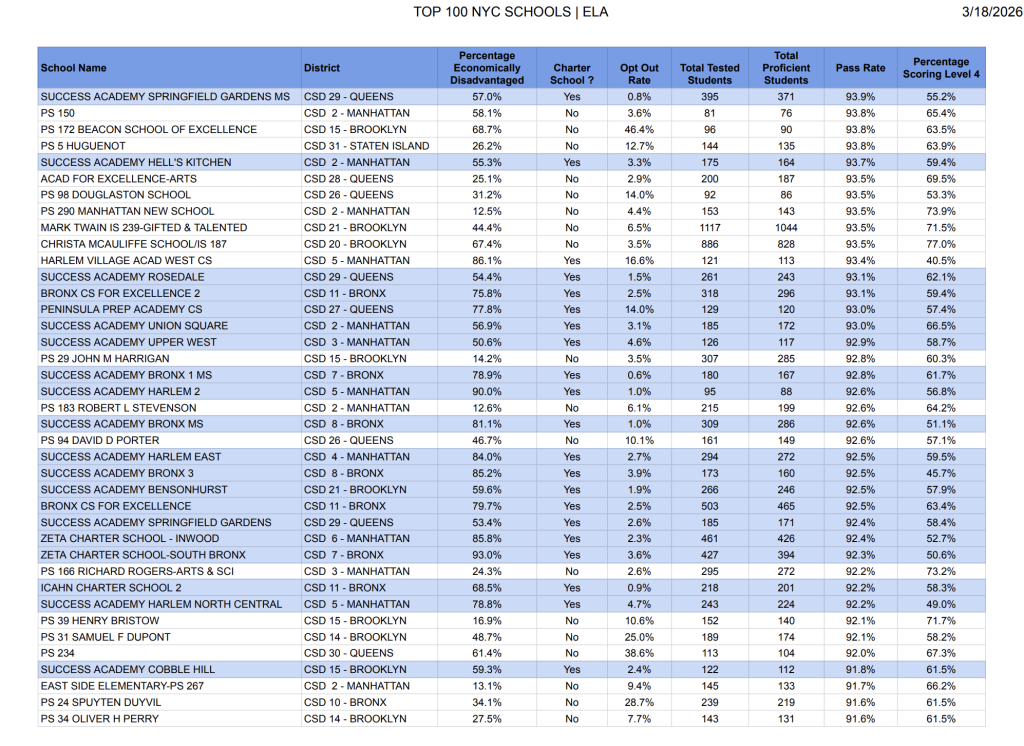
The results undercut the narrative being pushed by the New York Times, which published a news article this week originally headlined “As Income Gap Grows, So Do Fears Over Access to a Quality Education.” The online subheadline states, “Leaders and parents worry that a widening economic divide amid the current affordability crisis could amplify the role that money plays in access to a robust education in New York.” The article says, “some education leaders and parents worry that a widening income divide amid the current affordability crisis could amplify the role that money plays in access to a quality education in New York, one of the nation’s most economically unequal cities.”
I emailed the author of the Times article, Troy Closson, “Don’t you think it’s worth mentioning that most of the city’s best schools by English and math state test scores are charter schools serving poor kids in poor neighborhoods? Doesn’t that undermine the whole premise of your story?” He did not respond by deadline.
The Times report does mention that “In recent years, some middle-class parents have begun to consider charter schools, which are publicly funded, enroll 150,000 students and traditionally enroll poorer families,” but that’s low down in the article, after all the talk about “worry” and a quote from someone about “the growing gulf between not even just the haves and have-nots, but the ultra, ultra wealthy, and everyone else” and about how “At a certain point, it’s like education is a luxury good.”
The Times also chose just one academic—Stanford’s Sean Reardon—to quote in its story, without noting that Reardon’s work about income inequality and education is highly contested, including by one of his Stanford colleagues, Eric Hanushek. Reardon has described “widening income disparity in academic achievement,” or “No Rich Child Left Behind,” as a headline over a 2013 New York Times article he wrote put it.
It’s as if the Times’s progressive editors can’t bear to acknowledge that many charter school students are getting excellent educations. Such an acknowledgement might undermine the campaign to stoke anxiety about the “income gap” and therefore to justify higher taxes on the rich, voting for Zohran Mamdani—the complete left-wing agenda. Rather than reporting on the “worry,” why not provide readers with the factual information needed to determine whether the worry is justified or unwarranted? If the Times won’t do it, we will.
Unfortunately, the anecdotal lead featuring a worried individual is becoming a grim pattern in Times education coverage. Last week, it was the University of Pennsylvania law student who “has worried ever since he learned that Trump administration investigators had demanded that his school turn over the names of many Jewish people on campus.” This week, it is a parent who “struggled to find the right school for her bright son” and the subheadline about “Leaders and parents worry.” So much worry.
A lot of the incentives with online journalism are to figure out what your readers might be induced to worry about and then write a headline that will get them to click. My own worry is that those incentives are at odds with an accurate portrayal of reality, that is to say, the truth.
That’s not to be dismissive of upper-middle-class envy of the rich or of the difficulties parents sometimes have finding the right schools for their children. It is to say, though, that of all the things to possibly worry about in New York City in 2026, income-gap-related fears over access to quality education are not high on any rationally composed list.
There are many possible ways to measure public school performance—parent satisfaction surveys, employer satisfaction surveys, surveying the happiness of the teachers who work there (that one is a particular favorite of teachers’ unions), eventual college enrollment and graduation rates, whether students eventually wind up in prison, on welfare, or in good-paying jobs. But asking whether the schools are doing the job of teaching students to read and do math—as measured by standardized tests—is one method with enough political support that it has been enacted into federal and state law.
The good news in New York City is that thanks to a 1998 charter school law that then-governor George Pataki, a Republican, championed—and to vigorous efforts in the years since by charter school parents, network leaders, board members, charter teachers and staff, and others—charter schools where 80 percent or 90 percent of students are classified by the city as economically disadvantaged are getting more than 90 percent of their students to pass state math and reading tests. There’s always room for further improvement, and not all charter schools are high achievers. Yet it is an achievement worth recognizing and appreciating rather than ignoring or denying.