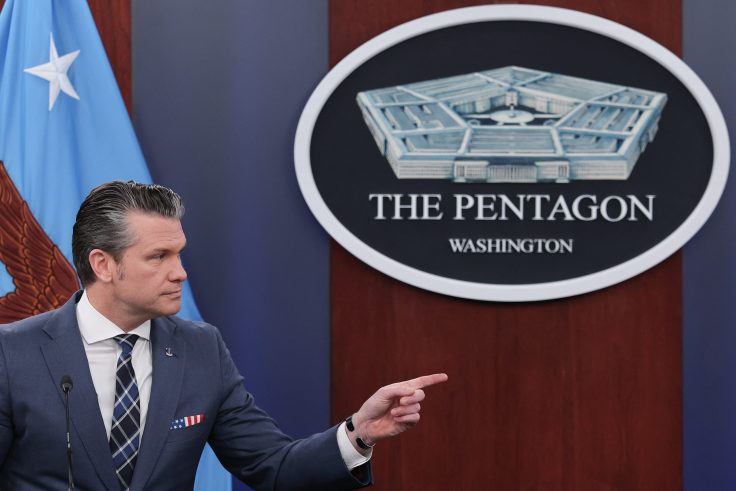
If and when America and Israel win the war against Iran, as I hope and expect we will, part of the reason will be the success of the secretary of war, Pete Hegseth, in communicating directly to the American people and to the troops.
Every war in the age of television has had its face. In Operation Desert Storm, the 1991 effort to repel Iraq’s invasion of Kuwait, it was General “Stormin’” Norman Schwarzkopf. In the Iraq War, it was Ambassador L. Paul Bremer III, functioning haplessly as American proconsul in Baghdad. In the present conflict, Operation Epic Fury, as the American part of it is called, Admiral Brad Cooper, the head of the U.S. Central Command, has made some compelling appearances. President Trump himself has spent plenty of time in front of the cameras. And the chairman of the joint chiefs of staff, General Dan “Raisin’” Caine, has appeared effectively alongside Hegseth. But if there’s a figure in the administration who is becoming the face of this war, it’s Hegseth—and so far, he’s doing pretty well.
If you had to predict who the Trump administration would want out there, Hegseth might not have leaped immediately to the top of a conventional wisdom-driven list. He was confirmed to the job on the narrowest possible margin—a 50-50 vote with Vice President J.D. Vance breaking the tie and Republican senators Murkowski, McConnell, and Collins against. Yet as Trump noted in announcing his nomination, Hegseth not only has degrees from Princeton and Harvard and experience serving in the Army in Iraq and Afghanistan, but he spent eight years as a Fox News television host. He’s professionally good at being on television—just like Trump himself, who starred in the television series The Apprentice.
Whether you catch Hegseth on an old-fashioned television or in a livestream pop-out window on the X app on a smartphone, the message is clear and consistent. Rather than get drawn into Vietnam-War style 5 p.m. follies of daily briefings, Hegseth and Caine have come out somewhat sparingly. They’ve been careful about keeping the press questions limited; the point of the briefings isn’t to make journalists famous, it’s to let Hegseth communicate to the country. Choose your preferred modifier—relentless, robotic—Hegseth stays on message, with short sentences, simple language, hammering the ideas home to the audience like another bombing sortie against enemy targets.
On March 19, Hegseth broke the fourth wall and straightforwardly acknowledged that the press were there primarily as props.
“I stand here today speaking to you, the American people, not through filters, not through reporters, not through cable news spin,” Hegseth said. “Yes, there are reporters in front of me, but they are not our audience today. It’s you, the good, decent, patriotic American people; you, the hardworking, tax paying, God-fearing American patriots.”
What has Hegseth been saying?
One somewhat refreshing thing is that he talks, unburdened by political correctness, about killing the enemy. “Our warriors have fought with lethality,” he said March 13. He is unsparing in describing the targets. “Rats,” he called Iran’s leadership. “Barbaric savages.” “Terrorist cowards.”
He’s been nearly as derisive toward the Pentagon press. “A dishonest and anti-Trump press will stop at nothing, we know this at this point, to downplay progress, amplify every cost and call into question every step. Sadly, TDS is in their DNA. They want President Trump to fail, but you, the American people, know better,” he said March 19. He called a CNN report “fundamentally unserious,” and said, “The sooner David Ellison takes over that network, the better.”
He’s been consistent about the U.S. war aims. “One: destroy their missile stockpiles, their missile launchers and their defense industrial base; missiles and their ability to make them. Two: destroy their Navy. And three: permanently deny Iran nuclear weapons forever.”
He’s been similarly consistent in touching on religion. On March 10 he said, “I’ll close with Scripture, drawing strength from Psalm 144. Blessed be the Lord, my rock, who trains my hands for war and my fingers for battle. He is my loving God and my fortress, my stronghold and my deliverer, my shield in whom I take refuge. May the Lord grant unyielding strength and refuge to our warriors, unbreakable protection to them and our homeland, and total victory over those who seek to harm them. And amen. God bless our troops and this mission.” On March 19 he said, “May almighty God continue to bless our troops in this fight. And again to the American people, please pray for them every day on bended knee with your family, in your schools, in your churches, in the name of Jesus Christ.”
And he’s been telling Americans that we are winning. “We’re winning decisively and on our terms,” he said March 19. “We’re winning decisively with brutal efficiency,” he said March 10.
It’s not everyone’s cup of tea. The Wall Street Journal’s Peggy Noonan gave him an early review as “something between an excitable morning TV anchor and the rooster who thought he brought the dawn.”
In the end the outcome of the war will be up to the brave people of Iran, to seize a better future for their country. It will be up to the U.S. and Israeli militaries and intelligence operations people and to the president and prime minister. But if Hegseth can help buy them all more time by projecting confidence and fighting the “quagmire” narrative from the press, it will help maximize the chance of success. The risk for Hegseth is if it doesn’t work out he gets blamed. Trump could cut him loose the way he did with Kristi Noem. But there’s upside, too. Hegseth, 45, was on the couch in the Oval Office this afternoon right alongside Vice President Vance and Secretary of State Rubio, who are thought of as presidential material. If this war ends in an American victory it may be the first of more wins ahead for Pete Hegseth.