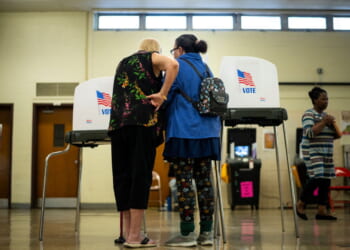
The president declared he wouldn’t sign any legislation until Congress passes the SAVE America Act – but not just any old “watered down” version of the bill. Trump wants restrictions on mail-in ballots, a ban against transgender procedures (often called “gender-affirming care” by progressives) for kids, and no men in women’s sports. Admirable as these goals may or may not be from anyone’s perspective, two things can’t be denied: First, none of these additions have anything to do with election security and preventing non-citizen voting. Second, none of them will make this bill any easier to pass in a bipartisan manner.
Even without amendment, achieving 60 votes on this act falls firmly in the aforementioned pipe dream category – but the changes certainly won’t make things any easier.
The second and third paths through the filibuster involve modifying or removing it entirely. A simple majority can invoke what’s called the nuclear option: removing the legislative filibuster from the Senate rules. This would result in whatever version of the SAVE America Act Senate Republicans want passing the upper chamber, but it would also mean that any simple majority moving forward could pass any legislation they like, no matter how extreme and partisan it may be.
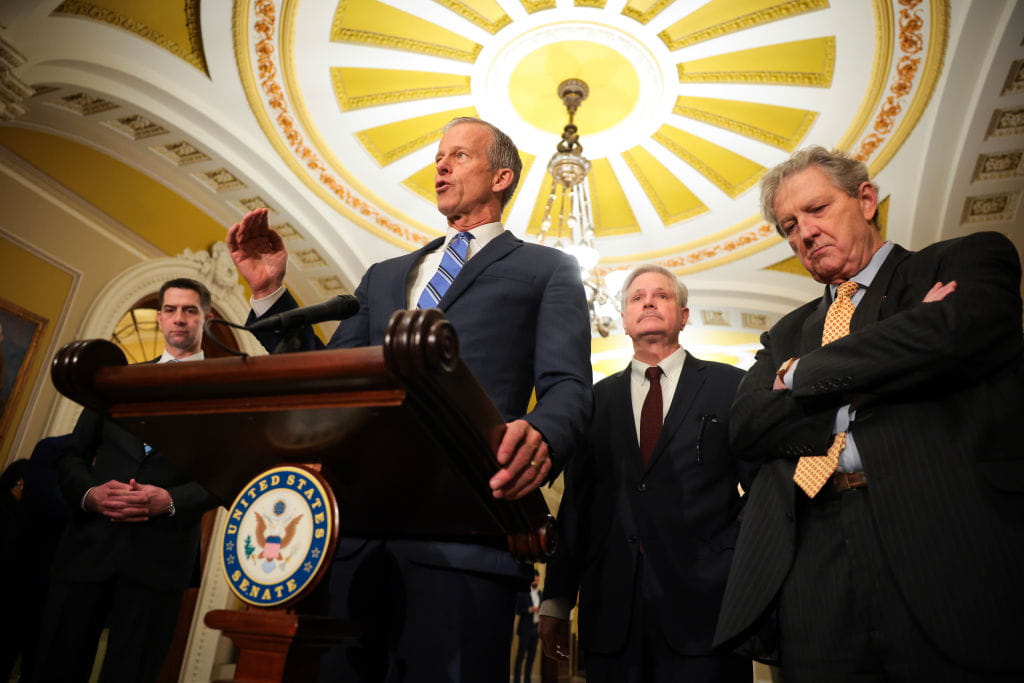
Sen. Thune maintains that he isn’t willing to call that vote – and many of his colleagues have made it clear they wouldn’t support it if he did. That said, the days of the filibuster may be numbered anyway, as Democrats seem determined to nuke it as soon as they hold the majority once again.
Then there’s the so-called talking filibuster. Were Republicans to force this method, Democrats – and any opposing Republicans – would have to actively hold the floor by talking in order to stave off the final vote. There’s no time limit on how long these speeches are – a couple have famously exceeded 24 hours – but there are little tricks Republicans can use to speed up the clock ever so slightly.
This method could force the final vote in anywhere from about 12 to 20 days, but it also brings the risk of unlimited amendment attempts. If Thune doesn’t manage it carefully, the process could take as long as about three weeks and result in a final bill that includes dozens of other policy riders from either side of the aisle as well. Think what Thune is doing now by adding Trump’s amendment goals, only a hundred times bigger. There’s no guarantee the House would pass such an amended bill, nor that the president would sign it into law. And even if they did – what would we the people be stuck with in the aftermath?
Reconciliation and Irreconcilable Differences
Bipartisan support is a pipe dream. The only way that’s even remotely likely is if Republicans manage to convince Democrats to sign on by giving them huge concessions in other areas – and even that’s a long shot, considering the partisan divide on these issues. Nuking the filibuster is doable if more Republicans were on board, but it risks being a Pandora’s box down the road. The talking filibuster, seemingly the middle ground, could work – again, if more Republicans weren’t opposed to it – but like cutting a deal with the Democrats, it could easily result in a bill that sticks America with so much more than voter ID, if it even clears the House and Oval Office.
Sen. John Kennedy (R-LA) has another idea: reconciliation. For the uninitiated, the reconciliation process is the rebellious child of the modern filibuster, birthed in the early ’80s. It has been used a couple of dozen times since to “reconcile” budget bills between the House and the Senate, and it requires only 51 votes, making it a convenient way around the filibuster. But here’s the catch: According to what’s called the Byrd rule, there are limits to what can be passed this way. Without wading too deeply into the technical details, reconciliation is only for budgetary matters.
Every part of this bill – from voter ID and proof of citizenship requirements to transgender medical prohibitions and women’s sports regulations – is precisely the kind of policy action the Byrd rule is designed to weed out. The reconciliation process has seen some major policy shifts squeak through, like Obama’s Affordable Care Act, Biden’s Inflation Reduction Act, and Trump’s One Big Beautiful Bill Act. But all of those issues were at least tangential to the budget or dressed up to look as if they were. The SAVE America Act, as currently written, simply is not.

But Sen. Kennedy doesn’t suggest that the bill, in its current form, be adopted via reconciliation. Instead, he implores the many clever lawyers in the Senate to draft a new version that is budgetary. Such a rewrite being blessed by Senate parliamentarian Elizabeth MacDonough as clearing the Byrd rule, however, seems highly unlikely – and then it would have to be accepted by the House as well.
Of the handful of options available, however, reconciliation could theoretically be the clearest path forward on the SAVE America Act as it exists today – assuming the Senate parliamentarian can either be convinced, ignored, or removed, all of which are technically possible but unlikely to occur.
Whatever route the Congress and the president take, something will eventually have to give. Someday this legislative session will end. Someday Democrats will control Congress yet again. Someday Donald Trump won’t be president. The question today, however, is how much of the meantime the legislature will remain locked up over this single bill.