In this war without direction, no one has a clue. Not Pete Hegseth with his childlike relish for enemy deaths and his characterization of the Islamic Republic as “toast”. And certainly not Donald Trump, who, having let his Israeli allies wipe out much of Iran’s civilian and military leadership, says wonderingly, “all of their leaders are dead… we don’t know who we’re dealing with.”
Ali Larijani, whom the Israelis assassinated on Tuesday, was a ruthless propagandist who broadcast the “confessions” of dissidents broken by torture, and an apparatchik whose National Security Council oversaw the slaughter of thousands of unarmed protesters in January. Yet his long membership of Iran’s ruling clique at least gave him insight into the country’s external enemies. At a pro-regime rally shortly before his death, he observed that “Trump’s problem is that he doesn’t understand that… the more pressure he applies, the stronger the [Iranian] people become.”
For nations driven by patriotism, religion or both — Iran, the Palestinians, Ukraine, Russia, Israel — capitulation becomes more unthinkable the longer the casualty list. In this, the Iranian regime has form. Drawing on its experience of fighting Iraq in the Eighties, when the Islamic Republic was a production line of commanders going fearlessly to their deaths — recall one-armed Hossein Kharrazi, who was killed while diverting a subordinate away from enemy fire, and is remembered by his men for his valor and self-sacrifice — the state replaces fallen generals and politicians quickly and without fuss.
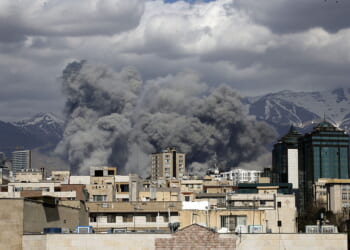
So far, at least 1,500 Iranians have been killed, including hundreds of civilians; much infrastructure has been destroyed. Now Trump is openly contemplating an invasion of the island of Kharg, off Iran’s southern coast, from where the country’s oil is dispatched to China and other more clandestine markets, while the CIA has been encouraging a rebellion among the Kurds in the country’s western provinces.
All the while, Mojtaba Khamenei, the country’s new supreme leader, who lost his wife, son and perhaps a leg in the attack that also killed his father and predecessor, Ali, promises a life without security for the regime’s enemies, both “domestic and foreign.” His Islamic Republic, a pariah state, tells the world’s most powerful military: bring it on.
That Iran derives strength from adversity and prefers heroic defeat to ungentlemanly victory derives in part from the foundation epic of Shia Islam. In 680, the Imam Hussein, the Prophet Muhammad’s grandson, along with a tiny band of followers, was put to the sword by the powerful caliph, Yazid of Damascus, in what is now southern Iraq. Iran’s sectarian identity works in tandem with cultural exceptionalism. The Persian language emerged from the Arab invasions of the 630s energized and expanded, becoming a tool fit for the works of beauty that Persian poets went on to compose.
Similarly, Islamic beliefs and Persian forms merged to create a new aesthetic, visible in cities like Isfahan and Tabriz, and which spread as far as Central Asia and India. No one, then, has ever accused Iran of suffering from an inferiority complex. Or, for that matter, of excessive deference towards the parvenu Arabs of the Persian Gulf, the Arabs, in the words of an old bit of doggerel, grubbing around for lizards while the Persians sip chilled water.
Since the war began, Iran’s drones and missiles have exacted a death toll of fewer than 50 on the far side of the Gulf, but put the regimes in question, to say nothing of world oil markets, into a tailspin all the same. As for the people of Beirut, bombarded by Israel while calmly receiving hundreds of thousands of refugees from Benjamin Netanyahu’s furious assault on south Lebanon (itself prompted by Hezbollah’s feeble strikes on Israel following the elder Khamenei’s assassination), they poke fun at their neighbors in the Gulf for gathering up their dishdashas and running for the basement at the first sound of tinkling glass.
Many ordinary Muslims thrill to the spectacle of plucky Iran refusing to bow to the oppressors of the Palestinians. Pro-Iran demonstrations were held in Iraq and Pakistan following Khamenei’s assassination, the latter costing at least 22 lives, while, on 11 March, President Recep Tayyip Erdogan of Turkey, a majority-Sunni country, pledged solidarity with Shia Iran. “We have but one religion,” he declared in parliament, “and that is Islam.”
Between US and Israeli attacks on military installations, gas fields, and the odd school, Iranian life goes on. Notwithstanding the danger and inconvenience, families convened yesterday to celebrate the Persian New Year, pride of place in homes being given to seven auspicious items (garlic; apple; a brown pudding with a base of wheat sprouts; sumac; the powdery fruit of the jujube-tree; vinegar; and coins), even if the traditional feast of herb rice and Caspian carp (beware: the tiny bones have a habit of lodging in the windpipe) has long been abandoned in favor of more affordable fare.
Yesterday I got through to Ali Dehbashi. An editor and literary doyen living in Tehran, I’d called to wish him Happy New Year. Dehbashi told me that his son Shahab had had a narrow escape that morning, when a house three doors down was obliterated in an Israeli airstrike. The target was Ali Muhammad Naini, the Revolutionary Guards spokesman: not that Shahab had any idea they were neighbors. His father is a pigeon fancier, but when I asked after the birds, Dehsashi told me that two pigeons and a canary had dropped dead from shock at the racket produced by Israel’s war machine. Having the misfortune to live on Palestine Square — which boasts a clock counting down the days to Israel’s longed-for destruction — he went on with typical understatement, “I suppose one is in the firing line.”
At the outset of the fighting, Trump urged Iranians to “take over your government” as soon as the dust had settled, for “the hour of your freedom is at hand.” Since then, in one of those cognitive exercises he lets us observe, like a child showing off his ability to join one bit of playdough to another, he has changed his mind. The President now deems a popular uprising unlikely because the security forces “have people in the streets… machine-gunning people down if they want to protest.” A few inquiries beforehand would have saved him from any misapprehension on this score and the world a lot of pain.
The irony of Trump and Netanyahu’s war of liberation is that it has silenced those opponents of the Islamic Republic who continued to agitate for freedom even after January’s massacre. Many had urged Trump to bomb the country to oblivion, placing their hopes in a restoration of the monarchy under Reza Pahlavi, the exiled son of the last Shah. Now, three weeks into this conflict of unexpected intensity, the true sentiments of the majority are hidden behind an intermittent internet blackout. Treat with caution the prognostications of Iran specialists in the US who haven’t seen the country in decades.
That said, the longer the pounding goes on, the more schools are hit and the more damage is done to buildings of national importance — it’s the meticulously cut mirror pieces adhering to the muqarnas, or stalactite squinch, that fall like dandruff when a bomb slams into the barracks a block away — the greater the likelihood that feelings towards the aggressors will cool.
The authorities are taking no chances. The national police chief, Ahmad-Reza Radan, has warned that should “scum, spies and hirelings”, his catch-all for pro-democracy protesters, return to the streets on the advice of Trump, Netanyahu or Pahlavi, they “will be treated as the enemy… our boys have their fingers on the trigger, defending their revolution, protecting their people and their country.” On Wednesday, three young men were executed for killing policemen in the January unrest.
For all his disagreeable qualities, Larijani’s removal has robbed Iran of an experienced negotiator who might have helped bring the war to an end before the country turns entirely to ashes — one of the reasons, it has been suggested, why Netanyahu targeted him. At present, peace suits neither the Israeli Prime Minister, who on Thursday said that the war would continue “as long as is necessary”, nor those Revolutionary Guardsmen for whom the current hostilities are an opportunity to militarize the Islamic Republic.
In all this, the hardliners may have an ally in Mojtaba Khamenei. His meager credentials as a Shia theologian are far from commensurate with the almost pontifical office, the guardianship of the jurist, which he lately inherited. The new supreme leader owes his elevation to the Guard. Assuming he stays alive — the attack that killed the father is thought to have left the son with life-threatening injuries — the clerical character of the Islamic Republic will fade and it will more closely resemble a uniformed dictatorship with a nationalist character.
Not a day passes without an official warning of threats to the country’s territorial integrity: code for foreign-funded agitations among the country’s Kurdish, Baluch and Arab minorities. But Iran isn’t in danger of falling apart. It isn’t Afghanistan or Iraq, modern confections of mutually antagonistic groups. Rather, it has a natural coherence based on the supremacy of the Persian language; its geographically logical homeland on the Persian plateau, ringed by seas and mountains; and the Shia Islam to which most Iranians adhere.
For centuries, indeed, these strengths have enabled Iran to survive invasions, violent changes of dynasty, famines, tribal uprisings, regicides and years of meddling by imperial Britain and Russia — not to mention the 1979 revolution itself. They will offset the centrifugal forces that Trump seems intent on stimulating. For the true danger to Iran is not disintegration, but implosion.
When Trump and Netanyahu decide that they have had enough, Khamenei and his friends in the Guard will have to deal with the same rotten institutions and ruined economy, the same seething anger and desire for change, that brought the people onto the streets in January — with the difference now that any chance of a diplomatic solution to Iran’s isolation has been foreclosed while Israel will continue to bomb the country and sabotage its institutions on a rolling basis. In the meantime, the “scum, spies and hirelings” haven’t gone away, and they have even less to lose. The police chief shouldn’t book any holidays.
Iran is experiencing the most evil days in its modern history. To mark an earlier catastrophe, the Anglo-American coup d’etat that ejected the country’s legitimate prime minister, Muhammad Mossadegh, in 1953, ushering in a quarter of a century of monarchical despotism, the poet Mehdi Akhavan-Sales composed the following lines which an Iranian friend of mine recently found himself reaching for.
“My house has caught fire, a soul-burning fire,
This fire burns in all directions,
Burning the curtains, the rugs, warp with weft,
I run aimlessly, crying, in the flames of the smoke-laden fire,
And amid my bitter laughter,
And the lamentation of my mirthless tears,
From a burning core,
I scream…”