If there’s one thing every generation of Americans has in common, it’s that they’re worried about the next generation.
And let me tell you, as a father of young children, I’m very worried about what’s around the corner for this country — and a viral clip making the rounds on social media is only amplifying those fears.
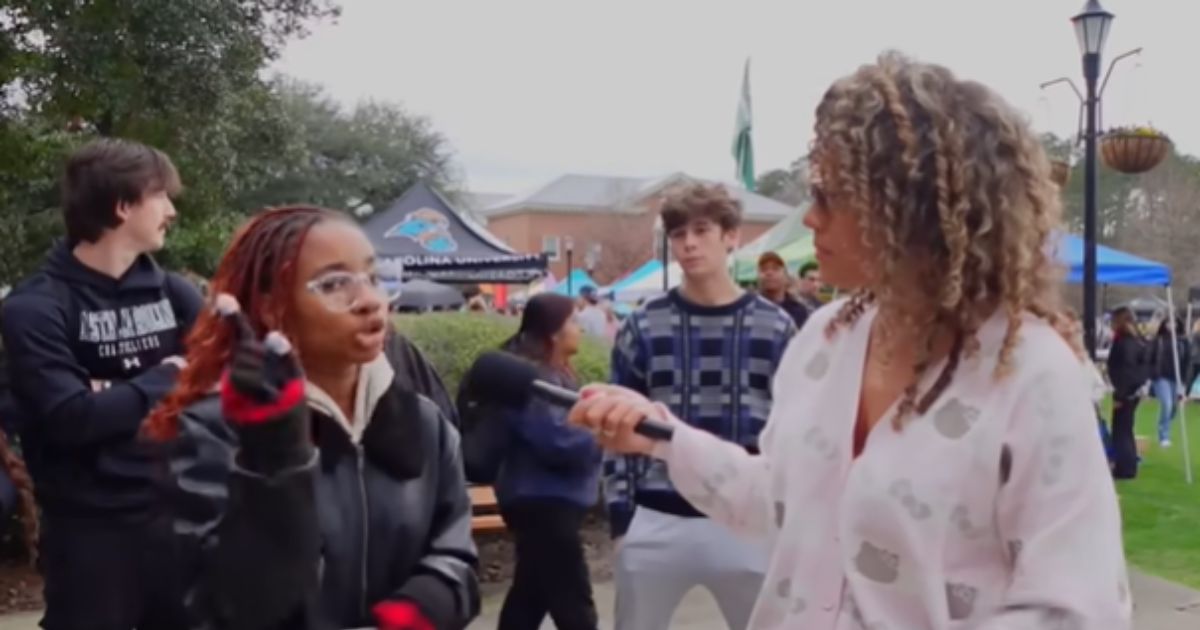
In January, “Her Patriot Voice” — a conservative YouTube channel run by Savannah Craven — posted a video showcasing her visit to Coastal Carolina University.
Craven was at CCU to discuss one of the more polarizing topics in modern discourse: Immigration and Customs Enforcement.
Sadly, instead of anything resembling nuance or thoughtfulness, Craven was met with, well, this:
While the entire 30-minute video will probably erase whatever shred of faith you had left in the modern American education system, there is one particularly troubling exchange I want to call a little more attention to.
At about 2:36 into the video, a young, black, female college student approaches Craven with a rather loaded question.
“Why would you say you support ICE?” the student asked Craven.
“Yeah, because they would get rid of these rapists and murderers that killed American women,” Craven responded without missing a beat and drawing attention to her poster.
And this is where the first blunder happened.
“So, are all of the immigrants that come into America rapists and killists?” the student fired back.
“Killists”? “Killists“??? Look, I’ve never been to CCU and it looks like a lovely campus, but hopefully this student isn’t in the school’s English program.
Craven, a much better person than me, didn’t hound the student about her vocabulary, and simply answered, “Nope.”
“Okay, so…” the student trailed off.
“So let’s get rid of these ones,” Craven said, pointing to her sign again. “You agree with that?”
“Yeah,” the student said.
“Okay, so you support ICE removing them,” Craven said.
“No.”
Craven then turned to the camera in a fourth-wall-breaking moment, as she tried to process the nonsensical logic. Little did she know she was about to be hit with another word that doesn’t exist.
“I support the condemption, as you said, of a rapist,” the student said before veering the conversation into some bizarre screed on race.
“Killist.” “Condemption.” Yowza. Perhaps unsurprisingly, the rest of the conversation did not go one iota better.
When Craven pressed the student to name one racist thing that President Donald Trump had done, she crashed out and started getting annoyed that Craven was a Trump supporter.
But the ultimate punchline? For as much of a bogeyman as ICE was to this student… she couldn’t even spell out what the ICE acronym stands for.
What you just watched in that exchange is a total and complete collapse in basic reasoning, and a textbook example of why you should never bring a butterknife to a bazooka fight.
The student’s argument, such as it is, seems to reduce down to something a toddler might say: removing people — even those she admits are worthy of condemption — is “mean,” and therefore it shouldn’t happen.
That kind of thinking might earn a sympathetic nod in a kindergarten classroom, but on a college campus, it’s beyond alarming. This is supposed to be the stage of life where young adults sharpen their critical thinking, not abandon it entirely in favor of whatever feels emotionally comfortable or acceptable in the moment.
And that’s the deeper issue here. It’s not about one awkward interview or one student fumbling through a tough conversation. It’s about an environment that appears to reward vibes over logic and slogans over substance.
When a student can simultaneously agree that violent criminals should be condemned but oppose removing them — and do so without recognizing the contradiction — I don’t think you could even describe that as a difference of opinion. It’s more akin to intellectual short-circuiting.
Worse still, the conversation quickly devolved into the all-too-familiar escape hatch: vague accusations and emotional deflection. Asked to provide a concrete example of alleged wrongdoing, the student pivoted, grew visibly frustrated, and leaned on broad, unsubstantiated claims instead.
It’s a pattern that’s become increasingly common: assert first, defend never, and when pressed, retreat into indignation rather than engage with the substance of the question.
If this clip is any indication, the concern isn’t just what the next generation believes — it’s how they think.
And if higher education is producing graduates who can’t follow a basic line of reasoning, can’t reconcile contradictions, and can’t defend their own positions under minimal scrutiny (to say nothing of the vocabulary), then the problem runs far deeper than politics. In fact, despite the topic of the video, this has very little to do with ICE or immigration.
It has a lot to do with whether the institutions tasked with shaping young minds are still doing that job at all.

Advertise with The Western Journal and reach millions of highly engaged readers, while supporting our work. Advertise Today.