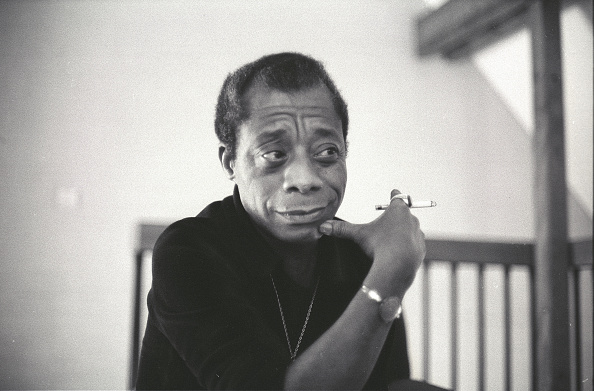
There is a famous line, often quoted and excerpted, from the 1970 documentary Meeting the Man, about the great American writer James Baldwin. In a moment of seriousness — really an exquisite performance of barely-controlled fury — Baldwin says: “Love has never been a popular movement, and no one’s ever wanted really to be free. The world is held together, really it is, held together, by the love and passion of a very few people. Otherwise, of course you can despair. Walk down the street of any city, any afternoon, and look around you. What you’ve got to remember is that what you’re looking at is also you. Everyone you’re looking at is also you. You could be that person. You could be that monster, you could be that cop. And you have to decide, in yourself, not to be.”
This is deadly earnest stuff, pitched like a sermon: in a lesser writer’s hands it might tilt toward the sentimental. But in Baldwin’s voice (which, by that point in his career, was nearly the same in talking as it was in writing), it is graceful, perennially relevant, and true. These days, when even the word “empathy” sounds to some like the language of stuffy social justice activism, the mere mention of race or sexuality only sets off the same dull culture-war script we’ve been playing out for decades. In our general hangover from the whole “Woke Era” (for lack of a better term) — which essentially canonized Baldwin as a kind of guiding shaman/saint — we run the risk of forgetting the pressing racial and sexual issues that era ultimately failed to address. We may be tired of hearing about them; we may resent the proliferating academic vocabularies with which they were often discussed; but we’re still not free of them. Nor are we free from the insight and genius of James Baldwin himself, who really was one of the most important writers on the intertwined evils of racism and sexual bigotry.
Though really, Baldwin was one of the finest American writers full stop: an excellent novelist and a moral essayist without any peer in the 20th century. He was also an unbelievably complex man: self-loathing and self-indulgent; courageous; jealous; a born performer, who enjoyed his fame, yet remained essentially religious in his sincerity and commitment to civil rights campaigns in America. These were the same paradoxes out of which he penned numerous of the most personal stories and essays of his time — and it’s this picture of Baldwin that Nicholas Boggs’s tremendous new biography, Baldwin: A Love Story, gets perfectly right. The key is in the subtitle, A Love Story. Since, at least in Baldwin’s writing, everything always came back to that most easily over-complicated, easily-dismissed, ubiquitous four-letter word.
“The world is held together by the love and passion of a very few people.”
In pursuit of its subtitle, Boggs’s book divides itself into sections, according to the great male loves of Baldwin’s life. The first — not a sexual relationship, to be clear — spans his early years under the influence of his mentor, the great Harlem Renaissance painter Beauford Delaney, whom Baldwin met as a young man in Upper Manhattan. The rest of the book covers several longer periods, in each of which a particular man (generally a bisexual, often married, man) became the focus of Baldwin’s artistic and romantic imagination: first the Swiss painter Lucien Happersberger, then the Turkish actor Engin Cezzar, then the French artist Yoran Cazac. These periods roughly correspond to those passages of time which Baldwin spent in France, in Turkey, and finally, in France again. Indeed, despite his many trips back to America — particularly in the Sixties — Baldwin spent most of his life in relative exile from the United States, bouncing between paramours.
Besides his many smaller love affairs, Baldwin’s greatest romances revolved around vague domestic fantasies about these “mostly heterosexual” men, and the commingled “family” of people he gathered around him: artists like Delaney, friends like Mary Painter, or personal assistants like David Leeming, Baldwin’s eventual biographer. Boggs is exhaustive in his attempts to tie these romantic pursuits — along with Baldwin’s developing sense of himself as a black, gay man in a time of absolute upheaval around American society’s relationship to those identities — into the progression of his novels, from Go Tell it On the Mountain (1952) to Just Above My Head (1979), and his greatest works of non-fiction, from Notes of a Native Son (1955) to The Devil Finds Work (1976). There is almost nothing in Baldwin’s own books which Boggs can’t trace back to what was happening in the writer’s life as he planned, wrote, and revised these works, sometimes over years.
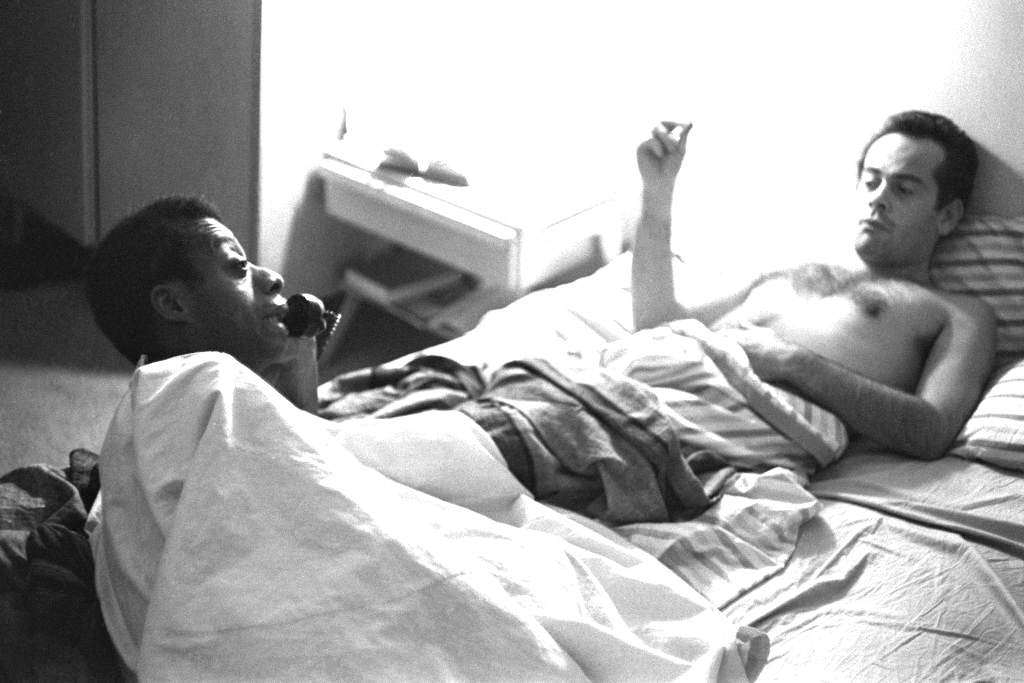
At times, this gives the reader an insightful look into Baldwin’s actual creative process. Yet Boggs’s biographical literary-critical method verges on becoming a vice, hewing pretty closely to the most clichéd ideals of writing-as-therapy, sometimes leaving little room for the possibility that Baldwin’s creations might have come from a deeper imaginative space, and not just from an attempt to achieve personal catharsis. Still, if it is a vice, it’s the only one, in what is otherwise a remarkable book of social and personal history. Some passages are so vividly rendered, Boggs manages to do the near-impossible, making one of the most tumultuous times in American history — the crest of the Civil Rights Movement in 1963 and 1964 — seem furiously present-tense and unpredictable. This is especially true of the episode encompassing Baldwin’s near-breakdown, while trying to stage his first play, Blues for Mister Charlie, with Lee Strasberg’s Actors Studio in New York. Baldwin’s unbelievable levels of stress make sense, when one realizes he had only recently traveled to a violently desegregating South, afterwards organizing his infamous meeting with Robert Kennedy, to get more explicit support for civil rights campaigners. He had also just participated in the March on Washington, where his scheduled speech was pulled, partially due to Baldwin’s reputation as a known homosexual.
Given his intimate relationships with fellows artists like Lena Horne, Marlon Brando, and Lorraine Hansberry — as well as his his brief friendships with civil rights leaders like Malcolm X, Medger Evers, Martin Luther King, Jr., Huey Newton, and Stokely Carmichael — it’s no surprise that a biography of Baldwin also doubles as a social history of American culture from the Forties to the Seventies. It reveals him as one of his own time’s greatest and sharpest moral voices — a man writing with unforgiving clarity about the inner struggles of black Americans and sexual minorities, not to mention the moral rot of a white America that couldn’t let go of its racial divisions (nor its deep psychosexual angst about those divisions, something Baldwin insisted was irrevocably intertwined with the roots of white supremacy). And at a certain point his expatriate exile and homosexuality both left him nearly adjunct to the newly forming canon of black American art.
Yet what remains most inspiring and influential in Baldwin’s writing is how he recognized, from the start, that the struggle for freedom for Black America (and White America, too, in the end), was inseparable from his own search for personal freedom, for the freedom to create himself. Like his close friend (and fellow genius) Nina Simone, the righteous rage which radiated out from his words was an undeniable personal rage, not just a greater, symbolic one. For Baldwin, the need to be free — free as a gay man, and as a black man — in a society set up to punish him for being either, was no different from the call for greater freedom across America, or across the globe. Yet for him the American Dream was a fairly monstrous myth, a myth of American innocence: one in which the country’s vision of freedom always came at the expense of the enslaved and the persecuted. Real freedom would require those who profited the most from the arrangement — white Americans — to let go of their innocence, to realize the horrors which had been required to create that naïve Dream.
That is, seriously grappling with American racism would mean understanding just how much it had to do with sexual fear and jealousy (as all racism ultimately does). But what was clear to Baldwin — one of his darkest but most important insights — was that there is no greater nightmare than America’s perennial wish to believe in that innocence. As he stated many times over, the creation of “white” as a category not only built a framework excluding black people from free society, it corroded the souls of white Americans, too — by only ever allowing them to be white. Reducing their lives and identities, to arbitrary ideals of racial purity, which would have to be defended (no matter how absurd, or immoral) in order to preserve the institution of slavery. For Baldwin, the restoration of abused black Americans, after centuries of horrors, would mean getting to the bottom of the historical disaster that was “whiteness” — which had left white Americans as confined to that destructive racial category as their black compatriots were to theirs.
Of course, there is a kind of fatalism that crops up, when we consider just how long this historical situation went on, how much it still defines American society. Baldwin himself spent much of his career growing weary and pessimistic about the hope for this kind of large-scale change. There are echoes of his later stance — his sadness about how little could be done to really achieve equality for black Americans and sexual minorities — in the general pessimism which has plagued so many social justice movements this century. Indeed, there is still widespread exhaustion with how much still has to be done, not least in combating poverty, or dismantling America’s hellish prison system (not to mention the kinds of outright white supremacist rhetoric and sexual bigotry which the MAGA movement has been happy to popularize again, even ironically). Across the 2010s and into the early 2020s, this pessimism tended to manifest as a directionless obsession with guilt, atonement, and the moral surveillance of other people — something our social media panopticons make too easy. Yet puritanical strains of social justice campaigning simply run counter to reality: freedom can’t be achieved by defining and enforcing any particular creed or morality. In order to be free, people must, as the philosopher Hegel once said of Shakespeare’s characters, be able to become “free artists of themselves” — a phrase which fits Baldwin’s own personal mission of freedom perfectly.
Baldwin was adamant, always, that though the world may be broken, though pessimism may in fact be realistic, people still always have a choice to love. We may call that trite, or dismiss it as sentimental. We may complain about how unrealistic it is, or about how many complicated political issues there are that get in the way of ostensibly simple ideals like love and peace and, yes, empathy. Yet if we don’t accept the possibility that love is always a choice — vulnerability, difficulty, pain be damned— then we doom ourselves (and each other) to hate, violence, ignorance, and evil. In a way, it’s exactly as simple as this. A lot of political rhetoric is only designed to make it seem ridiculous compared to, say, the realpolitik of immigration or law enforcement (as if human morality and spirituality could ever be reduced to a political argument). But if there is any lesson to be taken from James Baldwin’s life and work, it is that no matter how fatalistic we are, no matter how “realistic” we may wish to be, the only things that matter in the end are the things we do out of love. And that real human freedom would be the highest possible expression of that love.