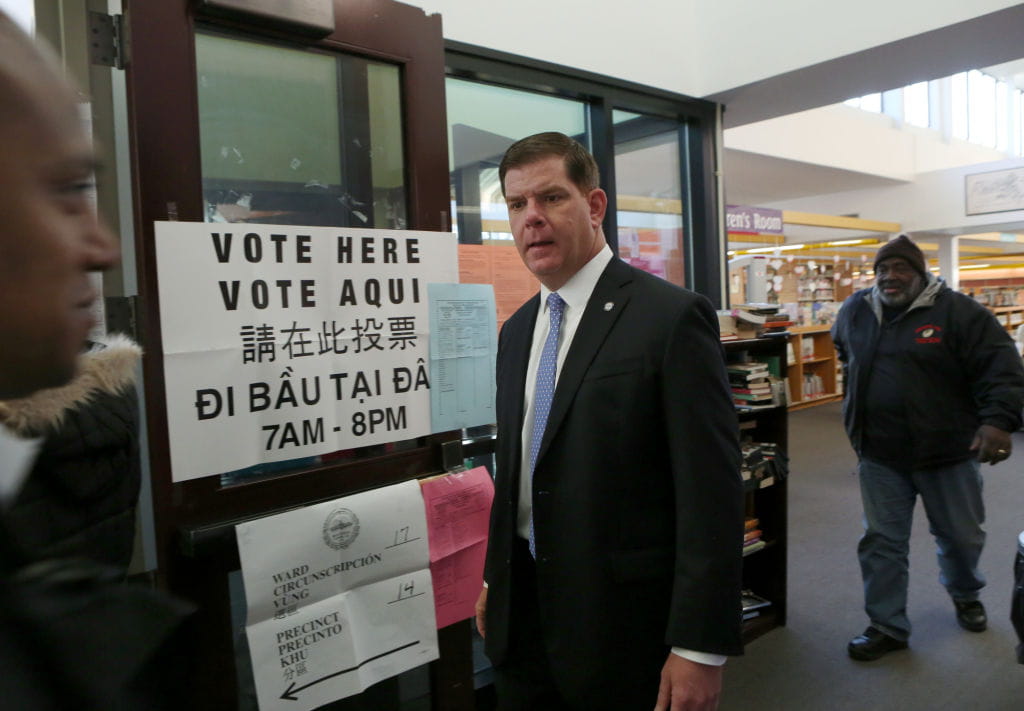
The city of Boston is considering new legislation to allow non-citizens the right to vote in local elections. The proposed rule would grant voting rights to non-citizens with “legal status,” impacting an estimated 675,647 residents, or just shy of 30% of the city’s population. The Department of Justice has other ideas.
“Boston is home to thousands of legal residents who contribute every day. They are our workers, parents, students, small business owners, people who deeply invest in their neighborhoods and in the future of the city,” said Councilor Julia Mejia, who introduced the home rule petition to expand voting rights. “They pay taxes and they do their fair share of heavy lifting when it’s time to act, yet they’re excluded from decisions that directly shape their schools, their public safety, and their daily lives.”
The petition comes after the US Department of Justice (DOJ) sued the city of Boston and Mayor Michelle Wu for its “sanctuary” policies restricting local law enforcement from working with federal officers on immigration enforcement operations.
Let Boston Non-Citizens Vote?
The petition states that “every legal resident” in Boston aged 18 or older may apply to have their names included in a list of “legal voting age residents,” who will be able to vote in “any election for local offices and local ballot questions.”
“The voter registration forms shall include a declaration to be signed under pains and penalties of perjury by the applying non-citizen voter that: (1) the individual is a legal resident of the city of Boston and the United States; (2) the individual, in good faith, intends to become a U.S. citizen and intends to begin that process, if eligible,” the petition continues. “Every non-citizen legal voting age resident who signed this declaration shall remain eligible to vote in any municipal election as long as they remain a resident in the city of Boston.”

Legal voting age residents would be compelled to register ten days prior to municipal and preliminary elections. The rule notes that non-citizens will not be able to vote in state or federal elections, and a separate ballot will be provided if a local ballot question appears on a state election ballot.
This is the Boston City Council’s second attempt to extend voting rights to non-citizens. In 2023, lawmakers voted 8-4 to pass a similar petition, but it failed to move forward in the Massachusetts State House.
‘Sanctuary’ City Lawsuit
The DOJ’s lawsuit against Boston and Mayor Wu alleges the city’s Boston Trust Act violates the US Constitution’s Supremacy Clause. The legislation in question blocks the Boston Police Department and other local authorities from cooperating with federal immigration enforcement.
“The City of Boston and its Mayor have been among the worst sanctuary offenders in America – they explicitly enforce policies designed to undermine law enforcement and protect illegal aliens from justice,” Attorney General Pam Bondi said in a statement. “If Boston won’t protect its citizens from illegal alien crime, this Department of Justice will.”
Mejia argued President Donald Trump’s administration-wide crackdown on illegal immigration is precisely why the city should grant non-citizens voting rights:
“Today, we’re back again because the urgency of this issue has only grown at a time when immigrant communities are facing increasing attacks, harmful rhetoric and fear. We have a responsibility at the local level to respond. This is about morale and whether our immigrant neighbors feel seen, valued, and protected in the cities that they call home.”
Non-Citizens Already Vote
While federal law blocks non-citizens from voting in federal elections, jurisdictions across the United States allow non-citizens to vote. Washington, DC, San Francisco, California, over a dozen municipalities in Maryland, and at least three cities in Vermont allow non-citizens to vote in local elections, according to Ballotpedia, a digital encyclopedia of American politics.
The Pew Research Center revealed that America was home to more than 28 million non-citizens in 2023, including 11.9 million permanent residents, 2.1 million temporary residents, and 14 million illegal immigrants.
For Americans against extending voting rights to non-citizens, all hope is not lost –18 state constitutions currently prohibit non-citizen voting: Alabama, Arizona, Colorado, Florida, Idaho, Iowa, Kentucky, Louisiana, Missouri, North Carolina, North Dakota, Ohio, Oklahoma, South Carolina, Texas, Utah, Wisconsin, and Wyoming.