Empathetic immigration policies put our country at great risk.
During a dinner at the annual gathering of the Ciceronian Society on March 19, a glance at my phone profoundly changed the rest of the evening. It had been an intellectually stimulating day with fellow Christian thinkers, for which my wife and I were grateful to be part of. Something familiar caught my eye: the photo of a man I instantly recognized, Brandon Shah. We were part of the same staff group section within the larger U.S. Army Command and General Staff College class of 2019. Brandon never used X, so I was immediately curious why he was showing up so prominently on my feed. Immediately, the following words accosted me: “The victim of the terrorist attack at Old Dominion has been identified as Lt. Col. Brandon Shah.”
My pulse raced, followed moments later by sudden rage. My anger over how the political class has betrayed veterans of the so-called Global War on Terrorism rekindled. My wife could tell something was bothering me. “Are you okay?” she asked. I wasn’t. My focus on the planned presentation I was to deliver later broke, my mind hijacked by a kind of mourning I had avoided throughout 20 years in the military due to learning that a man I served with died in combat on home soil.
For decades, I’ve observed our politicians signaling support for the troops, thanking us for keeping the nation secure. “I’m making the future safer for my descendants” is the bargain I believed and accepted in exchange for missing significant portions of my sons’ young lives. Then they imported the very threat they sent us to neutralize. We veterans of the war on terror did our part. But the government failed to uphold its end of the agreement, an egregious betrayal for which no amount of hollow “thanks for your service” incantations can cover.
For decades, policymakers and commanders full of utopian dreams and desperate to cement their legacy engaged in open-ended missions to rebalance the scales of power overseas rather than defend our own homeland.
As my colleagues and I were sent to foreign fields under arms, we were denied the ability to carry arms on home soil for personal defense. Firearms are restricted on military installations, and in most civilian settings where service members labor. Due to military regulations and local laws, troops are denied many of the Second Amendment protections they fight to uphold.
America for Americans
Brandon died at the hands of the terrorist Mohamed Bailor Jalloh, a man who immigrated to the U.S. from Sierra Leone. He was arrested in 2016 for attempting to offer material support to ISIS, gather weapons for a terrorist attack, and provide funds for people hoping to join ISIS. He pleaded guilty, was sentenced to 11 years in prison, and was released early in 2024 for completing a substance abuse training program. Had his original sentence been carried out, Jalloh would have remained incarcerated through 2029. Details on his immigration or past life events are hard to come by, as they often are when the murderer isn’t a white man, or one classified as such by the mainstream press.
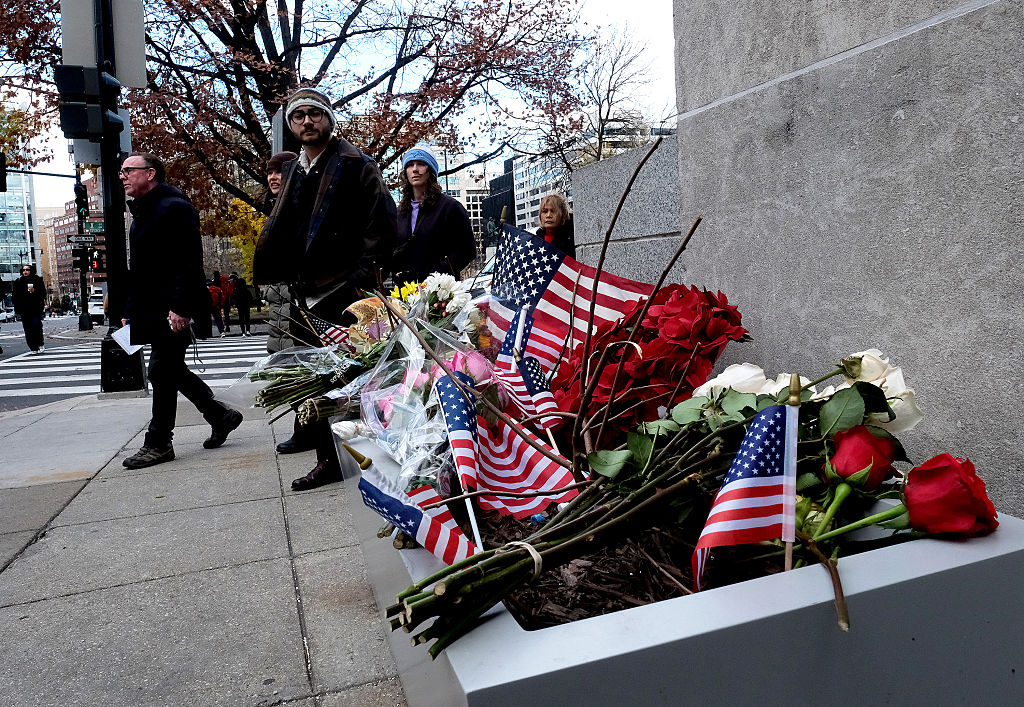
Brandon’s death is not the first instance of the U.S. homeland being turned into a combat zone. On November 26, 2025, an unvetted Afghan national, Rahmanullah Lakanwal, attacked a National Guard patrol in Washington, D.C., killing Army National Guard Specialist Sarah Beckstrom and severely wounding Air National Guard Staff Sergeant Andrew Wolfe. President Trump rightly awarded the Purple Heart to both. What they faced that day was engagement with an enemy combatant on U.S. soil. On September 8, 2021, Lakanwal was imported via the Operation Allies Welcome program, which allowed Afghans who wouldn’t fight for their own country to resettle here. Chaos and empathy prove a deadly combination.
We’re all aware of the deluge of illegal immigrants that flooded the nation because of the Biden Administration, which welcomed them with all but celebratory parades. Ending illegal immigration is a righteous priority. But left largely ignored, even by conservatives, is the legal means of immigration that imports threat actors. Senator Ted Cruz is well known for his take that “legal, good; illegal, bad.” But that’s incorrect. Jalloh was in America legally. Both he and Lakanwal seem to pass the Cruz test. But neither belongs here.
Fighting Them Here
My generation of veterans served under the Bush Doctrine, which stated: “We will fight them over there so we do not have to face them in the United States of America.” Yet, while we were sent overseas for the past two decades and counting, the U.S. political class accelerated immigration from Islamic countries, where the populace holds hostile views toward the Christian values upon which America was founded. Worse yet, those who demonstrate open loyalty to groups that want to destroy us are allowed to remain. Even John Walker Lindh, dubbed the “American Taliban,” was released early from prison despite retaining his Islamist beliefs.
The day of Brandon’s death, Norfolk Commonwealth’s attorney Ramin Fatehi blamed Shah’s death on a love of guns that constitutes a “national sickness.” In reality, the national sickness is a critical theory-infused brand of empathy that manipulates Americans toward disordered love, where a foreigner is given priority over familial and regional bonds. Pete Hegseth and David Goodwin called this social doctrine the “Cultural Marxist Paideia” in their New York Times bestseller, Battle for the American Mind. The terms “Islamophobia,” “racism,” and “hatred” are used to intimidate and silence patriots by those who have rushed the Trojan horse through American streets.
Joe Rigney’s argument that the West has a deadly obsession with empathy, the practice of trying to immerse oneself in the suffering of another, proves increasingly sound. This contrasts with sympathy, the righteous feeling of sincere concern for a fellow human being experiencing pain or difficulty. The former attempts to spread the suffering. The latter aids in healing it. In our case, critical empathy makes magistrates subservient to malevolent actors. That framework presents predators as victims who must be yielded to, flipping social contract theory on its head. But our Founders did not sacrifice their lives, fortunes, and sacred honor to give safe harbor to Islamic crusaders.
I’m pleased to see Senator Tom Cotton introduce the Naturalization Accountability Act, which would denaturalize immigrants convicted of felonies or who support terrorist groups. If you want to live here, don’t sympathize and cooperate with those who call for the murder of Americans and chant “Death to America.” Joining the Taliban or offering any support to terrorist groups such as ISIS, HAMAS, Boko Haram, Hezbollah, etc. should be an immediate disqualifier for the benefits of American citizenship—and such people should be deported with haste. The stigma rightly belongs to those who endorse evil.
But in the wake of the tragedy involving Bradon Shah, ROTC and Junior ROTC students at schools around the nation have been directed not to wear their uniforms out of concerns for their safety. The shame is placed upon the virtuous instead. This should not be.
Two days after receiving the shocking news of Brandon’s death, I shared the reflections that grew into this essay instead of my planned presentation at the Ciceronian Society conference. Through a choked voice, I looked at the group picture of Staff Group 2D, U.S. Army Command and General Staff College class of 2019, and concluded by remembering a time when we could gather as military officers to study without fear that Islamic terrorists and battlefield combatants would transform our classroom into a zone of combat.
Brandon and I were not close and did not maintain contact after graduating. But he was a fellow veteran, a man I spent most days of a year with, through both good and frustrating times. He should still be alive, a husband to his wife, a father to his child, and a mentor to his students. His death is a betrayal. Though the terrorist who killed him rightly faced immediate justice at the hands of bold cadets that day, there are many policymakers and enforcers whose hands are stained by their actions.