I was ‘first lady’ at my local Parkrun once. Just once – and I’d been chasing it for months. I’m no elite athlete. I was in my forties at the time, and had been the sort of child who was always picked last in PE. It may have been a free, 5km run in a local park, but coming first felt like winning Olympic gold. If a man who said he was a woman had claimed ‘first lady’, as is allowed under the current rules, I would have been fuming.
So while I was delighted by this week’s announcement from the International Olympic Committee (IOC) that males will no longer be able to compete in women’s categories, the Olympics can’t be treated as a special case. It must be replicated at the grassroots level, too – and not just in sport, but across every part of society.
The IOC’s new president, Kirsty Coventry, was refreshingly clear when she made the announcement. The science is not in dispute. Male biology confers advantages in strength, speed and endurance. At the Olympic level, even the smallest margins determine victory and defeat. It follows that allowing males to compete in the female category is not fair – and in some sports, not safe.
Of course, these are things we have known since the dawn of time. As a 5’3” woman who weighs less than nine stone, I don’t need the IOC to tell me it wouldn’t be safe for me to play rugby against men, or that one punch from a male boxer could seriously injure me. These are not complex or controversial insights. They are basic observations about reality.
And yet it has taken nearly a decade of increasingly absurd controversies for the IOC to say any of this out loud. During that time, female athletes have paid the price.
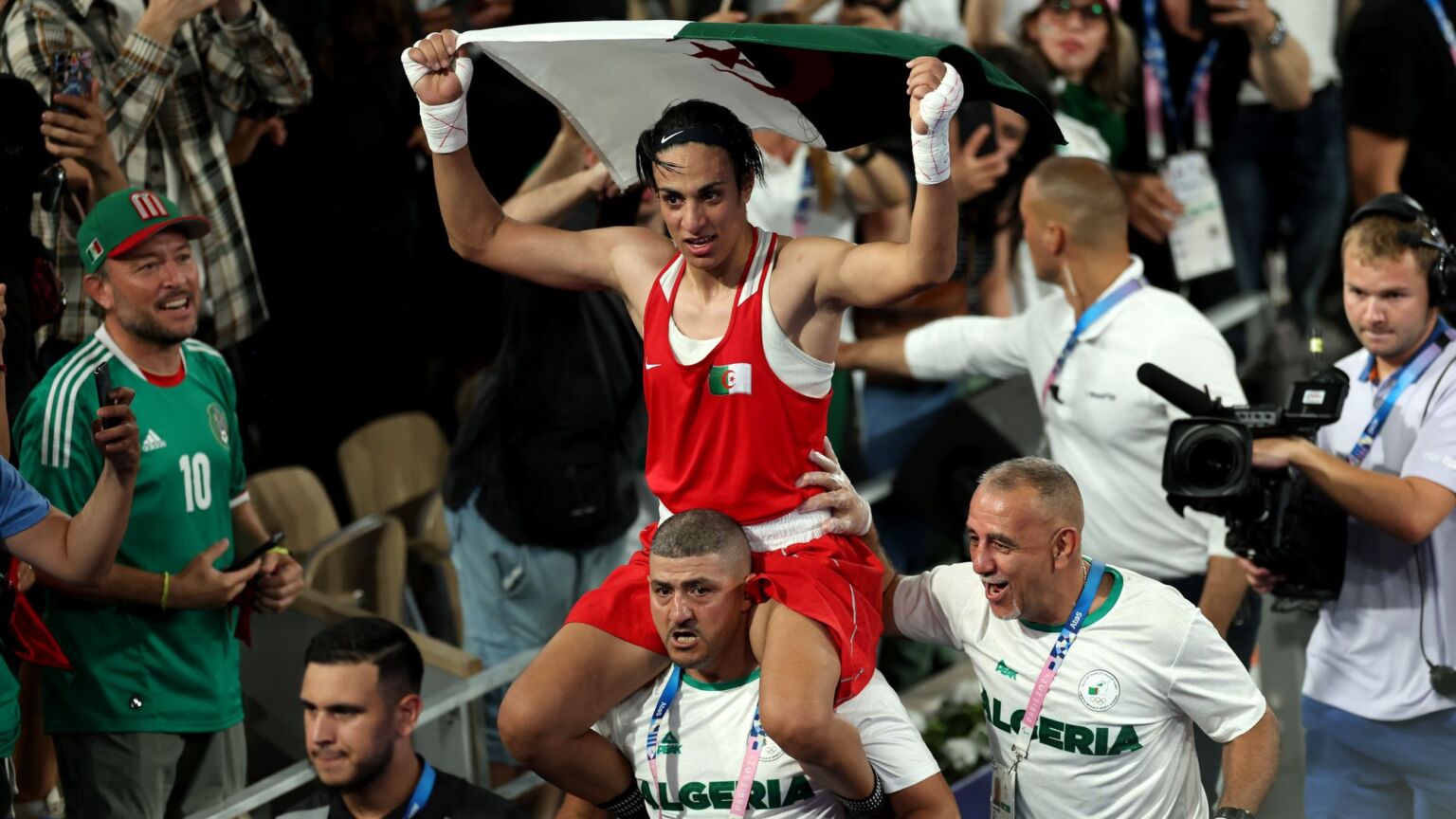
At the 2021 Tokyo Olympics, a male weightlifter from New Zealand called Laurel Hubbard competed in the women’s category, taking a place that would otherwise have gone to a female athlete. The world witnessed an even more egregious attack on fairness and common sense at the 2024 Paris Olympics. Imane Khelif, a male boxer from Algeria, won gold in the women’s welterweight division. Khelif’s bout against Italy’s Angela Carini lasted just 46 seconds. Watching a woman get punched in the face by a male opponent was a new low, and a stark reminder of why sex categories exist.
These are the cases that made headlines. There are many more that didn’t, in which women lost podium places, funding, recognition and the opportunity to pursue their dreams. And in most cases, there will be no justice. The IOC also announced this week that no medals will be reassigned and no records will be rewritten.
The IOC’s welcome decision follows years of campaigning from athletes such as Sharron Davies, Tracy Edwards and Mara Yamauchi, and the persistence of scientists like Emma Hilton. But it should never have taken this to establish something so self-evident. To make matters worse, many of those who spoke up did so at considerable personal and professional cost.
Yet it should be acknowledged why elite sport has been among the first major global institutions to recognise biological reality. Not because the IOC is uniquely brave, but because in sport, the consequences of pretending sex doesn’t matter are immediate, measurable and – in contact sports – possibly dangerous.
Any celebrations about the IOC’s decision should be tempered by the fact that trans activism is far from defeated. Three events from the past week in the UK remind us of how far this post-truth ideology has seeped into our society. There have been tensions and protests inside Girlguiding, following its long-overdue ban on male participants. A transgender woman was appointed to represent an endometriosis charity. And the Crown Prosecution Service referred to a transgender murderer – a man who had previously served in a male prison – as ‘her’. All of this comes less than a year after the UK Supreme Court clarified that ‘sex’ in the Equality Act means biological sex – a ruling that should have settled the matter, but plainly hasn’t.
While sport may have reached the point where reality can no longer be denied, the question is whether other sectors – education, charities, the arts and beyond – will follow, or continue to equivocate. Because the reality is, we don’t get to pick and choose where sex matters. We don’t get to say it matters at the Olympics, but not in grassroots sport.
At Parkrun, males still compete in the women’s category every week, taking places and course records that would otherwise belong to female runners. Their defenders often fall back on the idea that it’s ‘just a fun run’. It isn’t.
I’m speaking in a personal capacity here. The most common issues I deal with as a Parkrun event director are about results – times, placings and personal bests. And that matters across the field – not just for those chasing records, but for those further back, too. Calling it a ‘fun run’ doesn’t change that. And if sex matters in sport, it also matters in the spaces around it – including changing rooms and toilets.
We can’t say sex matters, but only sometimes, and at certain levels of sporting ability. That position is no longer sustainable. It never was. And while I’m thankful the International Olympic Committee has finally acknowledged reality, this will have to be the first of many dominoes to fall if we are to restore fairness for women and girls across sport and beyond.
Janet Murray is a journalist writing on women, culture and public policy. Follow her on X: @jan_murray.