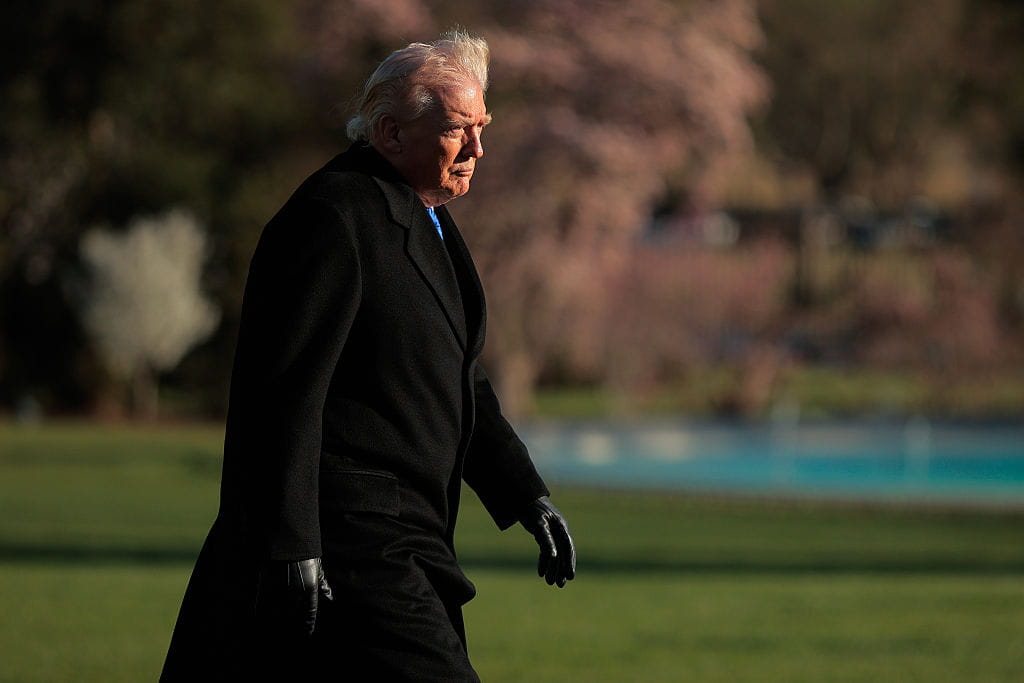
Three reports released in the last month claim American democracy is backsliding. The groups behind these studies claim to be nonpartisan, but their work relies heavily on the opinions of left-leaning scholars from around the world. Two of the organizations turned their data into a story about an authoritarian president who is singlehandedly destroying America’s democracy. Their bias, it seems, is a bug and a feature, making their views appear as solid as an Etch A Sketch drawing.
When Pessimism Diagnoses Democracy
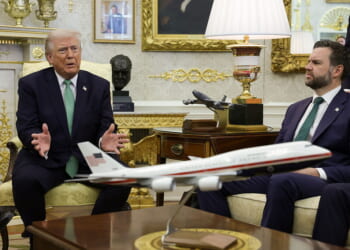
After gathering hundreds of responses from academics and surveying thousands of Americans, a democracy-tracking project called Bright Line Watch concluded that President Donald Trump’s return to the White House has landed the US midway between a liberal democracy and a dictatorship. Its findings come from two surveys, one conducted between December and January, the other between February and March. In the first one, the score for US democracy rose to 60 on a scale of 100, a seven-point increase from the early months of Trump’s second term. After the US captured Nicolás Maduro, the rating slipped to 56 and only gained one point in the second survey.
For comparison, between Trump’s first term and the end of Joe Biden’s presidency, the score remained between 60 and 70, fluctuating occasionally around major events. The current trajectory suggests the nation’s democratic performance will remain in the fifties, with no sign that it will recover anytime soon. Experts predict some improvements will occur over the next decade.
A bit of digging reveals that Bright Line Watch is deemed left of center, according to Media Bias/Fact Check, which claims the group emphasizes “anti-democratic trends associated with conservative leadership.” The research organization appears to use factual information but bolsters it with “loaded words” in an attempt to influence people by appealing to “emotion or stereotypes.” Those tactics seem more suited for the Fourth Estate than a serious study.
Perhaps more significant is that a 2024 report published in UC Berkeley News discovered that political scientists showed a “pessimism bias” in a Bright Line Watch survey about global democratic decline, conducted after the presidential election. Political scientist Andrew T. Little of UC Berkeley collaborated with Anne Meng of the University of Virginia and authored a research paper asserting that the group’s empirical and data-based evidence did not suggest a democratic decline had occurred in the decade leading up to 2024, the period on which Bright Line Watch based its study.
One explanation for the bias was that when scholars focus on a specific area, potential threats are more obvious and, in turn, elicit a heightened sense of urgency. “If you spend a lot of your time and effort focusing on bad scenarios that might happen,” said Little in an interview with UC Berkeley, “you might end up thinking they’re more likely than they really are.”
Another factor to consider is that raising alarms over something as vital as dangers to democracy frequently leads to more media invitations and can greatly benefit a person’s career. It’s called motivation bias. In fact, a niche has evolved from Trump’s supposed threat to democracy. Books on tyranny and authoritarianism by scholars such as Timothy Snyder and Anne Applebaum are usually bestsellers. Both authors have cranked out several such works since Trump’s first term.
Always Read the Disclaimer
The findings by Bright Line Watch are similar to two other assessments. One report was conducted by Freedom House, an organization whose mission is to “expand and defend freedom globally.” The other was by the Varieties of Democracy (V-Dem) Institute, which “produces the largest global dataset on democracy” and involves “over 4,200 scholars and other country experts.” It’s also funded partly by George Soros’ Open Society Foundations.
Freedom House claims that US democracy has declined by a total of 12 points over the last 20 years, bringing its average score to 81 out of 100, nine points below the European Union. V-Dem suggests the “level of democracy in the USA has fallen back to the same level as in 1965.” It claims the country’s democratic deterioration is so bad that it dropped its ranking from 20th to 51st out of 179 countries, placing the US between Slovakia and Greece.
“The developments in the United States are moving towards dictatorship,” said Staffan Lindberg, V-Dem’s founding director, speaking to NPR. He claimed the institute downgraded America’s rating because Trump has concentrated executive power, overstepped laws, and circumvented the Republican-led Congress.
“The speed with which American democracy is currently dismantled is unprecedented in modern history,” explained V-Dem in its 2026 report, which leads with a disclaimer: “The views and opinions expressed in the Democracy Report do not reflect an official position of the larger V-Dem Project.” Why are opinions in the report to begin with?
Buried in fine print is the methodology for the institute’s report, written in a befuddling language full of acronyms, footnotes, and links to verbose papers, one of which assures readers that despite using “radically different methodologies,” its democracy studies rely on “subjective judgments by experts to produce estimates of the level of democracy within states.” In other words, “just trust us.”
The Tocqueville Paradox
“Democracy is not a fragile flower,” said President Ronald Reagan in his Westminster Address. “Still, it needs cultivating.” Like everything worthwhile in life, it takes work. No system is perfect, but the American government is no doubt the strongest in existence. It will inevitably have its ups and downs, but our democracy has several bulwarks, including its wealth, longevity, legal tradition, and, perhaps most importantly, we, the people. Historically, rich democracies rarely perish. People’s views, on the other hand, well, those can be influenced and often change with the click of a mouse.
Unfortunately, few Americans seem to share an understanding of what democracy means. It has become a vague and overused term in politics, yet none of the surveys and reports mentioned here appear to give participants a definition when asking questions, leaving it entirely to self-interpretation. Some Americans can’t even name the three branches of government, let alone explain the meaning of democracy.

Numerous polls suggest that Americans’ dissatisfaction with the US system stems from economic anxieties, cultural fissures, and whether a political party represents their views, which may explain why so many people routinely change their opinions of democracy when the party in power shifts. The health of the system and how well it functions probably doesn’t cross their minds.
Maybe Americans believe democracy is declining because, as Alexis de Tocqueville once theorized, rising prosperity and improving social conditions can lead to increased dissatisfaction and to demands for reform. It’s often referred to as the Tocqueville Paradox. “The hatred that men bear to privilege,” said the French philosopher, “increases in proportion as privileges become fewer and less considerable, so that democratic passions would seem to burn most fiercely just when they have least fuel.”
In other words, improved conditions create greater expectations and make flaws more noticeable. As burdens lessen, people become more vocal about remaining grievances. So perhaps it’s not that democracy is declining but that people are hyper-focused on a few negative things while living comfortable and safe lives that countless people around the world couldn’t even imagine. It’s not much different from the pessimism bias scholars have shown in creating studies proclaiming that democracy is backsliding. As the novelist Saul Bellow put it, “a great deal of intelligence can be invested in ignorance when the need for illusion is deep.”