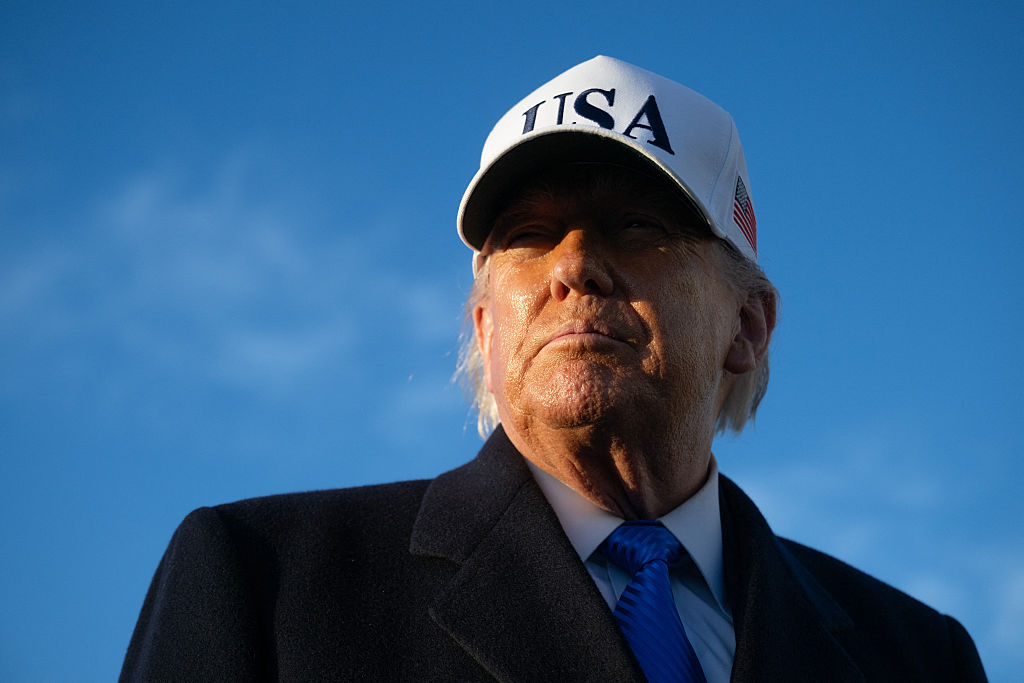
There are many historical parallels to be drawn with Epic Fury. The most telling, to me, is with the beginning of the First World War. Both conflicts began with what looked like a brilliant plan. The US and Israel aimed to decapitate the Iranian regime on day one of the war. Germany’s strategy was to secure a rapid victory in France. It was devised by Field Marshal Alfred von Schlieffen eight years previously, and rather than attacking France directly from the Franco-German border, where it had strong fortifications, the Germans would go through Belgium and Luxembourg and encircle Paris in a spiral-like movement. Speed was of the essence back then, just as it is today.
It is hard to imagine today the degree of optimism everybody had about the war when Helmuth von Moltke, the German military commander, executed a version of the Schlieffen plan. Kaiser Wilhelm II told his soldiers: “You will be home before the leaves fall from the trees.” Young men left their jobs to go to the front. Older men, like the German sociologist Max Weber, lamented their inability to fight. In Britain, too, the general expectation was that the war would be “over by Christmas”. Trump predicted that the Iran war would last four to five weeks. We are now in week five.
Initially, in 1914, Germany’s war went according to plan. The Germans pushed through Belgium, encountering British forces near Mons, and then moved quickly over the border into France, pushing the French and British armies some 250km to the south. The Germans came within 40km of Paris. But the seeds of failure were already sown. They advanced, but they failed to surround the city. The quick encirclement – Schlieffen’s grand plan — did not happen.
As the Canadian historian Holger Herwig writes in The Marne 1914 about the Schlieffen plan: “It was a single roll of the dice. There was no fallback, no Plan B. Speed was critical; delay was death. Every available soldier, active or reserve, was deployed from the first day of mobilization. The sounds and sights of two million men trudging across Belgium and northeastern France with their kit, guns, and horses in sweltering 30-degree heat, stifling humidity and suffocating dust was stunning, and frightening.”
And herein lies the problem with grand strategy: it unravels on contact with the unexpected. Reality has a nasty habit of sabotaging even the most carefully laid plans. As Herwig tells it, the German troops were simply not prepared for the summer heat.
The Franco-British counter-offensive started on September 6 with the Battle of the Marne, the single most consequential battle of the First World War. Essentially, the Allied Forces managed to split the two German armies, the one that came from the north towards Paris, and the other further east. On September 9, the Germans began a general retreat, and by September 12 they had fallen back to the Aisne in the north. This was the beginning of the trench warfare that would dominate the Western Front for another four years. It ended with Germany’s total exhaustion, militarily and financially.
“Herein lies the problem with grand strategy: it unravels on contact with the unexpected.”
Historians have examined in great detail why Germany, the military and economic superpower of its time, lost the war. But the most important reason was apparent in those first six weeks: there was no plan B. The Schlieffen plan did not account for the weather. Nor did it consider what might happen if the war dragged on: acute supply difficulties.
Donald Trump, too, has no plan B. In fact, it’s hard to decipher if he ever had a plan A — whether it was toppling Iran’s government, weakening its nuclear capabilities or crushing its regional influence. Certainly, the American decapitation strategy succeeded at a purely technical level; Khamenei was killed in the opening strikes. But Trump’s bombardment underestimated the enemy, who was swift to escalate matters. Iran closed the Strait of Hormuz and attacked the Gulf states allied to the US and Israel. And it hit the US where it is most vulnerable: its reliance on the global economy and the global financial markets. I concluded a while ago that the West is so dependent on imported raw materials that it is not in a position to fight any substantial wars – with countries like Iran, Russia or China. So it is proving.
This was also the case for Germany in 1914: it was very strong, but also extremely vulnerable to supply shocks. Germany produced around 70% of its food domestically, and was dependent on imports for fertilizers and intermediate goods. It’s a familiar story. Today, the West is running into shortages of helium and urea, essential for the production of semiconductors and fertilizer respectively.
This is something military planners, then and today, rarely have in their blueprints. Von Schlieffen and von Moltke were members of the aristocracy. They were focused on the big picture. They had little interest in the grubby business of mines and heavy industry. Similarly, the US military did not consider that there might be supply shortages for radars or interceptors. If the likes of Vladimir Putin and Xi Jinping have one advantage over us, it is that they understand raw materials and supply chains at a much deeper level than we do.
At the weekend, things escalated further. The Houthis, who control large parts of Yemen, entered the conflict with an attack on Israel. If the Houthis were to close the Bab el-Mandeb Strait, where the Red Sea passes through to the Gulf of Aden, the world would be on the verge of its biggest oil and supply-chain crisis ever. Around 30% of global container shipping passes through the Suez Canal.
There are also important differences to the First World War. But these are not necessarily comforting. Russia’s invasion of Ukraine in 2022 also started with a miscalculation leading to a long war of attrition that is yet to conclude. But unlike Germany in 1918, Russia is nowhere near the point of exhaustion — precisely because it has sounder supply chains.
Europeans have recently been framing the debate about their security solely in terms of the Russia-Ukraine war. They fear a Russian attack more than anything else. A far more immediate vulnerability, however, is their energy dependence. There are plausible scenarios of acute energy shortages ahead. The greater threat from China is not that it sells us cheap cars, but that it might stop selling us rare earth metals.
I always thought the Americans were strategically smarter than Europeans. That was indeed the case for the US-led postwar world order. But I didn’t factor in Donald Trump. He is clearly not a strategic global actor. And he is currently blowing up whatever goodwill he has in the Middle East on a war with no concrete goal or exit strategy. The best outcome right now would be one in which Iran agreed to reopen the Strait of Hormuz and not to pursue a nuclear program. But this is essentially a return to the status quo of 2015, when the Iran nuclear deal was agreed — probably Europe’s last foreign policy success story. As part of this deal, Iran accepted limits on its nuclear program, like a cut in its stockpiles of enriched uranium. It was Trump who left the accord.
If the goal of this war is to effect regime change, then, a ground invasion will be required. This may yet come to pass: the Pentagon is already preparing for such an eventuality. But to succeed, such an invasion would have to be of an order of magnitude bigger than Iraq. We are talking about First World War levels of troops. With reserves, Iran has around one million troops. If the US puts 10,000 “boots on the ground”, this is not going to result in regime change. And if, as is mooted, Trump were to invade Kharg Island in the Persian Gulf, Iran’s core oil export hub, the Iranian and the Houthis would hit back at oil and gas infrastructure elsewhere in the Middle East.
I am sure that US and Israeli strategists have more information available to them than even the best-informed commentators. But as the hard-fought experience of past wars shows, information does not prevent leaders from making mistakes.
Perhaps the single most important lesson of the First World War, then, is that you should not base your strategy on a single roll of a dice, as Herwig put it. Smart gamblers know that too. I always thought that, for all his many faults, Trump was a smart gambler. But in this war, which is far from over, the cards are stacked against him.