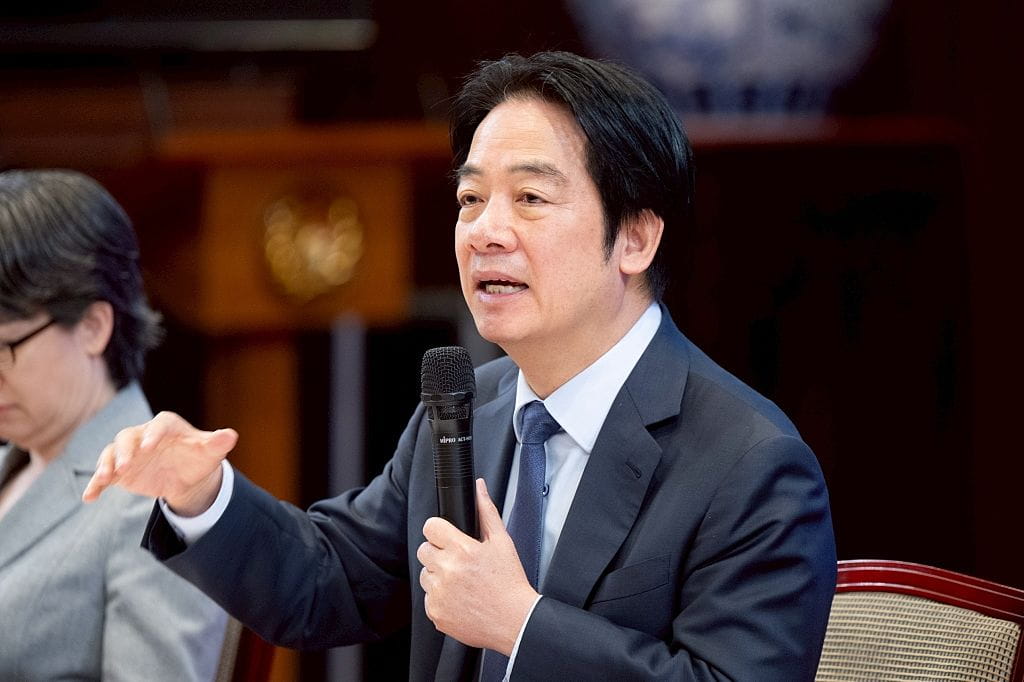
A bipartisan group of US senators met with Taiwan’s President William Lai at the Presidential Office in Taipei on Monday (March 30) to reinforce US commitment to the country’s security. The two-day visit to strengthen alliances in the region is the first trip to Taiwan by US lawmakers since last April. It comes six weeks ahead of President Donald Trump’s highly anticipated summit with Chinese Communist Party leader Xi Jinping.
Sen. Jeanne Shaheen (D-NH), the ranking member of the Senate Foreign Relations Committee, is leading the delegation, along with committee member Sen. John Curtis (R-UT). Curtis worked as a Mormon missionary in Taiwan beginning in 1979. Sens. Thom Tillis (R-NC) and Jacky Rosen (D-NV) are also part of the group. They are urging lawmakers in Taiwan to pass a critical $40 billion defense bill amid a struggle between Lai’s party and the opposition.
The Lai administration’s special military budget bill is “deadlocked,” the Taipei Times reported. The Kuomintang (KMT), or Nationalist Party of China, and the Taiwan People’s Party (TPP) have reportedly proposed alternative bills with lower defense spending. The legislation needs to pass for the Taiwanese to buy weapons from US defense companies to defend the self-governing island against increased Chinese military aggression.
Taiwan Supporting Its Defense
Shaheen told reporters at the Presidential Office, “Peace and stability in the Taiwan Strait are essential to the global economy and to our shared prosperity,” the Taipei Times reported. “I’d like to personally endorse the special defense budget and tell you that, back in Washington DC, my colleagues are watching — this is important.”
Tillis linked a shortfall in NATO’s defense spending over the past two decades to Russian President Vladimir Putin’s decision to invade Ukraine, according to The Times:
“As we go forward and celebrate Taiwan’s decades-long pursuit of life and liberty, please note that your defense and your peace can only come through strength — and that strength comes from taking action to support the Taiwanese people and your continued safety and sovereignty.”
Curtis told the Financial Times before the trip that emphasizing support for the defense spending bill was the “big reason for going.” His remarks come as some in Washington have reportedly expressed frustration that the Legislative Yuan has not passed the budget bill for its own defense.
Rosen reiterated her colleagues’ remarks about US commitment to peace and stability in the Taiwan Strait, according to the Taipei Times. “Taiwan must continue to invest in its own defense capabilities, as deterrence is essential to maintaining stability.”
South Korea, Japan, Hawaii
The US delegation is scheduled to meet with South Korean President Lee Jae Myung in Seoul and Admiral Samuel Paparo, the commander of the US Indo-Pacific Command in Hawaii. There will be visits to Tokyo and Okinawa, Japan.
Shaheen reportedly told the Financial Times she planned to ask Paparo how Operation Epic Fury is affecting the Indo-Pacific region and how China is supporting Iran.
Earlier this month, Peter Schweizer, president of the Government Accountability Institute, told FOX News’ Laura Ingraham that China provided its most advanced air defense systems to Iran and invested more than $100 billion in industrial energy projects there, much of which he said was in the form of loans to the Iranian government. Schweizer said, “With both Venezuela and Iran, Donald Trump has effectively taken 20% of China’s oil supply and reshuffled it.” That, coupled with China having to go back into the global oil market and buy with US dollars, made for “a disaster for China on multiple stages,” which has shifted Trump’s discussion with Xi.
When asked if the depletion of key US munitions supply in the war on Iran — and Ukraine — would make the United States more vulnerable in a potential conflict with China over Taiwan, Schweizer said:
“You certainly want to reconstitute our industrial base and produce more missiles. But here’s the problem. [Forty percent] of China’s oil goes through the Strait of Hormuz. That’s why when the Iranians were saying they were going to shut it, the Chinese were saying, ‘No, no, we want it to be open.’ So, [Trump] now has massive leverage over China. A move on Taiwan would be disastrous for Beijing. And let’s keep in mind, Donald Trump remembers in 2020 what the Chinese did during COVID. When they told him, ‘Stop talking about COVID coming from us or we’re going to stop providing you with PPE supplies,’ and what they told him earlier in this administration about rare earths. He’s now switched the conversation completely to his advantage. It was a brilliant move.”
China’s Disaster
On March 27, the IRGC blocked two Chinese container ships and one Hong Kong-owned ship from passing through the Strait of Hormuz, causing them to turn back. This came two days after Iran’s Foreign Minister Abbas Araghchi posted on X that the regime permitted “friendly nations,” including China, to pass.

The Trump administration has consistently said it has not changed the US-Taiwan policy, even as critics have speculated that the president could concede to Xi to oppose Taiwan independence.
In December, the White House announced a record $11 billion arms deal for Taiwan. Another one, reportedly worth about $14 billion, includes advanced interceptor missiles and is ready for the president’s approval. Reuters reported it could be signed after his May trip to China.
Last November, in an interview with 60 Minutes, Trump, referring to Xi, said: “He has openly said, and his people have openly said at meetings, ‘We would never do anything while President Trump is president because they know the consequences’.”
The president’s order of Operation Epic Fury on Iran on Feb. 28 is the clearest example of that.