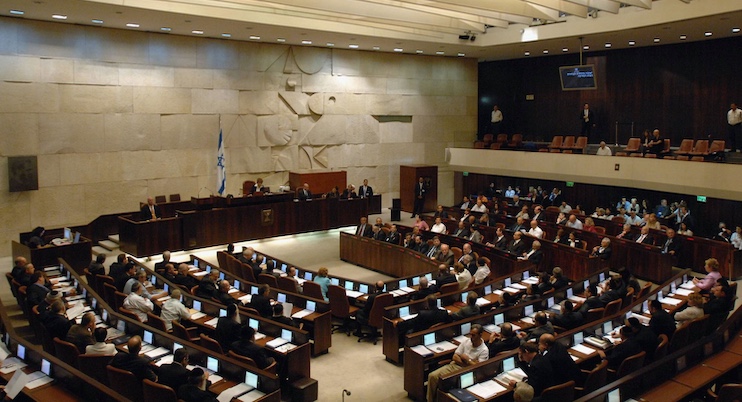
Yesterday, Israel’s Knesset passed a landmark law that will nonetheless never see the light of day. In that case, the motivation for the bill is arguably more important than its content.
The bill widens the application of the death penalty to include murders carried out to “negate the existence of the State of Israel.” Israel technically still has capital punishment on the books, but never invokes it, making it something of a dead letter. Nazi mastermind Adolf Eichmann was the last to be executed by the Israeli justice system—and that was in 1962 (and widely understood to be an exceptional case, for a million obvious reasons).
There has long been advocacy for a death penalty for terrorists in Israel, but it has never passed. Now it has—and it will soon be discarded by Israel’s high court. Why has it passed now, and why can’t it survive a court challenge?
Let’s take the second question first. The law as worded would make it easier to avoid a death penalty for Jewish defendants than Arab defendants, the latter of whom would be more readily found guilty of the particular motive of trying to destroy the state itself. Other details, such as the bill’s restricted window for appeals, are probably unworkable as well. For these reasons and others, the bill seems almost designed to be scrapped by the high court.
Was that the intent or expectation of the bill’s advocates? Probably not, but it may have made it easier for lawmakers from center-right parties like Bibi Netanyahu’s Likud to vote for it, since they don’t expect to have to defend its implementation.
So why has such a bill finally been passed now? That has to do with the bill’s true aim and purpose: to derail hostage deals.
The controversial swaps in which Israel trades a thousand or more Palestinian inmates, many who were responsible for deadly terrorism, for innocent Israeli civilians taken hostage by Hamas and other terror groups, have long been understood to incentivize future hostage taking. The most famous such trade came in 2011 when Netanyahu agreed to release over a thousand Palestinian inmates for Cpl. Gilad Shalit, who’d spent five years in Hamas’s dungeons by that point.
But it is not only the lopsided numbers that give many Israelis pause. Between April 2014 and July 2015, six Israelis were murdered by terrorists released in the Shalit deal. Much more was to come: Yahya Sinwar, the Hamas leader and mastermind of October 7, was released in that deal as well. So while Israelis prioritize the redeeming of all captives, they also worry about the danger that creates for the rest of the country. It’s a heartbreaking calculus even to entertain, and thus Hamas and other groups have made hostage-taking the barbarous crown jewel of Palestinian terrorism.
An obvious question arises: If Israeli lawmakers want to prevent future prisoner swaps, why don’t they pass a bill doing exactly that?
The answer is: They have tried and failed to do so repeatedly since 2014. The main reason these bills failed is because successive governments refused to tie their own hands, so the legislation would attempt to put peripheral restrictions on hostage deals without outlawing them. The most effective such restriction would have been disallowing Palestinian inmates serving life sentences to be released in such deals. But it’s likely that Israeli governments would be able to circumvent sentencing decisions anyway.
Also—and the same is true of this current death penalty bill—the new rules would not apply retroactively, so no one in custody would be affected by them.
Therefore, goes the thinking, the only way to prevent the government from releasing terror convicts is to require the government to execute them.
There is one more reason for the “success” of a DOA bill mandating capital punishments, and it is related to the current rise in anti-Arab violence in Judea and Samaria.
The case of Khaled Najjar is the best example here. Najjar was convicted in a terrorist murder over 20 years ago. The victim’s family remembers Najjar taunting them at his sentencing as follows: “We will kidnap soldiers until the last of our prisoners is released. Seven life sentences? I don’t consider those numbers. I’m going to be released.”
And so he was. He was finally killed in an IDF strike in May 2024.
Najjar, like many bloodstained terrorists, knew he’d never serve out his sentence. Because of the hostage deals, murder convictions only temporarily remove someone from the battlefield. It is a mockery of the justice system.
The sliver of young settlers terrorizing Palestinians in Judea and Samaria are easy to denounce from a moral standpoint: murder is evil, arson is evil, theft is evil. They are also worthy of denunciation from a strategic standpoint: blackening Israel’s name, inviting retribution, fomenting anarchy, forcing the diversion of IDF resources and manpower, etc. But the few violent settlers believe—wrongly, to be sure—that they are participating in an existing anarchy, not paving the way for a new lawlessness. They have weaponized the resentment some Israelis feel toward the system that ensures the most dangerous Palestinian terrorists will avoid their sentences and be freed to kill again and again.
Those violent settlers are in the wrong, full stop. Which doesn’t negate the fact that terrorists have gamed the Israeli justice system and Israeli leaders have been unable or unwilling to stop the manipulation.
The death-penalty bill is performative. Its purpose is to make a statement about hostage deals. And that statement, in the post-October 7 world, has a larger audience than ever.