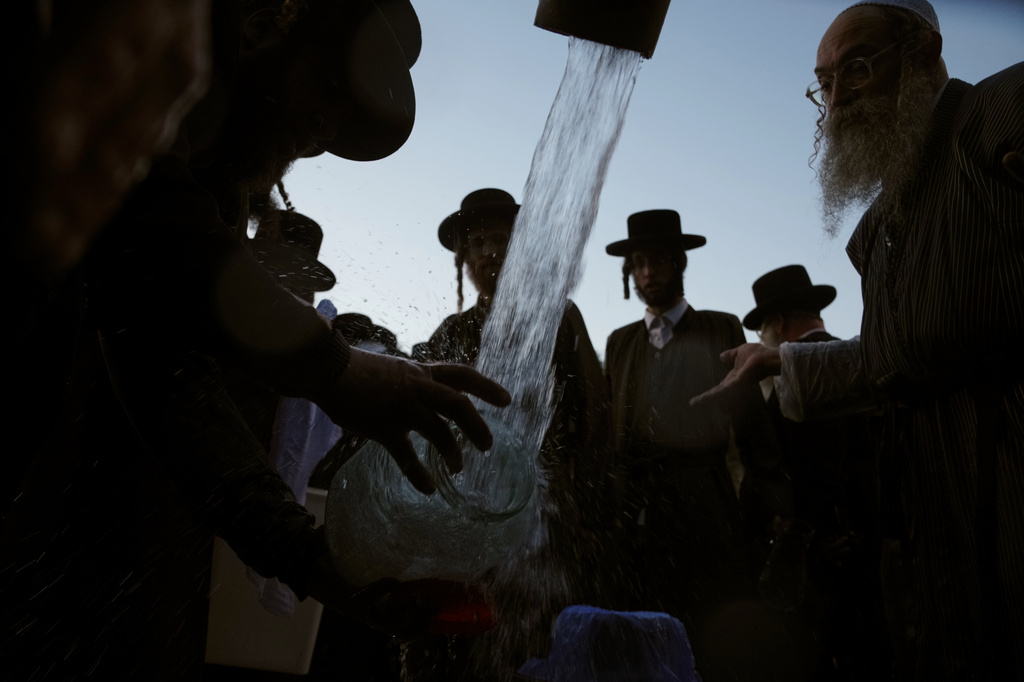
THE GARDEN TOMB, Jerusalem – Wednesday night marks the beginning of Passover for Jews in Israel and around the world. The war with Iran has made a dramatic impact on celebrations. It comes as President Trump signaled that the conflict could be nearing a turning point.
The president stated that the end of the war could be in sight and put a timeline on what he calls the final phase of the conflict.
He stated on Tuesday, “We’re finishing the job, and I think within two weeks, maybe a couple of days longer to do the job, but we want to knock out every single thing they have now. It’s possible we will make a deal before then.”
Trump is also dismissing concerns about Iran’s remaining nuclear capabilities, saying that what is left is buried and out of reach.
“It will take 15-20 years to rebuild what we have done to them,” he said.
The president is expected to address the nation Wednesday night with an update on the war situation.
Meanwhile, Iran is striking back with warnings of its own. The Iranian Revolutionary Guard Corps (IRGC) is threatening major international companies such as Apple and Microsoft, accusing them of supporting U.S. and Israeli operations, and declaring them to be “legitimate targets.” Trump quickly brushed off that threat.
“With what?” he asked. “BB guns? They don’t have much left to threaten.”
***Please sign up for CBN Newsletters and download the CBN News app to receive the latest news from a Christian perspective.***
He also aimed at traditional allies, including Britain and France, expressing his frustration that they haven’t done more to support the war effort.
However, in the Middle East, the war appears to be having the opposite effect. Israeli Prime Minister Benjamin Netanyahu cited new regional alliances that are taking shape.
In a pre-Passover address to the nation, he declared, “Not only have we strengthened the alliance with the U.S., but we are also creating new alliances with important countries in the region against the shared Iranian threat. I hope that, soon, citizens of Israel, I will be able to tell you more about these vital alliances.”
At the same time, the fighting continues on multiple fronts. Iranian-backed Houthis in Yemen fired missiles from the south, while Hezbollah keep up its barrage from the north.
Israeli Defense Minister Israel Katz asserted that the goal now is to permanently change the security barriers in Lebanon.
“We are determined to separate Lebanon from the Iranian arena, to uproot the snake’s teeth and remove from Hezbollah its ability to threaten, and to change once and for all the situation in Lebanon with a security presence of the IDF in the necessary locations, with strict enforcement and absolute deterrence. Just as in Syria and in Gaza, so too in Lebanon,” Katz insisted.
The conflict is now reaching beyond the battlefield. A surveillance video shows the moment an American journalist, identified as freelancer Shelly Kittleson, was kidnapped in Baghdad. Iraqi forces are now searching for her captors.
U.S. officials say they previously warned Kittleson of the threat, and they blamed an Iranian-backed militia.
Another video shows the moment an Iranian missile fragment hit Jerusalem’s Old City nearly two weeks ago, underscoring the threats that have dramatically shifted Easter and Passover in Jerusalem.
Out of safety concerns, Israel’s Home Front Command has been limiting events to up to 50 attendees, and if there is no place for people to shelter, the restrictions are even more severe.
The Church of the Holy Sepulcher, the place where many believe that Jesus was crucified and resurrected, will remain closed to the general public, along with the Western Wall.
And the live Easter service here at the Garden Tomb will not be live this year. Instead, it was recorded by CBN and will be shown on Sunday. There will be no public audience.
Simon Holland, director of the Garden Tomb, told CBN News, “It’s such a sadness because normally it’s so alive, so vibrant, so full of joy. So we will miss that, particularly this year.”