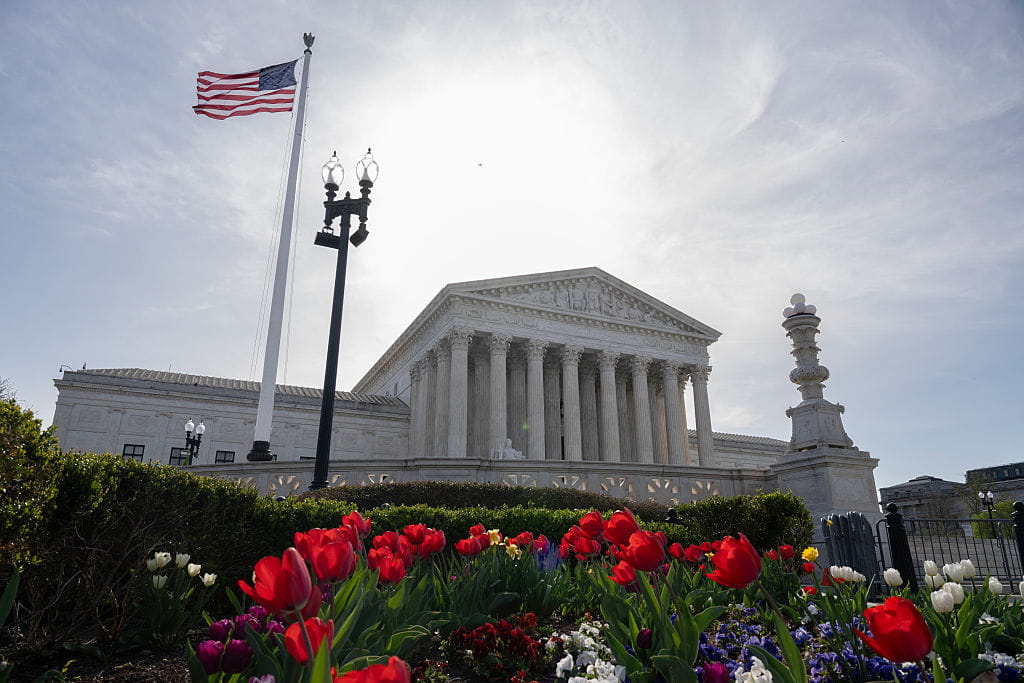
What transpires today (April 1) at the Supreme Court will lead to nothing less than another landmark decision from a panel of judges that has wrestled with multiple challenges to long-standing precedents, seemingly settled law, and the extended reach of President Donald Trump’s executive power. In this case, the Justices will finally settle the long-standing debate about the proper interpretation of the 14th Amendment as it applies to birthright citizenship.
The words of the amendment are: “All persons born or naturalized in the United States, and subject to the jurisdiction thereof, are citizens of the United States and of the State wherein they reside.” While the amendment has been broadly interpreted as properly conferring citizenship upon any person born in the United States, it is inarguable that it was intended to grant citizenship to freed slaves, those who had been held in bondage, not those who chose to flout the law. Illegal immigration hardly existed when the 14th Amendment was ratified in 1868, so no thought was given to the possibility that, in addition to slaves, another class of non-citizens would arise and usurp a right granted specifically to those who had been enslaved.
It seems likely that if those who authored the 14th Amendment did so today instead of 158 years ago, they would specify “formerly enslaved individuals” or some such language. But they did not, so we are left with an amendment that will stand as the law of the land as interpreted by nine Supreme Court Justices.
Birthright Citizenship and the Constitution
Who is and is not entitled to American citizenship? Is it anyone born in the United States? What if that person was born to a mother who did not have the right to be in this country? What if the whole purpose of that mother or father crossing the border in defiance of our laws is specifically to birth a child so that it could enjoy the privileges of citizenship in the American welfare state?
In attempting to predict the Justices’ decision in Trump v. Barbara, expected by late June or early July, it is important to remember that this Court has demonstrated greater independence than its adversaries claim to have expected. While dominated by strict constructionists, the Court has been willing to strike down long-standing precedents, most famously Roe v. Wade, and clarify the bounds of executive privilege; it also has delivered decisions disappointing to the president who appointed three Justices, most famously striking down Trump’s tariff scheme.
We would expect left-of-center Justices Sonia Sotomayor, Elena Kagan, and Ketanji Brown Jackson to uphold the current interpretation of the text, emphasizing the initial wording, while the remaining Justices wrestle with all the wording as well as how much weight should be placed on the perceived intent of the amendment. And while we often refer to conservative or liberal members of the Supreme Court, the current right-of-center Justices have hardly always been in lockstep. And on the issue of the 14th Amendment as it applies to birthright citizenship, there could well be two clashing conservative views of the Constitution in play.
Text or Context?
Are the conservative Justices textualists or originalists? Both are schools of thought associated with libertarian-minded jurists. Should the Constitution in general and the 14th Amendment in this case be interpreted by the letter of the law, by the exact words of the document, as pure textualists will argue? Or should it be guided primarily by the original intent of the amendment, which was to confer citizenship upon freed slaves after the Civil War, as originalists believe? This is where textualists and originalists will grapple with a thorny conundrum.
Were the Court to rule that the words of the amendment are superseded by the intent of its authors, the decision could open the floodgates to constitutional challenges over other parts of the Constitution. Court critics would undoubtedly lambaste one or more conservative Justices as hypocrites for professing fealty to the Constitution as written but then reversing course in this case in order to achieve a preferred outcome, the very criticism usually targeted at the left.

Is it acceptable to allow people to take advantage of the outdated letter of the law while we ignore its intent? It has always been liberals, not conservatives, who support the notion of a so-called “living Constitution,” claiming the founding document was written at a very different time and must be revised to reflect contemporary values and experience. But isn’t that just what Trump, not the left, is arguing in this case? In the end, given the inevitable and perhaps explosive wrangling over the amendment, will we be powerless to interpret it in a more expansive way?
Meanwhile, beyond the matter of original intent is the interpretation of five critical words in the amendment: “subject to the jurisdiction thereof.” The administration has made those words the foundation of its argument, claiming that illegal immigrants are not subject to any US jurisdiction and therefore are not eligible for citizenship. The Justices’ collective perception of the meaning of those five words will be a critical factor likely to swing the decision one way or another.
Political Downdraft
This challenge to a long-standing interpretation of the 14th Amendment is yet another example of Trump front-loading his audacious agenda, presiding on the presumption that he has just two years to accomplish his most ambitious objectives. But the hundreds of Republicans running for the House and Senate this year would have to deal with the political downdraft of a decision striking down birthright citizenship for the children of illegal immigrants, just as midterm elections approach. While Hispanic voters demonstrated in 2024 that they do not support illegal immigration by swinging heavily in Trump’s direction, such a decision would provide an opening for the left to reclaim a vital demographic group or, at the very least, a ripe opportunity to renew their decade-long claim that Trump is a racist xenophobe. The question is, after all the over-the-top vitriol they have thrown at him while losing to him twice, whether anyone beyond the usual victims of Trump Derangement Syndrome will bother to listen.
While Trump, as president, has tested the limits of his constitutional powers to a degree we have rarely, if ever, witnessed, the matter facing the Supreme Court today could lead to the greatest sea change of his administration since the closure of the southern border. The argument over this issue is another branch of Trump’s tireless efforts to end and punish illegal immigration, doing the dirty work other presidents refused to do. For all he has achieved as the 47th president, Trump was presented with a rare opportunity as the 45th to change the entire direction of the Supreme Court. He did so, successfully appointing three Justices in four years, and now he hopes a mostly, but not entirely, friendly Court will deliver a decision that adds another layer of game-changing reform to his historic legacy.