One of the refreshing things about President Trump is that his patience has its limits. America’s enemies have found that out the hard way—ask the late Ayatollah Khamenei or the now-former president of Venezuela, Nicolás Maduro. Some of our so-called allies are also hearing from the president.
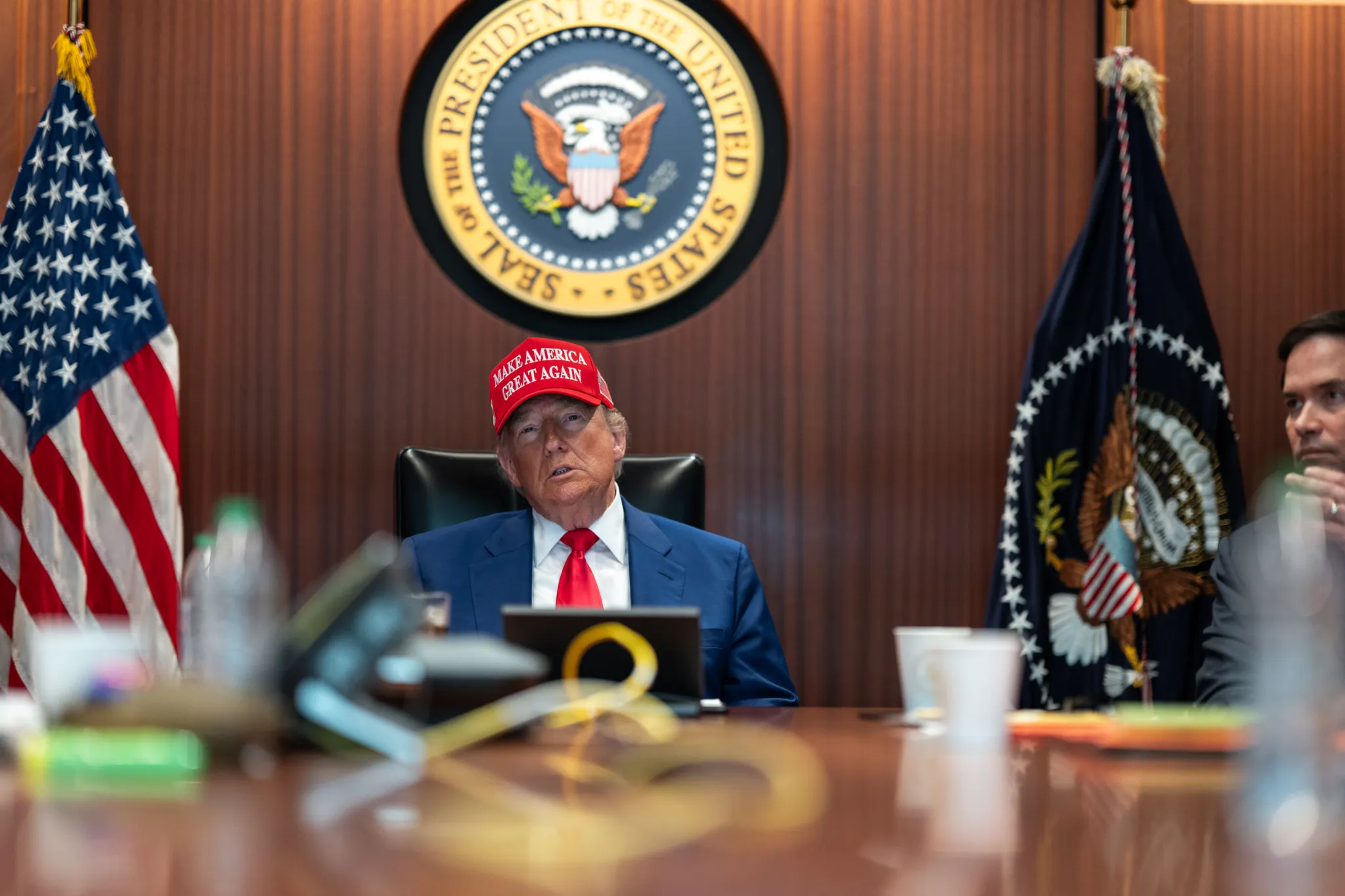
“All of those countries that can’t get jet fuel because of the Strait of Hormuz, like the United Kingdom, which refused to get involved in the decapitation of Iran, I have a suggestion for you…” Trump posted Tuesday morning. “Number 1, buy from the U.S., we have plenty, and Number 2, build up some delayed courage, go to the Strait, and just TAKE IT. You’ll have to start learning how to fight for yourself, the U.S.A. won’t be there to help you any more, just like you weren’t there for us. Iran has been, essentially, decimated. The hard part is done. Go get your own oil! President DJT.”
All that was missing was a “thank you for your attention to this matter.” It was classic Trump, cutting to the heart of the matter by challenging the other countries to show up. It’s a win either way, by shaming the allies into action or by exposing their fecklessness.
The phrase that came to mind was Yiddish: tochis afn tish. As Leo Rosten parsed it in the 1989 book The Joys of Yinglish, “Tochis afn tish does not mean ‘buttocks on the table,’ which is its literal translation, but — ‘Put up or shut up,’ ‘Let’s get down to brass tacks,’ or ‘Lay all your cards on the table.’”
A 2011 New York Times profile of a private investigator in Brooklyn explained the term, sometimes abbreviated and anglicized to “T.O.T.”: “It means ‘Put your tuchis on the table,’ … In other words, ‘Show me the proof.’”
Secretary of War Pete Hegseth reinforced the president’s point. Asked at a March 31, 2026 press conference, “Is the United States still committed to NATO’s collective defense?” Hegseth replied, “as far as NATO is concerned, that’s a decision that will be left to the president. But I’ll just say, a lot has been laid bare.”
Hegseth continued, “A lot has been shown to the world about what our allies would be willing to do for the United States of America when we undertake an effort of this scope on behalf of the free world. These are missiles that don’t even range the United States of America, they range allies and others. And yet, when we ask for additional assistance or simple access, basing and overflight, we get questions or roadblocks or hesitations. And the president’s pointing out you don’t have much of an alliance if you have countries that are not willing to stand with you when you need them. He’s simply pointing that out. And ultimately, it’ll be his decision of what that looks like after this is complete.”
Trump singled out France in a follow-up message. “The country of France wouldn’t let planes headed to Israel, loaded up with military supplies, fly over French territory. France has been VERY UNHELPFUL with respect to the ‘Butcher of Iran,’ who has been successfully eliminated! The U.S.A. will REMEMBER!!! President DJT.”
The United States during President George W. Bush’s presidency had a similar standoff with France over its lack of cooperation with the Iraq War. Critics will fault Trump for alienating Europe to begin with over tariffs or for failing to do the long-term personal relationship building, but he actually has spent time visiting and meeting with Europeans. In the case of other partnerships, such as those with Israel, the United Arab Emirates, Saudi Arabia, and even arguably Turkey and Qatar, Trump has gotten results. NATO, or at least some of its members, are a different story.
It’s one thing not to have any military might to deploy—there’s an old joke about French tanks that have only one gear, reverse—it’s another thing to refuse overflight by the U.S. in a war against a regime, Iran, that has killed Americans and is a threat to Western Civilization. It’s not exactly reciprocity when the U.S. invaded the beaches of Normandy to liberate France. Of the approximately 350,000 Jews in France in 1940, 77,000 “perished in concentration camps and killing centers—the overwhelming majority of them at Auschwitz—or died in detention on French soil,” according to the U.S. Holocaust Memorial Museum’s Holocaust Encyclopedia. That makes the refusal of France to allow overflight of arms shipments to Israel, as Israel fights against enemies who want to kill all the Jews, particularly poignant.
The left will accuse Trump of ruining relations with our European allies, just as the French-speaking 2004 Democratic presidential nominee, Senator John Kerry of Massachusetts, blamed George W. Bush for doing. It didn’t help Kerry much in the election, which he lost. The voters understood that if anyone was ruining the alliance, it wasn’t America or its president, it was the Europeans.
Whether France or any other countries show up in the Strait of Hormuz in response to Trump’s invitation will be interesting to see. If they do, let them bear the risk of running into any mines that may remain. And if they don’t, it will be up to Trump whether he wants to leave the area alone or act to seize and rename what the president called on Friday “the Strait of Trump.”