Early on in President Trump’s Iran war, a video circulated on X (formerly Twitter) of a C-RAM system intercepting an Iranian missile near the US Embassy in Baghdad. The tracer rounds were so close together, they seemed to form a continuous laser beam. Accompanying the great shear of light was a sublime sound straight out of Denis Villeneuve’s Dune.
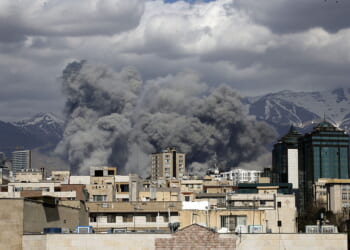
I thrilled to that haunting, mechanical roar. As a boy, I had been promised a future of technological marvels; here was their fulfillment. I thrilled also to images of missile stockpiles exploding and of Iranian Revolutionary Guard Corps headquarters vanishing in plumes of bilious smoke. I was happy to hear of Ayatollah Khamenei’s demise; and I enjoyed seeing the faces of mullahs and Iranian military commanders crossed out by red Xs in US and Israeli online propaganda.
There isn’t a little boy on the planet who doesn’t light up at the idea of killing the bad guys. Nor is there a man in whom something of that little boy — and his moral clarity — doesn’t live on.
A vocal, politically diverse cohort of Americans, however, have betrayed that healthy impulse. When the ayatollah was killed, The New York Times wistfully played down his reign of terror, while the “globalize the intifada” crowd held vigils to mourn him. Rather than express relief at the regime’s decapitation, most elected Democrats have framed the joint Israeli-US campaign as an illegal, unprovoked act of aggression. Legacy media understated our successes and catastrophized missteps. The Economist, in an article headlined “Advantage Iran,” declares that “a month of bombing has achieved nothing.” Across social media, partisans of what Josh Hammer calls the “Retard Right” — dabblers in low-IQ anti-Semitic conspiracism, such as Tucker Carlson, Candace Owens, and Nick Fuentes — reinforce this narrative. They boost pro-Iran propaganda that wildly overstates the success of Iranian missile attacks on American bases and Israeli cities, while minimizing the extent of the damage the campaign has wrought on Iran’s military.
The prevailing tone has not been measured, morally serious criticism of our objectives (or lack thereof) or the means chosen to achieve them, but of glee at the prospect of Trump’s — and thus America’s — failure. For Democrats, that glee anticipates a bloodbath for the GOP in the November midterms, and a third round of impeachment theater in 2027. The Retard Right is eager to see the same thing, for a different reason: they want to punish Trump for being, in their fevered telling, Benjamin Netanyahu’s servant.
This trash discourse is stealing oxygen from the conversations that matter.
I write this as a pacifist and a Christian, who has reluctantly come to adopt the theory of the just war — in a world sometimes so fallen that all of our options are tainted with evil, we must pursue what good we can, knowing that we will ask God’s forgiveness later. In such a situation, intransigent pacifism devolves into sentimental moralism. I believe this is where we find ourselves with Iran; as a consequence, my pacifism must yield to the calculus of just-war theory.
We’ve known for some time that Iran, if it so chooses, could in a few weeks enrich enough weapons-grade uranium for up to 16 compact nuclear warheads. But the stakes have been much higher than the publicly known. Last week, when the IRGC launched two intermediate-range ballistic missiles at Diego Garcia, an atoll in the Indian Ocean that houses a joint US-UK military base, the world learned that Iran is capable of striking London. And setting aside the specter of nuclear weapons, as a modern, industrialized country, Iran also possesses enough cesium-137 and cobalt-60 to make any number of dirty bombs, which could be packaged into missiles capable of striking most European capitals. As an erratic regime sworn to destroy the West, this makes it an imminent threat to NATO.
To pass just-war muster, among other criteria, a war must be pursued as a last resort. But as the theologian Oliver O’Donovan explains in The Just War Revisited, “the ‘last’ resort is bounded by the last practicable moment for effective action.” On Feb. 24, Reuters reported that Tehran was in the process of acquiring supersonic anti-ship missiles from China. Had it done so before Israel and the United States attacked, the cost of engagement would have soared astronomically. Although the Trump administration has done a poor job communicating this to the American people, it does appear that we chose to strike just as the window for effective action was set to close.
“After nearly five decades of indulging the Iranian regime’s mayhem, we have … thwarted its apocalyptic aspirations.”
Thus far, our actions have been very effective. The war with Iran has been more one-sided than perhaps any large-scale conflict in history, with America and Israel inflicting losses on the enemy in wild disproportion to what we’ve suffered ourselves. Khamenei and more than 40 of Iran’s top-ranking officials have been killed in air strikes, as have most of the Assembly of Experts tasked with selecting his successor. By destroying Iran’s navy and neutralizing up to 90% of its ballistic capabilities, Washington has already ended Tehran’s ability to project power in the Middle East, and we’re on track to scuttle what remains of the country’s nuclear ambitions.
What’s more, China and Russia had outfitted Iran with their most advanced defense technology, hoping that their Iranian proxy would keep Uncle Sam indefinitely bogged down in the Middle East, and thus ill-equipped to fight on other fronts. But this technology has proved utterly useless against the US military, both in Iran and Venezuela, signaling to Beijing that its ambitions in the South China Sea could be much costlier than anticipated.
These are substantive gains, and perhaps the Trump administration — notwithstanding its inconsistent messaging — will judge them sufficient. But a more decisive victory involving regime change (or at least regime moderation) is conceivable. Were that to occur, America would have direct influence over one-seventh of China’s oil imports and the ability to impede its Belt and Road Initiative, giving us plenty of leverage to dissuade it from invading Taiwan.
It is conceivable — yet the public discourse fails to conceive of it. We fail to celebrate our military victories; we show no pride for our military capacities; and we barely honor the fighting spirit of the men and women who serve. When the war began, the Twelver Shia death cult that controls Iran had just murdered thousands of its own citizens for protesting the regime’s abuses — yet many among us identify America as the bad guy.
My feelings are the opposite: while I mourn the loss of innocent lives and remain wary of the war becoming protracted — especially as President Trump weighs the possibility of sending in ground troops to secure Iran’s uranium — I am also optimistic. After nearly five decades of indulging the Iranian regime’s mayhem, we have dealt it a measure of justice, and thwarted its apocalyptic aspirations. And the geopolitical scales are rebalancing in a way that may yet produce justice on an even grander scale.
A nation’s character is judged by whether it is willing to sacrifice for what it deems to be a greater good, and whether it can take pride in its own strength and do the work necessary to maintain it. There is nothing virtuous about a weak man who chooses not to fight. His choice hardly counts as one. But a strong man trained in combat who chooses peace has exercised judgment of real moral weight. These are the qualities that I hope we rediscover, and learn to nurture in the coming months. While it may be hard to see today, amid the hysteria of its opponents, Trump’s Iran war may just bring about such a transformation.