Birthright citizenship is a hot-button issue. Proponents claim it is well-established American jurisprudence; opponents point to the historical context of the 14th Amendment, which ensured citizenship for former slaves, and argue that the law is not designed for illegal aliens to practice so-called “birth tourism.” The legal wrangling over the original intent and the subsequent evolution of the law obscured the underlying socio-political dispute over whether it incentivizes illegal immigration.
A Clearly Foggy Amendment
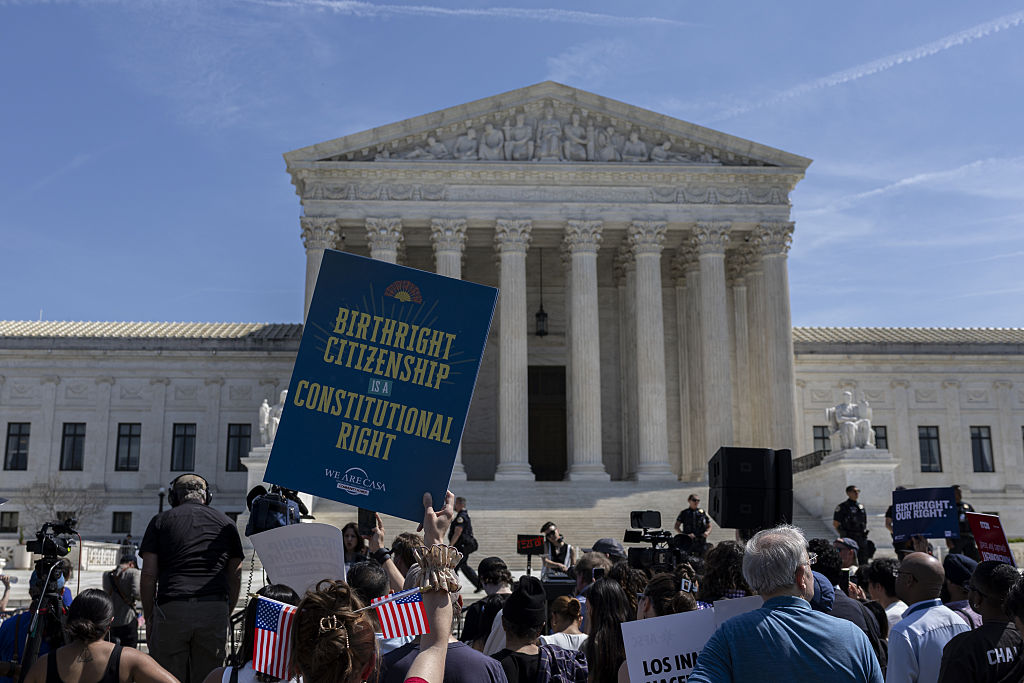
Ratified on July 9, 1868, the 14th Amendment appears clear: “All persons born or naturalized in the United States, and subject to the jurisdiction thereof, are citizens of the United States and of the State wherein they reside.” Yet the legal hairsplitting that prevailed during the Supreme Court’s oral arguments yesterday (April 1) demonstrated that the distinction between the phrases “born in” and “subject to the jurisdiction thereof” remains in tension nearly 160 years later. If birthright citizenship requires only birth on US soil, why did the 14th Amendment include “and subject to the jurisdiction thereof”? And if that phrase distinguished visiting ambassadors or sojourning tourists from slaves, where do today’s mass of illegal immigrants squeeze into the spectrum?
The circumstances on the ground have changed dramatically since 1868: Illegal immigration was not an issue then, but it has become a paramount concern in the early 21st century. Many on the progressive left ostensibly seek to erase all borders, essentially dissolving nationhood in the bargain and advancing a one-world community. On the traditionalist right, those concerned with preserving the rule of law believe lax immigration enforcement and birthright baby deliveries undermine assimilation and threaten to overheat the boiling pot that once defined America.
Politics has now crashed into the shortcomings of law. The justices are tasked with interpreting and applying a vague, longstanding legal principle that has not aged well in an effort to address modern illegal immigration threats. It is estimated that some 250,000 babies are born to undocumented immigrants in the United States each year. Does the Court apply the law by its lettering and original intent, or interpret it to address this citizenship crisis today?
A Challenging Case
The linguistic weaknesses of the 14th Amendment sparked disputes during oral arguments about what 19th-century legislators and judges meant by words such as “allegiance,” “domicile,” and “jurisdiction.” Changing the language of the amendment is impossible without a time-consuming, contentious vote by the entire country, so the judges must discern a path through this old language in a new world unforeseen by the original drafters.

This tension was evident yesterday. Some questions by conservative justices suggested that the Supreme Court may not rule in support of President Donald Trump, as many pundits have predicted. Justice Brett Kavanaugh observed that Congress, in the 20th century, used language in laws that does not support the Trump administration’s characterization of an intent to exclude children of illegal immigrants from birthright citizenship. Judge Samuel Alito raised the “humanitarian issue” of illegal aliens who may have been in the country for a long time and have assimilated but not applied for citizenship, noting that US immigration laws have been “ineffectively and in some cases unenthusiastically” enforced. Of past decisions, Justice Neil Gorsuch said, “It seems to me it’s a mess,” which could cut either way.
The betting market odds would not be long as to how Justices Ketanji Brown Jackson and Sonia Sotomayor will cast their votes. The conservative justices (except perhaps for Justice Clarence Thomas, a descendant of slaves who will likely side with the Trump team) are not so predictable. Clearly, they struggled during oral arguments with concerns not only about disentangling the inscrutable rhetoric of definitions and originalism but also with the logistical problems of how to implement a ban on birthright citizenship for illegal immigrants.
Birthright Battle Bodes Bitter Blowback
While many argue that the executive order behind the birthright citizenship controversy is patently illegal, the oral arguments and exhaustive briefs demonstrated that the law is far from clear. As Robert Luther III of Antonin Scalia Law School at George Mason University asserted in an opinion piece for Bloomberg Law:
“Because immigrants who entered the US illegally aren’t domiciled in the US, their children aren’t birthright citizens. Trump’s executive order reflects the original meaning of ‘jurisdiction’ in the Citizenship Clause, so the Supreme Court should embrace it.”
If the matter of granting birthright citizenship to illegal immigrants were put to a popular vote today, very different language would likely be employed. In lieu of that, a handful of judges will decide the issue based on a complex debate over the meaning of words written nearly 16 decades ago in an era very different from today’s.
Dig Deeper Into the Themes Discussed in This Article!
Liberty Vault: The Constitution of the United States