OAN Staff Brooke Mallory
6:17 PM – Thursday, April 2, 2026
The intersection of flourishing forensic technology and decades-old cold cases has yet again reshaped the landscape of American criminal justice. On Wednesday, the Utah County Sheriff’s Office provided a definitive conclusion to a mystery that had plagued the state for over fifty years.
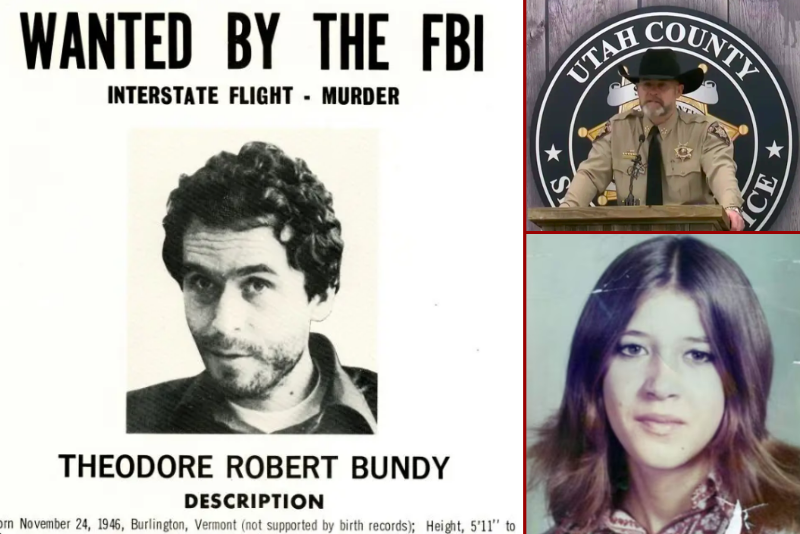
Through advanced DNA extraction and matching, investigators have officially linked the 1974 death of 17-year-old Laura Ann Aime to the notorious serial killer Ted Bundy — serving as a testament to the transformative power of modern science in providing a semblance of justice for victims long silenced, officials say.
The narrative of Laura Ann Aime’s tragic end began on Halloween night in 1974.
Aime, who was described by her family at the time as a vibrant “free spirit,” had vanished after leaving a party in Salem, Utah. Her disappearance sparked an extensive search that ended in heartbreak nearly a month later when her remains were discovered by hikers in American Fork Canyon.
The evidence at the scene suggested a harrowing ordeal. According to the evidence, investigators at the time had believed that Aime was bound, beaten, and kept alive for several days before her eventual murder. While the investigation remained active for decades, the limitations of mid-20th-century forensics left the case in a state of perpetual suspicion rather than certainty.
Ted Bundy had long been the suspected assailant looming over the Aime case. During the mid-1970s, Bundy was a law student at the University of Utah, a period now recognized as the height of his murderous activities across the Pacific Northwest and the Mountain West.
Although Bundy verbally confessed to Aime’s murder shortly before his 1989 execution in Florida, his admissions lacked the granular detail required for a formal legal closure. Police also believed that Bundy was fabricating this claim at the time.
Without physical corroboration, the case remained technically “unsolved,” leaving the Aime family in a painful limbo of essentially “knowing” the culprit — but lacking the proof to shut the door on the investigation.
The turning point arrived in 2023 with the implementation of a new forensic protocol by the Utah Department of Public Safety. This cutting-edge technology allows analysts to extract usable DNA profiles from samples previously considered too small, degraded, or contaminated. Forensic experts revisited evidence carefully preserved from the 1974 crime scene, successfully isolating a single male DNA profile.
When this profile was cross-referenced with the FBI’s national database, it returned a perfect match for Bundy — whose genetic information had been entered into the system in 2011 following the discovery of a preserved blood sample in Florida.
Ultimately, the closure of the Aime case is “more than an administrative success” for the Utah County Sheriff’s Office; it is an “act of historical correction,” according to Utah officials.
As Sgt. Mike Reynolds noted during the announcement, “Laura Aime is the quintessential daughter of Utah County. We felt the pain the family feels when she was taken. We felt the pain that you felt this whole entire time, and we’ve had the desire to deliver to you some type of healing.”
Modern investigators have not only validated the suspicions of their predecessors, but have also signaled to the families of other cold case victims that the passage of time is no longer a barrier to the truth.
Stay informed! Receive breaking news alerts directly to your inbox for free. Subscribe here. https://www.oann.com/alerts
What do YOU think? Click here to jump to the comments!
Sponsored Content Below