Question asked and answered:
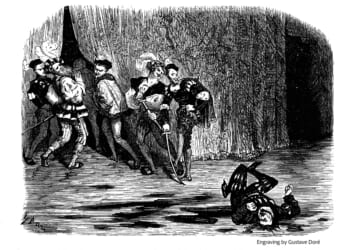
We went from beautiful architecture like this to sterile, lifeless structures.
Hell, even in the 80’s everything was full of color and life.
Why does every building these days, including schools, look like prison?
Bring back the beauty! pic.twitter.com/6Dkp7zjg9a
— One Bad Dude (@OneBadDude_) April 3, 2026
In February, James Lileks had some thoughts on the American modernist architect Louis Kahn (1901-1974) and a photo that says everything:
While browsing through an Architectural Record from 1977, there was a gushing review of the incredibly brilliant Yale Center for British Art by the incredibly brilliant Louis Kahn.
* * * * * * * * *
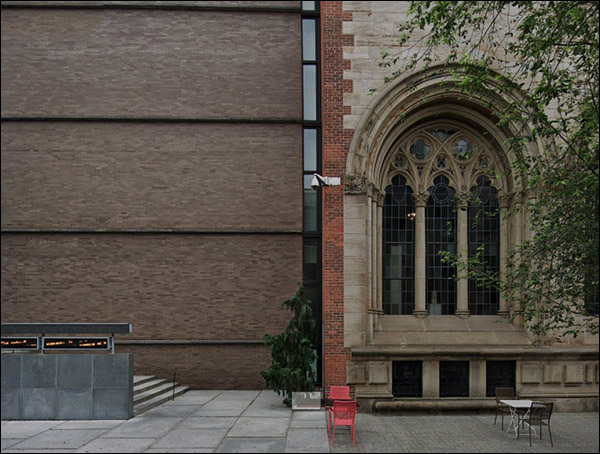
The British Center’s special site and function surely had something to do with these surprising developments. Directly across the street from it stands the earliest of Kahn’s mature buildings: the first in his great sequence of inventive designs. It is Yale’s Art Gallery of 1953.
Ah yes. That one. The building that gave us one of the best examples of life before and after the Second World War.
Hint: Kahn’s building is on the left.
You know how many years separate those two structures?
Nineteen.
The building on the right was completed in 1928. The building on the left was begun in 1947.
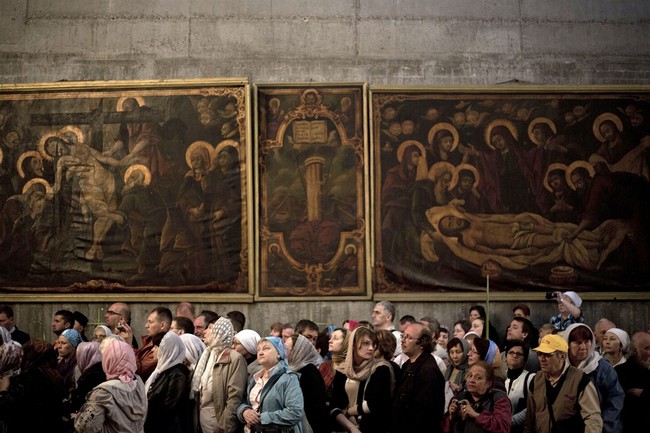
Currently on display at the Kimbell Museum in Fort Worth are the treasures of the Holy Sepulcher, after previously being displayed last year at New York’s Frick Collection:
The finest treasures, commissioned by European royalty and carried by pilgrims to the Church of the Holy Sepulcher, have made another voyage hundreds of years after they first arrived in Jerusalem — to the Kimbell Art Museum in Fort Worth.
More than 60 objects in gold, silver, and precious gems are displayed, representing the finest works of 17th and 18th century artisans.
Traveling to only two sites in North America, these spectacular vestments and dazzling sacred vessels are on display through June 28.
* * * * * * * * *
The craftsmanship and beauty of the historical objects speak to a greater truth for today’s faithful, suggested Friar Stéphane Milovitch, OFM, director of the Cultural Heritage Office of the Custody of the Holy Land and chairman of the Board of Directors of the Terra Sancta Museum in Jerusalem.
“With this exhibition, you can see that man tries to give the best of his capacity for God. In this century, sometimes we worship God — we pray and it’s good — but we don’t invest all our capacity. And it is a lesson of the past to see how people invested the best of their capacity. … We understand that God was important for them. If not, they would not have done that.”
Although the vestments and liturgical objects are truly works of art, the purpose of their creation was to point to the glory of God.
The Closing of the European Mind
As I was leaving the exhibition’s opening night last month, I began rifling through the key dates in the downfall of Europe’s worldview that prevents such magnificent artwork to be created again.
The French Revolution began in 1789. It began with the notion of – stop me if you heard this one before recently – “no kings.” It didn’t end quite so benignly, as Jonah Goldberg wrote in 2007’s Liberal Fascism:
Given the benefit of hindsight, it’s difficult to understand why anyone doubts the fascist nature of the French Revolution. Few dispute that it was totalitarian, terrorist, nationalist, conspiratorial, and populist. It produced the first modern dictators, Robespierre and Napoleon, and worked on the premise that the nation had to be ruled by an enlightened avant-garde who would serve as the authentic, organic voice of the “general will.” The paranoid Jacobin mentality made the revolutionaries more savage and cruel than the king they replaced. Some fifty thousand people ultimately died in the Terror, many in political show trials that Simon Schama describes as the “founding charter of totalitarian justice.” Robespierre summed up the totalitarian logic of the Revolution: “There are only two parties in France: the people and its enemies. We must exterminate those miserable villains who are eternally conspiring against the rights of man…[W]e must exterminate all our enemies.”
But what truly makes the French Revolution the first fascist revolution was its effort to turn politics into a religion.
In 1882, less than a century after the French Revolution began, Germany’s Friedrich Nietzsche famously declared “God is Dead.” In Hooking Up, his 2000 anthology of his 1990s-era non-fiction articles, Tom Wolfe wrote:
The year was 1882. The book was Die Fröhliche Wissenschaft (The Gay Science). Nietzsche said this was not a declaration of atheism, although he was in fact an atheist, but simply the news of an event. He called the death of God a “tremendous event,” the greatest event of modern history. The news was that educated people no longer believed in God, as a result of the rise of rationalism and scientific thought, including Darwinism, over the preceding 250 years. But before you atheists run up your flags of triumph, he said, think of the implications. “The story I have to tell,” wrote Nietzsche, “is the history of the next two centuries.” He predicted (in Ecce Homo) that the twentieth century would be a century of “wars such as have never happened on earth,” wars catastrophic beyond all imagining. And why? Because human beings would no longer have a god to turn to, to absolve them of their guilt; but they would still be racked by guilt, since guilt is an impulse instilled in children when they are very young, before the age of reason. As a result, people would loathe not only one another but themselves. The blind and reassuring faith they formerly poured into their belief in God, said Nietzsche, they would now pour into a belief in barbaric nationalistic brotherhoods: “If the doctrines … of the lack of any cardinal distinction between man and animal, doctrines I consider true but deadly”—he says in an allusion to Darwinism in Untimely Meditations—“are hurled into the people for another generation … then nobody should be surprised when … brotherhoods with the aim of the robbery and exploitation of the non-brothers … will appear in the arena of the future.”
Concurrent with the “the death of God,” by the late 18th century, European avant-garde architects began believing that it was time to, as Walter Gropius, the first leader of the Bauhaus would declare in the 1920s, to “Start From Zero,” and strip away all that bourgeois frippery from architecture. In From Bauhaus to Our House, Wolfe wrote:
Then there was the principle of “expressed structure.” The bourgeoisie had always been great ones for false fronts (it hardly needed saying), thick walls of masonry and other grand materials, overlaid with every manner of quoin and groin and pediment and lintel and rock-faced arch, cozy anthropomorphic elements such as entablatures and capitals, pilasters and columns, plinths and rusticated bases, to create the impression of head, midsection, and foot; and every manner of grandiose and pointless gesture—spires, Spanish tile roofs, bays, corbels—to create a dishonest picture of what went on inside, architecturally and socially. All this had to go. All masonry, all that gross and “luxurious” granite, marble, limestone, and red brick was suspect, unless used in obviously non-load-bearing ways. Henceforth walls would be thin skins of glass or stucco. (Small glazed beige ceramic bricks were okay in a pinch.) Since walls were no longer used to support a building—steel and concrete or wooden skeletons now did that—it was dishonest to make walls look as chunky as a castle’s. The inner structure, the machine-made parts, the mechanical rectangles, the modern soul of the building must be expressed on the outside of the building, completely free of applied decoration.
Because of its association with Gropius, the founder of the Bauhaus, and Mies van der Rohe, its last director, we tend to think of the Bauhaus as a school of architecture. But it was also an art school as well. One of the artists who taught there was Joself Albers, who emigrated to America in 1933 when Germany’s National Socialists succeeded the more liberal socialism of the Weimar Republic, in which the Bauhaus flourished. (Gropius was “unexpectedly” eager to continue to work for the new regime, but Hitler the failed artist absolutely loathed modernism.) Upon arriving in America, Albers spent most of the 1930s and ‘40s teaching at Black Mountain College in North Carolina, until joining the faculty at Yale in 1950. Once he arrived at Yale, Wolfe writes that Albers began teaching its students the same design principles he employed at the Bauhaus:
In 1950, Yale got its own Bauhäusler when Josef Albers arrived from North Carolina to become the head of fine-arts instruction. Albers immediately instituted the fabled Bauhaus Vorkurs, except that now he wasn’t interested in depositing sheets of newspaper on the table. Now he deposited squares of Color-aid paper on the table and told the students to create works of art. As a painter, Albers himself had spent the preceding fourteen years seeking to solve the problem (if any) of superimposing squares of color, one upon the other. Now he had the Yale students doing it … and month after month went by. Yale, simply because it was Yale, attracted outstanding artists from high schools all over America. Some young lad who could take a piece of marble and carve you a pillow that looked so full of voluptuous downy billows you would have willingly tried to bury your head in it—this reincarnation of Bernini himself would sit there with Albers’ implacable Color-aid paper in his hands … starting from zero … and watch Albers point to some gristle-brained photographer’s little playpretty layers of colored squares and hear him say: “But this!—is form sculpted by light!” And the walls of the compound box closed in yet a few more inches.
The Wrath of Kahn
The Kimbell Art Museum in Fort Worth, which is currently displaying the treasures of the Holy Sepulcher, has two main buildings to house its collection. Its primary exhibition hall was designed by the aforementioned Louis Kahn in 1966. The pavilion housing the Holy Sepulcher was opened in 2013. It was designed by, and named for, Renzo Piano, an Italian architect who worked for Kahn for a few years, which coincided with the time Kahn was designing the Kimbell.
It’s unfair to single out Louis Kahn, though. In an early form of political correctness, or what the kids these days call “the woke mind virus,” virtually every major architect from the 1930s through the early to mid-1970s could produce nothing but forms inspired by the Bauhaus, and related 1920s-era International Style architects such as France’s Le Corbusier. And virtually every major corporation and museum wanted its showcase facilities to be designed by a superstar modernist architect. (50 miles up the road from the Kimbell, is “The Star,” the training facilities and office complex housing Jerry Jones’ Dallas Cowboys, the self-proclaimed “America’s Team.” It’s buildings were directly inspired by Mies van der Rohe’s architecture, forms he began designing in Berlin in the 1920s.)
During the 19th and 20th centuries, vast swatches of European intellectuals and artists decided that God was dead, royalty no longer held sway over society, and they no longer wanted to build in the old traditional forms. Or as Theodore Dalrymple wrote about a 1995 visit back to the British town he grew up in:
Until quite recently, I had assumed that the extreme ugliness of the city in which I live was attributable to the Luftwaffe. I imagined that the cheap and charmless high rise buildings which so disfigure the city-scape had been erected of necessity in great gaping holes left by Heinkel bombers.
* * * * * * * *
“A great shame about the war,” I said to the store assistant, who was of an age to remember the old days. “Look at the city now.”
“The war?” she said. “The war had nothing to do with it. It was the council.”
The City Council—the people’s elected representatives it transpired, had done far more damage to the fabric of the city in the 1950s and 1960s than had Goering’s air force. Indeed, they had managed to turn it into a terrible visual ordeal for anyone with the most minimal visual sensibility.
I would love to see a return to the older forms of building, and of art. But Europe has spent the last 200 hundred years running away from them – and sadly, so have we. The year before the American bicentennial, the FBI moved into a building that looked like this:
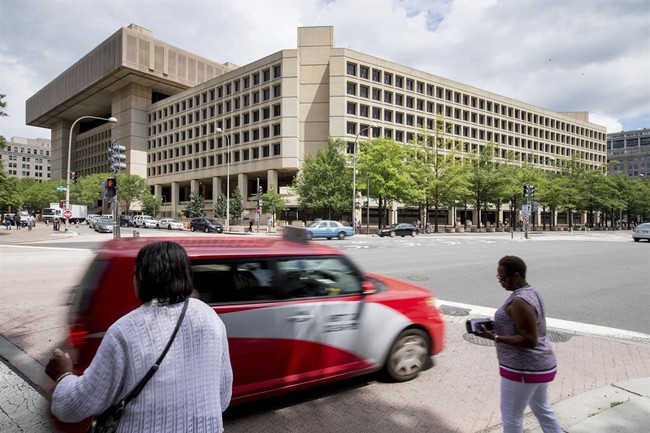
When President Trump attacked that form of modern architecture, appropriately called “Brutalism” during his first term, leftist house organs such as Slate and NPR rushed to defend it. As Varad Mehta, then of the Ace of Spades Decision Desk, tweeted, “‘Brutalism is good because Trump hates the FBI building’” might be the Slate pitch to end all Slate pitches.”
In The Closing of the American Mind, his 1987 best-selling cri de coeur on the poor state of higher education, Allan Bloom wrote, “We have here the peculiarly American way of digesting Continental despair. It is nihilism with a happy ending.” And with nihilistic buildings and art to match.