Oscar Wilde wrote Salome, a salacious one-act play, not long after he finished The Picture of Dorian Gray. Both belong to the early 1890s, when he was riding high and headed for the fall that came in 1895. “I like comedy to be intensely modern,” he confided in an 1894 letter. And, at the time, Wilde’s comedies were fabulously popular. And yet he added: “I like my tragedy to walk in purple and to be remote.”
Wilde’s iconic tragedy, Salome is certainly remote. The play is set in the time and place that Jesus called home: 1st-century Galilee. Its plot, too, is archaic. Wilde takes it, with considerable liberty, from a scene in the Gospel of Mark, which itself has rough parallels in Josephus’ book Judaean Antiquities.
In Mark’s telling, John the Baptist — a desert prophet who baptized Jesus — was imprisoned by one of the Romans’ many client rulers, Herod Antipas. The issue was a delicate one. John had condemned Herod’s new marriage to his half-brother’s wife, Herodias. (Josephus tells us that Herodias was also Herod Antipas’ niece.) According to John and, presumably, Jesus, the marriage was incestuous. This charge threatened dynastic legitimacy, and Herodias’ peace of mind. “Herodias had a grudge against John,” we read in the Gospel, “and wanted to kill him.”
The right moment came on Herod’s birthday, when he “gave a banquet for his courtiers and officers”. The ruler not only had a liking for his new wife (and niece), but for her daughter (his grandniece). Tradition, following Josephus, has given this girl the name Salome. We read this in Mark:
“When Herodias’ daughter came in and danced, she pleased Herod and his guests; and the king said to the girl, ‘Ask me for whatever you wish, and I will grant it’.”
Herodias told her daughter to ask for John’s head, and the child added a surreal touch. The prophet’s head, she declared, should be brought to her on a dish. It was a banquet, after all. Reluctantly, Herod complied. The weirdness of the scene is captured well by the evangelist:
“Immediately the king sent a soldier of the guard and gave orders to bring John’s head. He went and beheaded him in the prison, and brought his head on a platter, and gave it to the girl. And the girl gave it to her mother.”
It is this dark moment in Mark’s life of Jesus that Wilde decides to walk in purple — his phrase — on the cusp of a very brutal 20th century. Having beat Sigmund Freud to the tyranny of unconscious desires in The Picture of Dorian Gray, Wilde then beats him to the death drive in Salome.
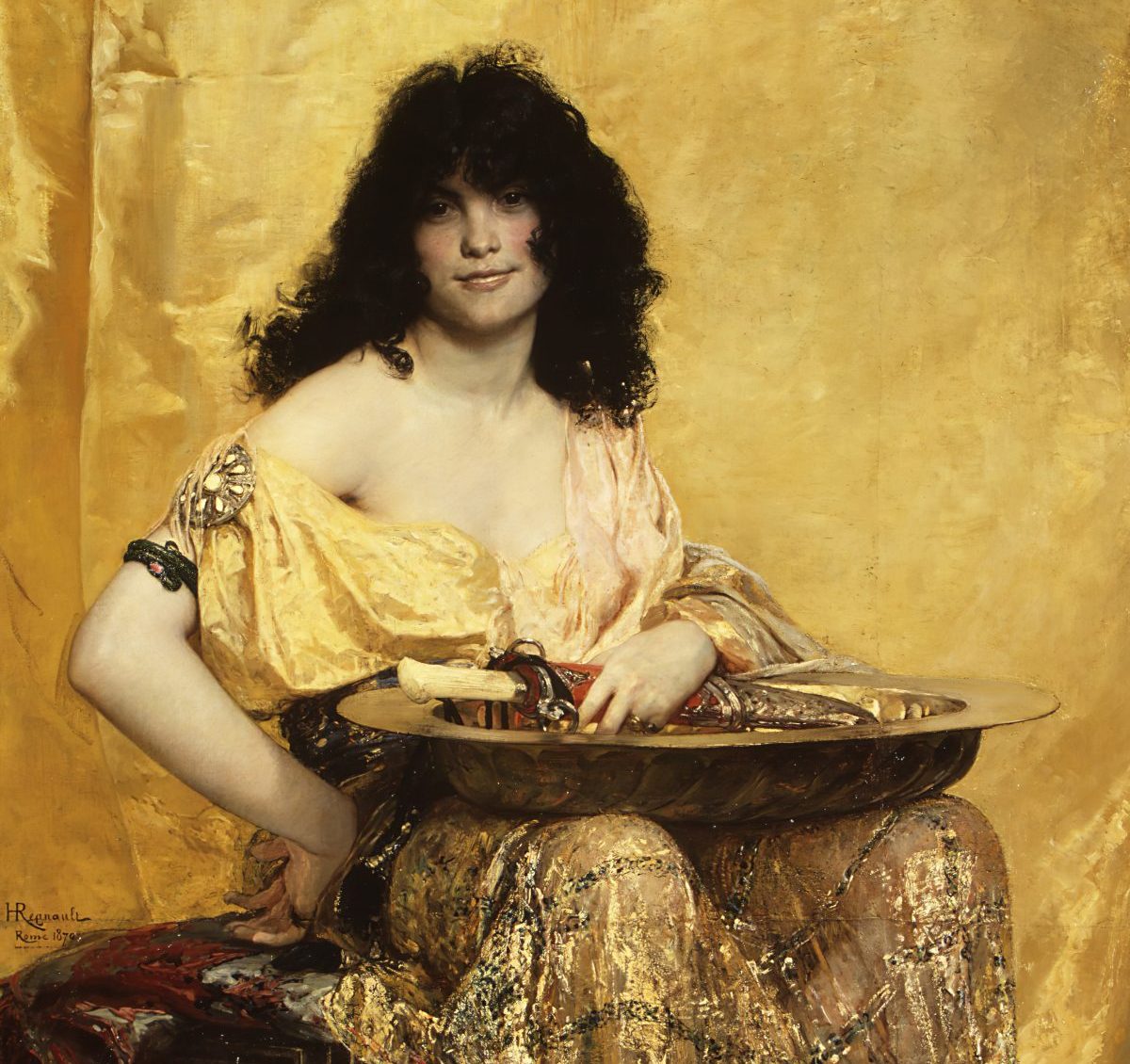
Now, French theorist René Girard was right to point out that Herodias’ daughter is a “child-victim” of the Herodian court. The Gospel’s dancing girl, Girard stressed, was “really a child”. She had “no desire to formulate”. It is in lurid contrast to Salome’s biblical depiction that modern artists have mythicized her (as Julia Kristeva puts it), making her into a figure of insane desire. She is not only eroticized by Wilde but by Gustave Flaubert, Stéphane Mallarmé, Guillaume Apollinaire and many others.
In À rebours, a novel that Wilde read deliriously and drew great inspiration from, Joris-Karl Huysmans reflects on just this contrast:
“Neither St Matthew, nor St Mark, nor St Luke, nor any other of the sacred writers had enlarged on the maddening charm and potent depravity of the dancer. She had always remained a dim and distant figure.”
It is only in modern art, which strays “far beyond the data supplied by the New Testament”, that Salome has become what Huysmans calls a “weird and supernatural” figure: a “symbolic incarnation of undying Lust”.
This is the tradition in which Wilde is writing. In his play, as in Gustave Moreau’s hundred or so hypnotic paintings of Salome, the Gospel’s exploited child is recast as a vampirical femme fatale. But there are still a couple of striking things that set Wilde apart from the fin-de-siècle craze for Salome. First, Wilde’s drama is quite suffused with biblical language. He is one aesthete who not only thoroughly knew but thoroughly used the Old and New Testaments.
Second, to a far greater extent than in, say, Flaubert’s text on Salome (“Herodias”, one of the Three Tales), John the Baptist appears in Salome as a magnetic preacher of Jesus (as he is in the Gospels). It is only in Wilde’s play that we hear oracles like this from John’s lips: “I hear upon the mountains the feet of Him who shall be the Saviour of the world.” Salome can be read as a timeless circling of the strange question: Will Jesus become the Saviour of the world, as John prophesies? Or rather, is it ultimately true that “Caesar is lord”, as Herod asserts more than once in the play?
Of course, this is not the only question that Salome is circling. Wilde’s play is structured like a vortex. Incest and suicide, obsession and murder form a dark coil in which everything trends down. Every move his characters make seems to draw them further into madness. Every look is a kiss of death. Lust is omnipresent, but it only serves as a lure to destruction. Everyone in the play — or nearly everyone — symbolizes the same lust, the same destruction.
Yet though the play was virtually banned until Richard Strauss staged his radical operatic version of Salome in Dresden, in 1905, its real theme may not be sin and death, but resurrection and the salvation of the world. In other words, Jesus’ work may be what is really at stake in Wilde’s Salome. But where is Jesus? He never appears on Wilde’s stage. “He is in every place, my lord, but it is hard to find Him,” one character tells Herod. As lines like this suggest, Wilde’s transgressive spectacle can be read as a fin-de-siècle mystery play.
For what are some of his femme fatale’s last words? “The mystery of Love”, says Salome, “is greater than the mystery of Death.” The only question then becomes: Who, or what, is the center of the mystery of Love in Salome? The center of this greater mystery may well be hard to find.
After all, nothing in Salome is entirely the same as itself. “The moon is like the moon”, Herodias says, as if to reassure herself: “That is all.” But that is emphatically not all Salome’s moon is like. In Wilde’s nocturnal world, as we read in the first lines of the play, the moon is “like a woman rising from a tomb”. It is surely significant that this criminal drama is lit by a semidivine being — the moon — which has returned from a place of total darkness, bringing light to the world.
So, too, the night wind in Salome is ominously not just itself. “Do you not hear it?” the play’s half-crazed tyrant asks his wife and guests on the night of his ill-fated party. What Herod means is that, to his ears (but not his wife’s or guests’), the wind above his palace sounds “like a beating of wings”. Of course, it is never a good sign when the wind begins to roar like a pair of “vast wings” closing the sky over your head — the wings of an angel of death – and you are the only one who can hear it.
Like a dreamer trying to reason his way out of a nightmare, and a lovesick man still hoping to enjoy his birthday party (if only his devastatingly pretty stepdaughter would look at him), Wilde’s tyrant warns himself: “It is not wise to find symbols in everything that one sees.” Herod knows where a paranoiac sensibility can lead (and does, in fact, lead): “It makes life too full of terrors.” The only problem that Herod has — and that we, too, have — is that everything one sees really is a symbol. And whether or not it’s wise to see it, human life is full of terrors.
One of life’s terrors is intense desire. For real desire is dangerous. Wilde’s Salome is a figure of youthful innocence and sexual indifference being suddenly overcome by a raging desire for the body of a doomed prophet, John — whom Wilde, like Flaubert, calls Iokanaan. “Suffer me to kiss thy mouth, Iokanaan”, she pleads with this pale-skinned, red-lipped man of God. But the only way her lips can meet his are once his neck has been cut and his lips reek of blood. This is where the play ends, and it is tempting to see the mad girl’s necrophiliac kiss as the final revelation of Wilde’s “mystery of Love”. But is it?
Remember what Salome says: “The mystery of Love is greater than the mystery of Death.” With that in mind, we must ask: Where is the greatest mystery in Salome? A close reading of the play suggests that the drama’s deepest questions are found in its tension-building middle, not its revolting conclusion.
“The mystery of Love is greater than the mystery of Death.”
Rather than look for the mystery of Love in Salome’s wicked kiss, we might want to look for it in Iokanaan’s reply to the girl’s ardent request: “Suffer me to kiss thy mouth.” It is worth noting, first, that Wilde’s prophet is young, and holy, and “very gentle, too”. (Flaubert’s Iokanaan is merciless and fiery.) It is this gentle visionary who tells a too-desirous girl:
“There is but one who can save thee. It is He of whom I spake. Go seek Him. He is in a boat on the sea of Galilee, and He talketh with His disciples. Kneel down on the shore of the sea, and call unto Him by His name. When He cometh to thee, and to all who call on Him He cometh, bow thyself at His feet and ask of Him the remission of thy sins.”
“To all who call on Him He cometh” might well be Wilde’s formulation of the mystery of Love. We notice, though, that Iokanaan tells Salome that she must “call unto Him” — this mysterious figure — “by His name”. What is his name? We are never told in Salome. He is called “Messias”, the “Son of Man”, and the “Saviour of the world” — but he is never called Jesus. The name by which Herod’s stepdaughter is meant to call Jesus is only found in the sacred text from which both Iokanaan and Salome are imaginatively drawn: the Gospel of Mark.
“The mystery of Love”, says Salome, “is greater than the mystery of Death”. But of which of those mysteries is she a tragic figure? “There are not dead men enough”, she also says, when she is feverishly waiting for Iokanaan’s head-and-neck to be brought to her on “a silver charger”. There are not dead men enough. This is the perfectly banal logic of murder and mass murder.
But what is said in Salome about the One who comes to all who call upon him? “He raises people from the dead.” Which is the greater mystery here? The cold reality of the death drive, or this eerie glimpse of resurrection? The cynical fury that says, There are not dead men enough, or the ancient love that says, Sleeper, awake! Rise from the dead, and Christ will shine on you (as we read in Paul’s Letter to the Ephesians).
It is not mere conjecture to see an unnamed figure, Jesus, as the mysterious center of Salome. Even Wilde’s superlative biographer, Richard Ellmann, notes that he originally meant to write a longer play in which “Salome eventually became a saint”. The idea was this. After murdering Iokanaan, Salome then decided to heed his words (which make it into the published Salome): “Get thee to the desert, and seek out the Son of Man.” This is a prophet’s rebuke — and Wilde’s, too? — to the modern death drive in one of its most fascinating and desirable incarnations.
Once in the desert, Salome began to imitate Iokanaan’s austere form of life. As we read in the Gospel, he “was clothed in camel’s hair, and had a leather girdle around his waist, and ate locust and wild honey”. Salome, too, dressed in crude skins and consumed raw foods. She lived this way until, one day, she saw the Son of Man passing by in the wild places of Galilee. Then, in Ellmann’s words, “she recognized him whom the dead voice had heralded and she believed in him”. And she became what we could perhaps call “Saint Salome”.
Wilde’s original heroine, Saint Salome, was not satisfied by her bitter kiss of Iokanaan’s severed head. The prophet’s death, the mystery of Death, had not contented her. Instead, she sought out the One who “raises people from the dead” — or so they said in 1st-century Galilee, and so they still say today.
It is perhaps in Wilde’s unwritten Salome that his greater mystery, the mystery of Love, is fully revealed. But we could look for it, too, in his wrenching prison-house letter, De Profundis, which he wrote in a crushing two-year period when he was “studying the four prose-poems about Christ with some diligence”. Wilde meant the canonical Gospels, of course, and impressively he studied them in Greek. What did they tell him? “Love”, for Jesus, “was lord in the fullest meaning of the phrase.” Love, not Caesar, is lord of all things.
This is what is “so unique about Christ”, Wilde concludes in De Profundis. His “divine instinct” for love. Could Jesus’ death-surpassing love be the hidden center, too, in Salome? There are many hints in Wilde’s libidinous play of a mysterious and pure divine love which, greater than the moon, dies and then arises — radiant — from the tomb.