Over the last decade, the two major political parties have become more distinct and drifted further apart in their goals, policies, and ideologies. The government has become more divided, and, in turn, so has the country. That some lawmakers viewed the recent government shutdown as a win-lose scenario rather than a problem in need of a solution illustrates a type of self-serving behavior the Founders predicted would surface if a duopoly became embedded in the government.
John Adams once said he feared nothing as much as the republic being divided by two great parties. “This,” he said in a letter to Jonathan Jackson, “is to be dreaded as the greatest political Evil.” Nearly 16 years later, President George Washington warned the nation in his published farewell address that the “alternate domination of one faction over another, sharpened by the spirit of revenge, natural to party dissension, which in different ages and countries has perpetrated the most horrid enormities, is itself a frightful despotism.” Perhaps they were just being dramatic, but one look at politics today suggests the Founders’ fears may have been warranted.
‘The Two-Party Doom Loop’
In the second half of the 20th century, America’s political realm involved an unofficial four-party system: Liberal Democrats and conservative Republicans worked alongside liberal Republicans and conservative Democrats. Nearly 50 years ago, “144 House Republicans were less conservative than the most conservative Democrat, and 52 House Democrats were less liberal than the most liberal Republican,” explained Pew Research Center in 2022 in a detailed analysis of the growing polarization in Congress. Since 2002, after Rep. Constance Morella (R-MD) was defeated in a re-election bid and Rep. Benjamin Gilman (R-NY) retired, “there’s been no overlap at all between the least liberal Democrats and the least conservative Republicans in the House.” In the Senate, the overlap ended in 2004, with Georgia Democrat Zell Miller retiring.
One factor that contributed to the partisan divide is that politics, over many decades, became fully nationalized and “transformed from compromise-oriented squabble over government spending into a zero-sum moral conflict over national culture and identity,” said political scientist Lee Drutman in The Atlantic. “As the conflict sharpened, the parties changed what they stood for.” Dissension worsened, and the four-party system became two. With fewer factions, tribalism intensified.
Lawmakers nowadays are either with or against their team, it seems. Look at how Democrats often ostracize their colleagues who don’t toe the line or who vote against party interests. Tribalism like this can amplify bias, warp political debate, divert policy platforms, and stifle compromise. Democrats and Republicans frequently seem as if they’re systematically and intentionally trying to undermine each other’s legitimacy. One side might do it more routinely than the other, but they both appear to do it.
With the government divided, said Drutman, “congressional opposition partisans have no incentive to work with the president; their electoral success is tied to his failure and unpopularity.” This is what we’ve come to expect from the left during Trump 2.0. Elected Democrats have ostensibly turned stonewalling into a performance piece. Legislative gridlock can drive presidents to use executive authority more frequently and sometimes results in the judiciary having to step in to resolve significant decisions, making Supreme Court appointments even more consequential.
We’re stuck in what Drutman calls “the two-party doom loop.” The further the two parties diverge, the higher and more emotional the stakes seem, and the more each side sees the other as an existential threat. They stop talking and resort to an us-vs-them mentality while sinking into echo chambers. Then they diverge further: lather, rinse, repeat.
Polarized Politics
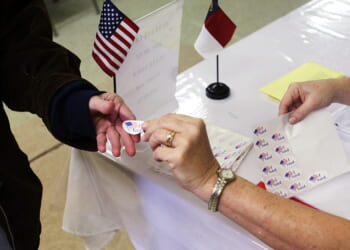
Polarization in DC has coincided with – and likely helped create – a cultural partisan split. Voters have geographically sorted themselves and grown more divided ideologically, making them less likely to switch sides. It’s all about team loyalty. Even splitting a ballot has become less common. Most people vote for a party, not a candidate, a habit partly formed by and central to political polarization.
Hating the other side has almost become standard among the electorate. Worse, many voters seem to despise the opposition more than they like their own team. “Democrats and Republicans — the 85% of U.S. citizens who do not identify as pure independents — have grown more contemptuous of opposing partisans for decades, and at similar rates,” explained the journal Science in a 2020 study titled “Political Sectarianism in America.”
Ever since President Donald Trump returned to the White House, the polarization between the two parties has seemingly worsened to the point where Americans often appear to be an afterthought. They’ve become more oppositional and less willing to work together, helping to fuel the cultural divide fracturing society and infecting every branch of government. This type of division is not historically unprecedented, but the internet has enhanced the media’s ability to fan the flames. Perhaps that’s why the divisive nature of today’s two-party system seems disparate from any decade in recent memory. In the past, however, polarization has been overcome by strong presidential leadership.
America has undergone several waves of political reform since its inception. Maybe it could be on the verge of another, but it’s difficult for a president to unite people when much of what he does is questioned or labeled unconstitutional. A multi-party system could break the binary rivalry and invigorate political debates with alternative points of view while giving the electorate more options. But the chances of a new party succeeding are about as good as the likelihood Democrats and Republicans will start trusting each other. Maybe politics is doomed.