‘If your goal is to try to make the case for climate change, you have crossed the line from scientist to activist,’ economist says, ‘and why would the public trust you?’
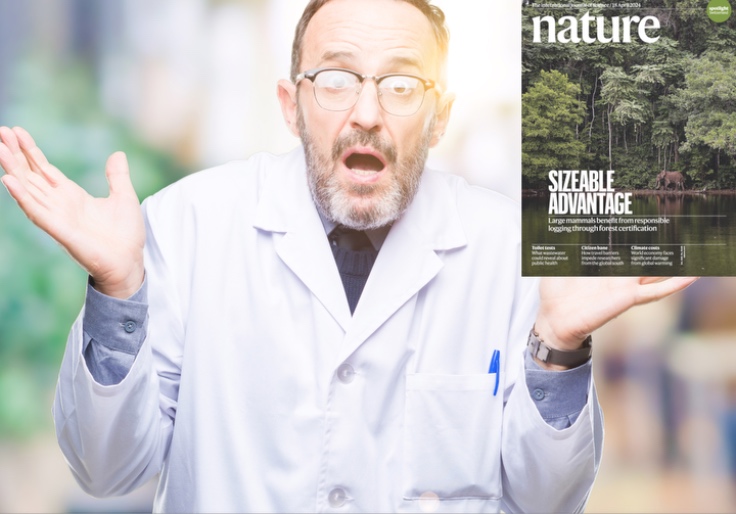
The scientific journal Nature retracted a bombshell study—cited by Forbes, the Associated Press, and Reuters—predicting that climate change would cause economic catastrophe, after economists found the report had significant errors.
Nature retracted the study on Wednesday after a team of economists found significant flaws in the data, the New York Times reported. The study, released in April 2024 by researchers at the Potsdam Institute for Climate Impact Research, found that climate change would not only cost the global economy $38 trillion by 2049 but also slash the global economic output 62 percent by the year 2100, a far higher figure than earlier research had found.
“The authors acknowledge that these changes are too substantial for a correction,” the retraction note states. Before the official retraction, a Nature editor’s note posted last month alerted readers that “the reliability of data and methodology presented in this manuscript is currently in question.”
Mainstream media outlets trumpeted the Potsdam Institute’s findings, with Forbes writing that “climate change is on track to cost the global economy $38 trillion a year in damages within the next 25 years” and the AP saying that “climate change’s economic bite in how much people make is already locked in at about $38 trillion a year.”
Reuters, meanwhile, reported that the $38 trillion number was “a figure almost certain to rise as human activity emits more greenhouse gases.”
International economic organizations, including the Network for Greening the Financial System (NGFS) and the Organisation for Economic Co-operation and Development (OECD), also cited the study in their reports on climate change. The United States is a member of the OECD, and the Federal Reserve was a member of the NGFS until January of this year.
The team of economists that debunked the study found that the Potsdam Institute researchers “noticed problems with the data for one country, Uzbekistan, that significantly skewed the results,” according to the Times.
“Most people for the last decade have thought that a 20 percent reduction in 2100 was an insanely large number,” Stanford professor Solomon Hsiang told the Times. “So the fact that this paper is coming out saying 60 percent is off the chart.”
“The paper does not provide additional evidence of economic damages from climate change, nor can it serve as a basis for reliable future projections,” Christof Schötz, a colleague of the Potsdam researchers, told the Times.
The retraction note credits both Hsiang and Schötz, among others, with “bringing these issues to [the authors’] attention.”
Retraction Watch, which tracks corrections in scientific journals, noted that the study is more evidence of an increase in retractions. “Nature has retracted 32 papers since 2020, including three in 2024,” the organization stated. “The retraction today marks the sixth for the journal in 2025.”
The retraction comes as activists have toned down their apocalyptic rhetoric on climate change. Billionaire Bill Gates, who spent $2 billion dollars trying to prevent what he called a “climate disaster,” said in October that climate change “will not be the end of civilization” and that ineffective climate protests are “diverting money and attention from efforts that will have more impact on the human condition.” Axios last week reported that climate change is “fading in importance on some U.S. lawmakers’ priority lists.”
The error-ridden Potsdam study has frustrated some researchers, who say it damages climate scientists’ credibility. Economist Lint Barrage, who believes the study has even more “methodological problems” that “bias the results upward” than the retraction note admits, told the Times that “it can feel sometimes, depending on the audience, that there’s an expectation of finding large estimates.”
“If your goal is to try to make the case for climate change,” Barrage said, “you have crossed the line from scientist to activist, and why would the public trust you?”