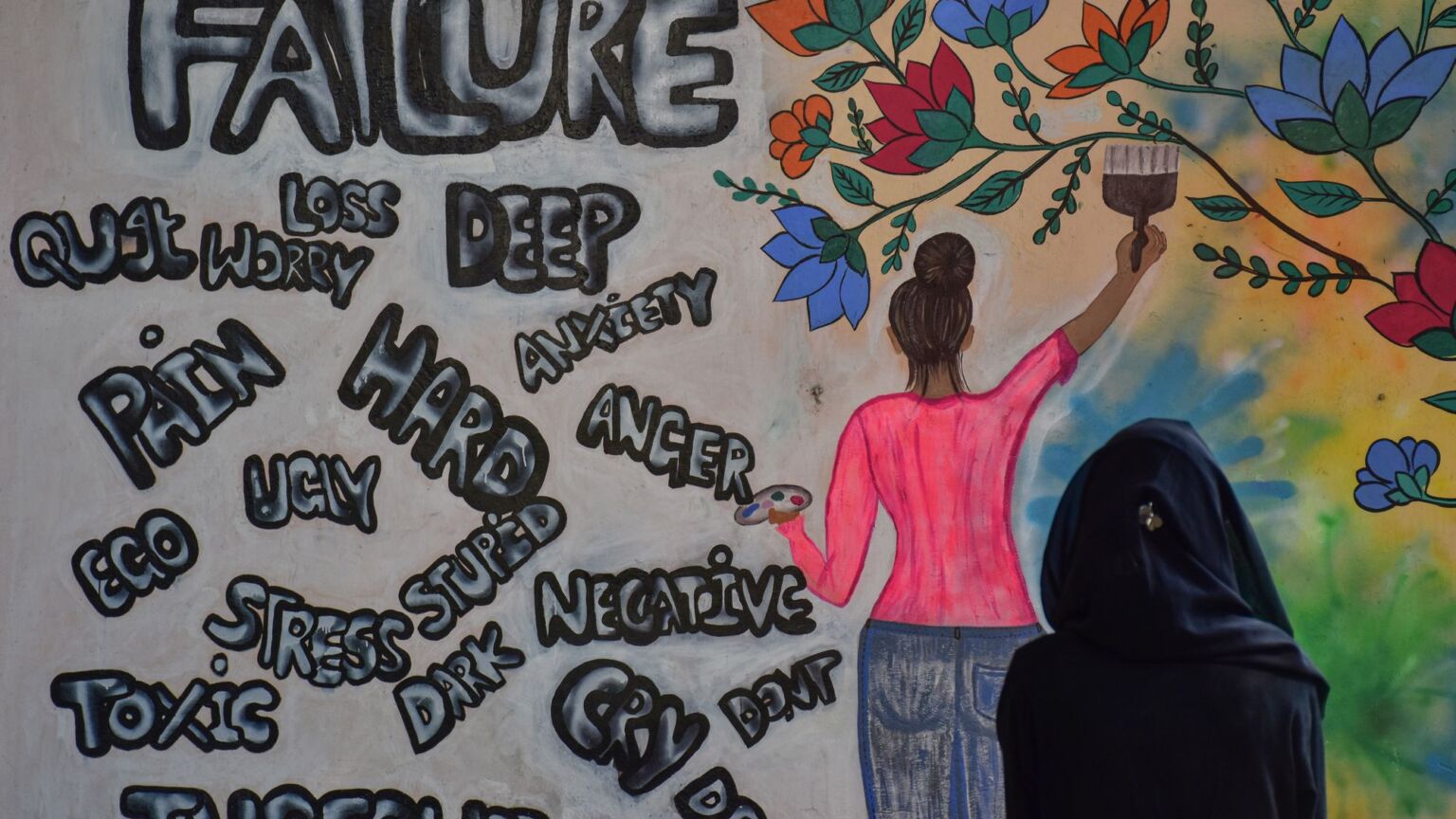
Labour has long been the party of welfare rather than workers. It is therefore no small thing that a man who hopes to one day lead Labour, UK health secretary Wes Streeting, has set his sights on one of the welfare state’s biggest new customers: the mental-health lobby.
This week, Streeting announced that he had ordered a review into a ‘rising demand’ for ‘mental-health services’ in the UK. According to the BBC, it will ‘look at whether there is evidence of overdiagnosis’ of ADHD, autism and mental-health conditions. Peter Fonagy, the clinical psychologist leading the review, will hardly know where to begin.
The figures that have prompted Streeting’s unexpected review are bleak indeed. There are four million working-age Britons who are on some kind of disability or incapacity benefit, or approximately one in 10 of the working-age population. Nearly 50 per cent of new claims are made on mental-health grounds, the vast majority of which – roughly 80 per cent – are approved after little more than a brief phone consultation.
The impact on the state’s finances are crippling. By the end of this parliament, the Office of Budget Responsibility (OBR) predicts one in every £10 the government spends will be on benefits for working-age Britons. Of the more than £400 billion the OBR estimates the government will be spending on welfare, £109 billion will be on sickness payments. Because of the UK’s stuttering economy, these vast payments are being funded by what now seem to be interminable tax rises. As Michael Simmons, economics editor at the Spectator, writes: ‘We are living through a historic transfer… from work to welfare. Labour has chosen a bonanza for benefits claimants funded by austerity for workers.’
The younger you are, the more likely you are to be diagnosed with a mental-health condition. This is hardly a surprise: so sweeping are the definitions that it is difficult for a child these days not to be diagnosed with something. For example, according to the BBC, ADHD is characterised by ‘inattention’, ‘hyperactivity’ and ‘impulsivity’ – which sounds an awful lot like how most children behave.
The extraordinary effects of what is often described as a mental health ‘epidemic’ among young people can be seen in the education system. One in five English pupils – nearly two million – now receive special educational needs and disabilities (SEND) support. A further 600,000 are on education, health and care plans (ECHPs) – a rise of more than 70 per cent in six years. Spending on SEND and ECHPs has already effectively bankrupted multiple councils in England.
What appears to be driving the huge rise in SEND and ECHP spending is the fact that parents and schools are taking advantage of what has become a buffet selection of mental-health disorders, each accompanied by a sufficiently vague definition. A recent study by the London School of Economics found that in affluent areas of the UK, 12 per cent of pupils who receive SEND support have been diagnosed with autism, while a further 15 per cent receive support for ‘Specific Learning Difficulties’ such as dyslexia and ADHD. These are much higher rates of diagnosis than in poorer neighbourhoods. Unsurprisingly, the Institute of Fiscal Studies described the rise in ADHD and autism diagnoses among school children as something witnessed almost exclusively in ‘high-income countries’.
This bizarre marriage is best observed in American universities, the epicentre of modern therapeutic culture. According to a recent essay in the Atlantic, the universities of Chicago and Michigan – two of America’s oldest and most prestigious – are now struggling to accommodate the huge number of students who require special rooms to sit their exams. At Harvard and Brown, 20 per cent of students are classified as disabled. Of course, this isn’t a generation returning from war. They are not suffering from ‘long Covid’ following the pandemic. Put simply, ‘It’s rich kids getting extra time in tests’, as one professor bemoaned.
It is becoming increasingly obvious that rather than being rescued by mental-health ‘awareness’, young people have become the victims of it. This is not their fault. They have been raised to interpret normal human emotions and experiences – nervousness, or difficulty understanding tough concepts in school – as pathologies.
They have also been betrayed by successive governments. In the UK, Tory and Labour administrations alike have overseen the deindustrialisation of Britain, often in the name of greenism, draining cities and towns of meaningful work. And to compound the blow, these governments have sought to reclassify and redefine worklessness and unemployment in terms of a physical and increasingly mental ‘incapacity’ to work, treating far too many people as potential patients rather than as productive members of society. The result, an expanded welfare state, is now so accommodating that we now live in an age of ‘sickfluencers’ – online influencers who help people apply for as many sickness benefits as possible.
Streeting, although deserving of some credit for at least raising the issue of overdiagnosis, likely knows that he is on a hiding to nothing. Indeed, when chancellor Rachel Reeves tried to shave a paltry £5 billion from the welfare bill, she was defeated by a backbench rebellion from welfarist Labour MPs. In her budget last month, she increased the welfare budget by a further £17 billion. Streeting, a career politician, will know that he won’t make any friends by shining too bright a light on this issue if he wants to one day lead the party of welfarism.
To tackle the mental-health epidemic, we need far more than political lip-service. We need a government prepared to tackle the culture of welfarism, and the sick and unwell society that it promotes.
Hugo Timms is an editorial assistant at spiked.