A great paradox has emerged at the heart of Trumpian populism. All of the movement’s various factions agree about putting “America First.” Yet the pundits and intellectuals associated with each faction are increasingly invested in at least one foreign state (and, in some cases, several). These countries — from Qatar to Hungary, Russia to Israel — embody the factions’ respective visions of the good life at home. Or else, they’re celebrated for opposing a different, reviled foreign country or domestic population.
A cynical interpretation might be that, with President Trump and MAGA in power, various foreign influence operations are in overdrive, trying to recruit homegrown American allies close to power. A less conspiratorial read is that these days, some degree of “globalism” is impossible to avoid for influencers and intellectuals — even hard-core nationalist ones.
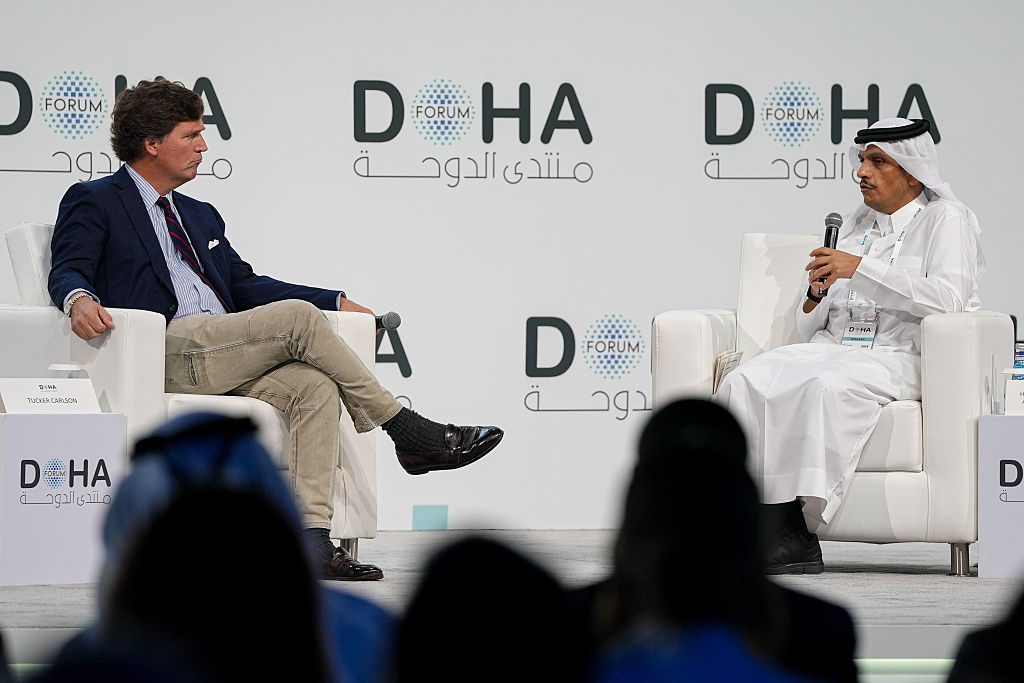
The crisscrossing lines of tension — between the various factions and their beloved foreign lands — became starkly visible this week during the annual Doha Forum. The Qatari state sponsors the annual gabfest to promote “Diplomacy, Dialogue, Diversity.” Tucker Carlson, a leading spokesman for the Israel-critical faction of MAGA, spoke at the forum, and was pictured on the sidelines flipping off the camera while holding a cocktail; in another photo, he was seen standing next to Donald Trump, Jr. (a reminder of the Trump dynasty’s general Qatar-friendliness).
But Carlson didn’t just speak in Qatar. He staked a personal claim in the tiny emirate, telling the country’s prime minister and foreign minister, Sheikh Mohammed bin Abdulrahman Al Thani, “I am . . . tomorrow buying a place in Qatar…. I’m doing that because I like the city. I think it’s beautiful.”
He was joined by Rob Smith, described by Fox News as a “black gay conservative influencer,” who gushed on X about the “INCREDIBLE time to be a FREE AMERICAN and visit the AMAZING Doha, Qatar! Can’t wait to return!”
To each his own, I suppose. I’ve only transited through the Doha airport, and couldn’t get out fast enough, what with the gaudy atmosphere, the tacky design, the dry duty-free shops — all upheld by an army of South Asian and Southeast Asian workers who showed the foreign sahib such extreme obeisance, it made me wonder if they were forced into it or kept in line with corporal punishment (human- and labor-rights groups allege widespread worker abuse, including in the construction of the airport).
Neil Patel, a longtime Carlson collaborator and his co-founder at both The Daily Caller and the Tucker Carlson Network, seemed to trollishly revel in just this impression, taunting opponents with a Doha Forum greeting posted from “the booodthirsty [sic], terror-supporting slave state of Qatar,” as he put it.
At his best, Carlson speaks for the Jeffersonian ideal of a modestly propertied, competent, and free republican citizenry. Qatar is very, very far from the vision. So why is he love-bombing the Doha sheikhs? It’s because they represent a counterpole to another foreign state, Israel, which Carlson blames for playing a destructive role in the Middle East and a distortive one in domestic US politics. Lately, the pro-Israel community has been accusing many of the Jewish state’s critics of being on the Qatari payroll. Carlson’s newfound admiration for the slave state — unlike Patel, I mean that unironically — probably has less to do with Qatar as such than poking his factional enemies in the eyes.
Which brings us to Israel, a site of deep libidinal investment for a different populist faction — and not just populists, but also classical liberals, neoconservatives, and hard-core evangelical Zionists, among others — and for a much longer span than the Right has been interested in charming Qatar.
For Americans of a certain vintage (me included), support for Israel has been an extension of our faith in Western democracy, and an expression of our solicitude for the Jewish people in the wake of the Holocaust. Zionism predates the industrial slaughter of Jews in World War II, but that event added urgency to it. In my case, part of my political maturation involved the conclusion that, for so long as the world is divided into nation-states, the Jews are entitled to one of their own.
Yet lately, Israel’s American reception has dramatically changed. The Jewish state’s popularity is underwater with nearly all demographic groups save for Republicans over the age of 50. This owes to a number of factors. One is fatigue with the Mideast wars and, relatedly, strategic divergence between Jerusalem and Washington (the United States wants to leave the region; Israel keeps goading Washington back in, most recently by explicitly demanding American intervention in its 12-Day War with Iran).
“These days, some degree of ‘globalism’ is impossible to avoid.”
Another is the brutality of Israel’s operations in Gaza — and the growing power of an Israeli hard Right that makes the country hard to swallow for liberal-minded Americans, not least many younger American Jews.
Amid these troubles, Israel has become a Right-wing-influencer destination (even as others take the opposite journey to Qatar). For hard-line populists drawn to it — figures like Laura Loomer and Tommy Robinson — support for Israel is less about postwar liberal ideals and more about the Jewish state as a smiter of Muslims and a place that is increasingly and unabashedly ethno-nationalist, a transformation they wish more Western democracies would emulate.
The pundit junkets to Israel continue — I’ve taken several under the auspices of mainstream Jewish groups and Christian ones — but they have a different tenor now, and attract a different type of commentator.
Other MAGA trips have similar domestic valences. Hungary is seen as a successful nationalist model that combines an unapologetic cultural conservatism and border restrictionism with Christian-democratic, pro-family welfarism (though many Anglo-American admirers neglect to notice, much less try to reproduce, that last aspect). Russia is, for some, a “based” avatar of Christian civilization (notwithstanding its high rates of alcoholism and low birth rates); others rally to its cause because they oppose NATO interventionism and NATO values (“globo-homo”).
Here’s the thing, though: as an American and a Republican, you can simply favor a more restrained foreign policy without falling in love with any foreign state, whether a fortress-outpost of Jabotinskyism or a decadent, slave-owning sheikhdom. Indeed, the modal attitude among the MAGA base is probably something like: to hell with all of them!
There is an interesting material explanation for America First factions’ investment in exotic lands. To wit, intellectuals and pundits are part of the hyper-mobile professional class, even the ones who outwardly reject transnational mobility.
We’re hyper-online, have the means to travel, and attend schools, seminars, and shindigs that put us in touch with opinion elites from around the world. Moreover, the human mind, if we are to believe the Greek sages and Saint Paul in Romans, tends to seek universal models and rationalities. Pure MAGA-ism, for the chattering class, is almost impossible. We’ll always have Paris — or beautiful Doha.