As much as any other, the United States is a nation based upon a carefully crafted mythology. But unlike most European societies, America lacks what the Spanish essayist Miguel do Unamuno called the “tragic sense of life” — the feeling that existence is messy and muddled, and that all things must come to an end. By the third decade of the 21st century, of course, we all know that America’s political structure is flawed and will someday, perhaps soon, crumble beneath its heaving contradictions. Yet we also desperately wish for that not to be the case, even if we know, in our hearts, that this is a hopeless way of analysing the America of Nick Fuentes and Ilhan Omar.
All the same, we continue to build our national identity not atop hard-nosed studies of our past and present — but on stories of America’s exceptionalism, a pathology that affects both ends of the country’s political spectrum. Each side has its heroes and villains. Yet from a higher conceptual standpoint, these duelling narratives function almost identically. Absent a tragic frame, neither flag-waving exceptionalism, nor its identity-obsessed opposite, can admit that America is defined less by some abstract “idea”, whether the utopian pursuit of “liberty for all” for the Right or racial loathing for the Left, and more by the vagaries of its Anglo-Protestant origins.
Nowhere is this obsession with this mythos of America clearer than how the nation’s political elites view the Founding. One side, after all, insists that 1776 was near-divine — even consulting AI versions of George Washington for insight on the country’s contemporary malaise. The other condemns the founding as genocidal, built on the stolen land of indigenous peoples and the mass enslavement of Africans. Yet both centre America’s birth as an epochal event, either as the root of all evil or “the most consequential revolution in history” reflecting “the noblest aspirations of humankind”.
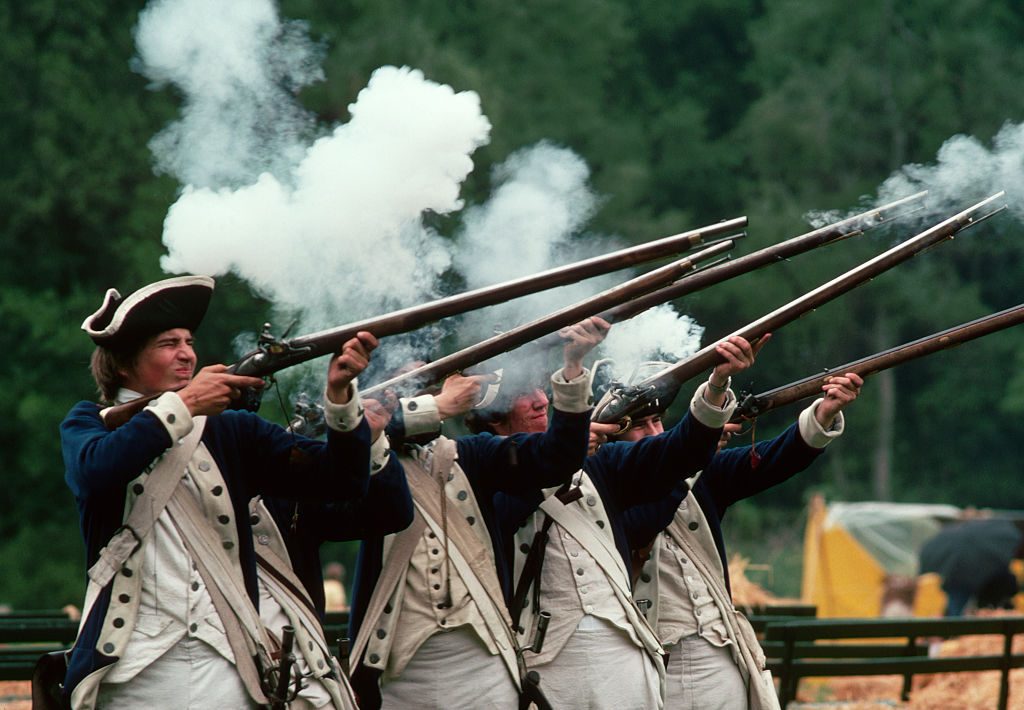
Those last quotes come from the first five minutes of Ken Burns’s new PBS series The American Revolution — but don’t let the patriotic cheerleading fool you. For in the end, the show does a remarkable job of blending what political scientist James Ceaser called “exceptionalist” and “anti-exceptionalist” narratives together into a coherent whole, along the way pleasing patriotic Republicans and subversive Democrats alike. Indeed, that’s rather the point. By crafting a documentary where Left and Right can all feel “represented”, Burns deftly avoids dealing with the roots of America’s problems and how they manifest themselves today, good news for our plutocratic rulers, and bad for the rest of us.
Among the dwindling educated cohort that still watches public broadcasters like PBS, Ken Burns is a documentarian of unmatched achievement. And, to be fair, the reputation is well-earned. Starting with his show on the construction of the Brooklyn Bridge, he has produced some of the best multimedia historical nonfiction of the last 40 years. He’s proved remarkably popular too. During his watershed 1990 series The Civil War, PBS averaged nearly 14 million viewers per episode, with an unheard-of 39 million tuning in to watch at least one night of the series. As we drift ever closer towards a post-literate society, Burns is now the closest thing the United States has to a national raconteur, pioneering a method of engaging historiographic visual storytelling that’s broadly accurate, frequently engrossing, and capable of bringing both scholars and general audiences to the table.
Given his reputation, it’s unsurprising that nearly anything Burns produces now will fund the entire PBS operation for years. That’s especially true since the Reagan administration began slashing funding for public broadcasters in the Eighties — cuts that were accelerated during the Gingrich-led GOP Congress of the Nineties. Now, under Trump and Musk’s DOGE, US public broadcasting is effectively dead. In its place, PBS is funded largely by wealthy corporations and foundations. Yet if that’s meant Burns has had plenty of cash to make dozens of programmes, on everything from the Vietnam War to jazz, his glittering career hasn’t been critic-free.
Especially to those working within the often-cloistered world of scholarly American history — a nitpicking discipline filled with poorly-paid but self-important individuals — he remains an unpopular figure, representing a dubious strain of “pop history”. The public is his intended audience, not scholars. The obvious corollary, in the university common room anyway, is that everything about his work is suspect, especially for Leftist academics already sceptical of his patriotic references to the revolution’s inherent nobility.
The Right, for its part, does something similar. Spurred on, perhaps, by a sense that his association with PBS represents progressivism manifest — hardly unreasonable given its patrician fans and complacently liberal funders — conservative critics flooded social media to accuse Burns of capitulating to “wokeness”. Much of their rancour focused on two rhetorical sleights of hand early in The American Revolution. The first comes near the six-minute mark of episode one, which describes the Iroquois Confederacy of Native American tribes as a “democracy”. It’s an odd claim to make without the caveat that the Iroquois system was not a liberal democracy as Americans understand the term. Rather, it was something else entirely, a society based on collective land ownership and indigenous values utterly rejected by the Founders.
Yet that pales compared to Burn’s second example of shallow inclusivity, when he implies that Benjamin Franklin’s first call for independence was somehow inspired by the Iroquois. It’s certainly a bizarre claim — Franklin’s politics were clearly far more shaped by philosophers like John Locke — even if it again speaks to the Right’s tendency to bristle at any suggestion that the United States didn’t emerge as a kind of secular miracle.
“The United States didn’t emerge as a kind of secular miracle.”
Ideological grumbles aside, of course, placing the Iroquois Confederacy front and centre surely represents a shrewd career move on the part of Burns and his colleagues. In the liberal public broadcasting world, no one is above cancellation, not even Burns. With millions watching, the filmmaker and his colleagues knew they had to please identitarian obsessives, both inside his PBS team and across the airwaves.
More fundamentally, though, Burns’s focus on the Iroquois speaks again to that sense of exceptionalism: in a way that blends the Right-wing cheerleading with its more sceptical Leftist mirror. After all, foregrounding the Iroquois in this way promotes a multicoloured pseudo-inclusive version of American exceptionalism, with Burns succumbing to the mythological deification of the country’s origin story: just now with added diversity. Certainly, turning the Iroquois into the true unrecognised Founders feels better than acknowledging that they — and, by proxy, all the indigenous tribes of what became the United States — were crushed, absorbed, or otherwise expunged en route to the stucco-framed dystopia we inhabit today.
What gets lost here, of course, is Unamuno’s sense of the tragic, the recognition that the Thirteen Colonies’ revolt, like every war and revolution, involved brutal violence and shameless cultural erasure. No less important — and contra the Burns contributor who reifies the standard trope of the US as a nation that coheres “not around ancient history, but ideas” — this glibly inclusive framing also ignores the genuine roots of American society and politics.
The fact is that all the ideas embedded in America’s founding governmental structure did not appear as miracles, but rather emerged from a deep and complex Anglo-liberal heritage. This encompasses everything from the Glorious Revolution to the Puritan exodus to frontier revivalism. Even those that arguably weren’t, notably small‑“r” republicanism, were filtered through the Anglo lens of limited government, free markets, and deep suspicion of taxation. Nearly every signatory to the Declaration of Independence was an Anglo-Protestant. Only one, Charles Carroll, was Catholic. Yes, Jefferson and Franklin were Deists, but even that was a genteel cousin of Anglicanism. No less striking, the new United States was profoundly English in its ethnic makeup: especially once you exclude enslaved Africans and indigenous peoples, neither of which were considered fully human by most Founders.
None of this history — ugly, contingent, grounded not in grand principles but in the gloomy depths of the past — is exactly inspiring: and it partly explains why Americans might prefer to wallow in exceptionalism instead. Yet if it’s explicable, it’s also a problem, and not just for the historical record. For in his inability to genuinely analyse our past, Burns is equally unable to reflect on the present, and how the republic founded in 1776 reached the ludicrously dysfunctional spot it now occupies. Forget petty arguments over income tax; this is especially pertinent given our current governing structure, with all its flaws, is basically the same one established way back at the tail end of the 18th century. But because, we are told, it appeared as a kind of immaculate conception, it can never, ever change.
And here, again, we must return to one of the fundamental problems in all American discourse — the one no foundation, documentary series, or identitarian gesture dares grasp. Left or Right, America has no true tragic sensibility. Tragedy requires acknowledging limits, accepting inescapable loss, and admitting that some conflicts cannot be reconciled through uplift or philanthropy. But America’s elite culture, from Burns’ refashioned Founder worship to the donor class’s racial‑and-gender therapeutics, refuses to sit with this truth.
There are several ways of understanding this. Joseph Campbell, the eminent scholar of comparative mythology, argued that once a culture’s great myths unravel, its leadership soon collapses. With this in mind, it’s easy to see that a mythical founding is deeply valuable to America’s plutocratic elites — ensuring citizens remain loyal, whether loyalty is deserved or not. It follows, meanwhile, that more challenging reinterpretations, ones embracing historical nuance and the sense that one’s gain is another’s loss, are never rewarded by the country’s rich and powerful. That’s hardly surprising — America’s elite has thrived off precisely this status quo. Such connections are implied right at the start of all Burns’s shows. For this most recent one, the list of centimillionaire estates underwriting the project takes nearly two full minutes to recite.
That hints at another, less grandiose reason, why progressive donors might fund cosily exceptionalist documentaries like The American Revolution. At bottom, after all, they endanger nothing of the economic system that allows elites to extract their wealth and accrue their outsized civic influence. It’s an irony compounded by the fact that Burns’s progressivism, if cringeworthy to the Right, is actually not much of a threat to anything that concerns the economic interests of their donor class. The whole fight, like most of the culture war, is one safely contained with the unconscious limits of exceptionalism. One side laments that the Revolution didn’t include women and minorities; the other not so much. “Was the American Founding great — or only great for its time?” That’s the full scope of the debate allowed about our national origin.
There’s a cultural element here too. For one thing, and notwithstanding the sniffiness of progressive academics, shows like The American Revolution allow funders to pose as fighting for “social justice” and righting the wrongs of US history by teaching the viewing public not to be “racist”, “sexist”, or “heteronormative”. It is a posture that flatters them, insulates them, and publicly distances them from the social conservatism most common among the poor and working classes.
By leaning into this cultural distance, meanwhile, the wealthy donor class believe they are properly socialising the Great Unwashed. Funding public programmes that foreground “minority” voices allows establishment types to cleanse the reputational sins of family estates. Consider, here, a man like Alfred P. Sloan: a major and consistent funder of PBS programmes, and someone who, as the long‑time head of General Motors, tirelessly worked to kill public transit systems all across the United States. Sloan’s cold-blooded campaign to uproot trolley and train systems helped destroy any shot at walkable communities or sane urban planning across most of Middle America. But now that his descendants fund documentaries on the Native American roots of the Bill of Rights, they can believe that the ledger is somehow cleared.
Taken together, anyway, these varied justifications for exceptionalist storytelling all serve the same purpose — helping us avoid seeing the nation as it actually is. A tragic place, pretending to be hopeful. A wounded empire, forcing a smile, performing optimism. A people desperate for meaning in a sea of digital emptiness, which still insists nothing truly irreversible has ever happened. Until we reclaim some ability to face our past without immediately laundering it into a dopey lesson or a posture, America will remain what it is now. A society that cannot tell its own story honestly, because it cannot bear to confront the cost of being itself.